June 2, 2026
Symmetric vs.
Encryption is a core cryptographic technique used to protect data by converting it into an unreadable form, ensuring confidentiality…

Osama Ahmed
6 min read
Symmetric vs. Asymmetric Encryption: The Decision That Determines Whether Your Data Is Actually Safe
Encryption is a core cryptographic technique used to protect data by converting it into an unreadable form, ensuring confidentiality, integrity, and secure communication in digital systems.
Is your data truly encrypted, or just locked with the key under the doormat? Let's explore the critical differences between symmetric and asymmetric encryption
The Two Families of Encryption
Every encryption scheme in modern computing descends from one of two philosophies. Understanding the difference between them is not a technical nicety. It is a business-critical decision with real consequences for your architecture, your compliance posture, and your exposure to risk.
Symmetric Encryption: The Shared Secret
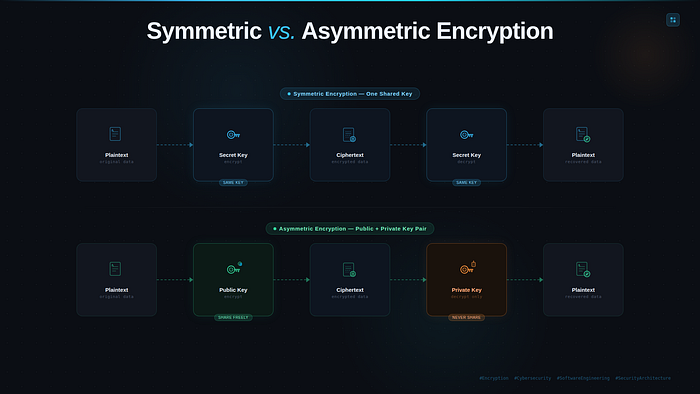
Symmetric encryption operates on a single key. The same key that locks the data is the same key that unlocks it. Both parties — the sender and the receiver, or the system writing data and the system reading it — must possess this identical key.
The analogy: Imagine a physical safe with one combination. If you want your business partner in another city to access the contents, you both need to know that combination. You have to share it somehow — over the phone, in a letter, in person. The moment that combination leaves your hands, your security depends entirely on how safely it travels and who might be listening.
This is symmetric encryption in a nutshell.
Where it lives in your systems:
- Database encryption — When you encrypt sensitive columns in your database (social security numbers, credit card data, health records), you're typically using symmetric encryption. AES-256 is the industry standard here.
- File and disk encryption — Full-disk encryption on laptops, encrypted backups, protected file archives. All symmetric.
- Cloud storage — AWS S3 server-side encryption, Azure Blob Storage encryption at rest. Symmetric under the hood.
- VPN tunnels — Once a secure channel is established, the actual data flowing through it is encrypted symmetrically because of one key advantage: speed.
That last point matters. Symmetric encryption is fast. AES-256 on modern hardware is extraordinarily efficient. When you need to encrypt gigabytes of data, terabytes of logs, or a high-throughput database, symmetric encryption is the tool for the job.
The inherent problem:
The weakness of symmetric encryption is not the algorithm. AES-256, properly implemented, is practically unbreakable. The weakness is the key itself — specifically, how you distribute it.
If you and I have never communicated before, and I want to send you an encrypted file, I have to give you the key. But if I can send you the key securely, why couldn't I just send you the file securely through that same channel? And if I send you the key insecurely, then an attacker who intercepts the key can decrypt everything.
This is the key distribution problem — and it's why symmetric encryption alone isn't sufficient for securing communications between strangers on the internet.
Asymmetric Encryption: The Lockbox System
Asymmetric encryption solves the key distribution problem elegantly by using two mathematically linked keys instead of one: a public key and a private key.
Here's what makes this powerful: anything encrypted with the public key can only be decrypted with the private key. And the public key can be shared with anyone — broadcast to the entire internet — without compromising security.
The analogy: Think of a mail slot on the front door of an office building. Anyone walking by can drop a letter through the slot. The slot is public — its location is known, anyone can use it. But only the building owner has the key to open the collection box inside and read the letters. You can hand the "deposit" mechanism to the whole world and still guarantee only you can access what's been deposited.
Where it lives in your systems:
- HTTPS / TLS — Every time you see that padlock icon in a browser, asymmetric encryption was used to establish the secure connection. The server presents its public key (via a certificate), your browser uses it to securely exchange a session key, and from that point forward the conversation is encrypted.
- SSH authentication — When your engineers SSH into a server using a key pair rather than a password, that's asymmetric encryption. The public key lives on the server; the private key never leaves the engineer's machine.
- Digital signatures — When you sign a software release, a contract, or an API response, you're using your private key to create a signature that anyone with your public key can verify — but no one can forge. This is the backbone of code signing pipelines, document authentication, and non-repudiation in legal and financial systems.
- JWT authentication — JSON Web Tokens signed with RS256 or ES256 use asymmetric keys. The API issues tokens signed with its private key; any service in your infrastructure can verify them using the public key without ever needing access to the private key.
- Certificate authorities — The entire trust chain that makes the internet work is built on asymmetric cryptography. When your browser trusts a website, it's trusting a chain of digital signatures all the way up to a root certificate authority.
The trade-off:
Asymmetric encryption is computationally expensive. Encrypting large volumes of data with RSA or Elliptic Curve algorithms is orders of magnitude slower than AES. You wouldn't use it to encrypt your entire database. the performance cost would be prohibitive.
Which leads us to how these two systems work together in the real world.
The Hybrid Model: How TLS Actually Works
Modern secure communications don't choose between symmetric and asymmetric encryption. They use both in sequence to get the best of each.
Take TLS (Transport Layer Security), the protocol behind every HTTPS connection:
- The handshake — Your browser connects to a server. The server presents its public key (embedded in its SSL certificate). Your browser uses asymmetric encryption to securely negotiate a one-time session key. At no point does this session key travel unencrypted across the network.
- The session — Once both sides have agreed on the session key, all subsequent communication is encrypted using that key with AES is fast, efficient symmetric encryption.
The asymmetric step solves the key distribution problem. The symmetric step delivers the performance needed for real data transfer. Together, they form a system that is both secure and practical.
This hybrid pattern appears throughout well-designed secure systems. Understanding it helps you ask better questions when reviewing your own architecture: Is the handshake secure? How long do session keys live? What happens when a session key is compromised?
The Mistake That Keeps Me Up at Night
I want to talk about the most dangerous mistake I see in production systems — not because it's exotic or sophisticated, but because it's shockingly common, even in well-funded companies with experienced engineering teams.
Teams encrypt data with AES-256 and store the encryption key in the same place as the data.
In the same database. In the same environment variable file. In the same repository. Committed to version control with a comment that says something like # TODO: move this secrets.
That TODO is still there two years later.
Here's the hard truth: if an attacker gains access to your database and your encryption key is in that same database, or in a config file in the same server, your encryption provides exactly zero additional protection. They have everything they need to decrypt every record.
Encryption without proper key management is security theater. It looks good in a compliance audit. It fails completely in an actual breach.
The tools exist to solve this correctly. AWS Key Management Service, Azure Key Vault, Google Cloud KMS, HashiCorp Vault — these are purpose-built for separating encryption keys from the data they protect, with access controls, audit logging, and key rotation built in.
Why This Is a Business Decision, Not Just a Security Decision
When your team says "we're using AES-256 and HTTPS," the right questions to ask are:
- Where are the keys stored, and who can access them?
- How often are keys rotated, and what's the process when a key is compromised?
- Are we using symmetric encryption where we need asymmetric, or vice versa?
- Do we have audit logs showing who accessed the key management system and when?
These questions don't require a deep cryptography background. They require an understanding of the concepts — which is exactly what this article is for.
Encryption is not a checkbox. It's an architecture decision with ongoing operational requirements.
The Practical Summary
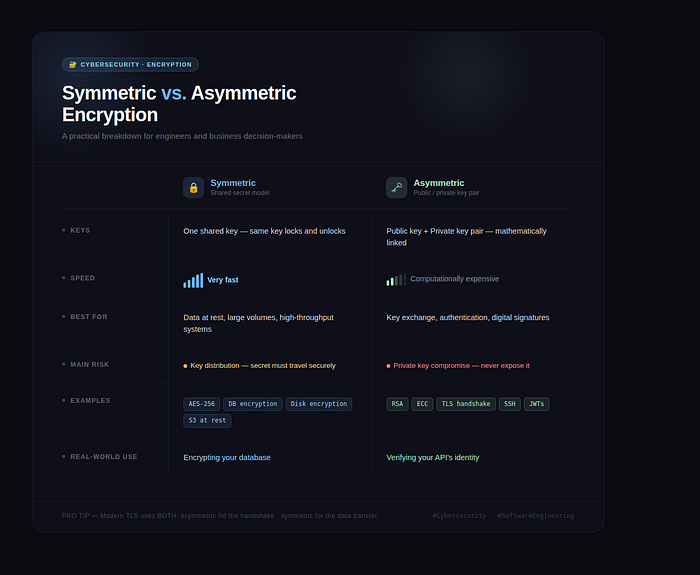
The most secure systems use both asymmetric for the moments where trust needs to be established, symmetric for the heavy lifting once it has been.
Finally
If you're building a secure application from scratch, scaling a platform that handles sensitive data, or doing a security architecture review.
What's the most overlooked encryption implementation mistake you've seen or made in a real system? I'd genuinely like to know.
#Cybersecurity #Encryption #Security #Architecture #DataProtection