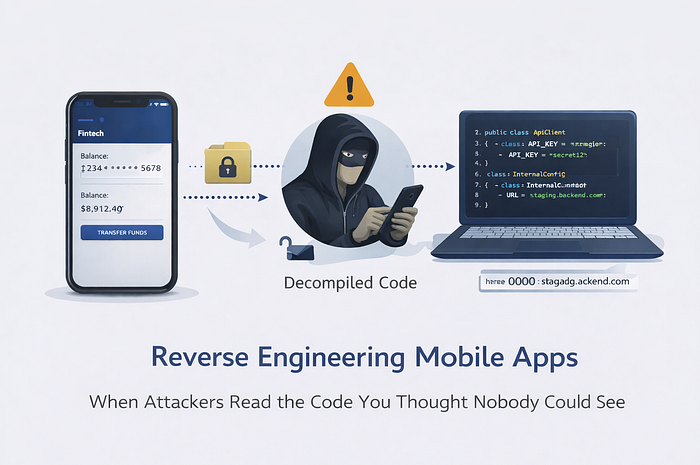

Most developers assume that once an app is compiled and published to an app store, the code inside it is effectively invisible to the outside world. It has been converted from readable source code into a binary format that looks like meaningless machine instructions.
That assumption is one of the most consistently exploited misconceptions in mobile security.
Compiled does not mean hidden. And for attackers who know what they are looking for, a published mobile app is less a locked vault and more a sealed envelope that most people simply never thought to open.
Here is a simple way to picture it. A company builds a sophisticated vending machine and ships thousands of units to locations worldwide. The machine's internal wiring, the combination that opens the service panel, the supplier codes that unlock wholesale pricing, and the override sequence that bypasses the payment system are all physically built into every unit. The company assumed nobody would bother taking one apart. A technically curious person buys one, opens the panel, photographs every circuit, and now has everything they need to manipulate every other unit in the field. The information was never truly hidden. It was just inconvenient to access.
That is reverse engineering. The app is the vending machine. Anyone who downloads it has a copy of everything built into it.
This is not limited to fintech apps. 1. Gaming companies lose proprietary game logic and anti-cheat mechanisms to reverse engineering regularly. 2. Healthcare apps have had internal API structures exposed through binary analysis. 3. Corporate enterprise apps have leaked internal server addresses and authentication mechanisms. 4. E-commerce platforms have had discount logic and pricing algorithms extracted and exploited. Any compiled mobile application distributed publicly contains everything its developer built into it, and the tools to examine that content are freely available and well-documented.
In fintech, the consequences of a successfully reverse-engineered app are severe and wide-reaching. Hardcoded API keys found in the binary give attackers direct access to backend services, sometimes with the same permissions the app itself holds. Internal API endpoint structures extracted from the app reveal the full surface area of the backend, including endpoints that were never intended to be discovered through normal usage. Business logic exposed through decompiled code shows exactly how transaction limits are enforced, how fraud detection thresholds are set, and where the boundaries of the system's trust model lie. Cryptographic keys or initialization vectors embedded in the code compromise the encryption protecting stored data. Authentication tokens or default credentials left in the binary from testing provide ready-made access to internal environments.
Technically, the process is more accessible than most people realize. Android APK files are ZIP archives. Anyone can unpack them with standard tools, extract the compiled Dalvik bytecode, and run a decompiler that reconstructs readable Java or Kotlin code with reasonable accuracy. The reconstructed code will not be identical to the source but it will be close enough to read logic, identify hardcoded strings, map API calls, and understand how the application behaves internally. iOS binaries are more resistant to full decompilation but are still analyzable through static analysis tools that extract strings, symbols, class names, method signatures, and network call patterns from the binary. Dynamic analysis goes further, running the app in a controlled environment with instrumentation tools that intercept function calls, capture network traffic, and trace execution paths in real time.
A realistic scenario: a security researcher downloads a fintech investment app from the Google Play Store and unpacks the APK. Running a decompiler against the bytecode produces readable code within minutes. Inside a utility class, they find a hardcoded string labeled internal API key with a value that has clearly never been rotated since the app launched. They make a direct call to the backend API using that key and discover that it grants read access to aggregated user portfolio data. Separately, they find a staging environment base URL hardcoded in a configuration class, still pointing to an active server running an older version of the API with fewer security controls than production. Neither of these required any sophisticated tooling. Both were sitting in plaintext inside a publicly downloadable file.
Protecting against reverse engineering starts with accepting the foundational reality that any code distributed to a user's device must be treated as potentially readable. 1. Never hardcode secrets, API keys, credentials, or internal URLs in the application binary under any circumstance. 2. Use certificate-based or runtime-fetched configuration for any values that grant access to backend systems. 3. Apply code obfuscation tools that make decompiled output significantly harder to read and reason about, understanding that obfuscation is a deterrent rather than a complete solution. 4. Implement runtime application self-protection mechanisms that detect tampering, debugging, or instrumentation attempts and respond appropriately. 5. Store any cryptographic material in hardware-backed secure enclaves rather than in application code or local files. 6. Conduct regular security reviews of your own binary using the same tools an attacker would use, because finding the exposures in your own build before publishing is far less costly than finding them after.
The code you ship is a document. It describes your system's logic, its boundaries, and its secrets. Publishing it to an app store does not make it confidential. It makes it globally available to anyone curious enough to look.
Security built on the assumption that nobody will examine what you shipped is not security. It is optimism.
#CyberSecurity #ReverseEngineering #MobileSecurity #ApplicationSecurity #FintechSecurity #AndroidSecurity #iOSSecurity #SecureByDesign #OWASP #CTOInsights #Fintech