
Introduction:
Modern web applications rely heavily on frameworks like React and Next.js to build fast and interactive user experiences. But what happens when a vulnerability appears inside the core technology powering millions of websites?
That's exactly what happened with CVE-2025–55182, also known as React2Shell — a critical vulnerability that allows attackers to run malicious code on servers without even logging in.
For cybersecurity learners and professionals, this vulnerability is a powerful real-world example of how small validation mistakes can lead to massive security risks.
What is CVE-2025–55182?
CVE-2025–55182 is a Remote Code Execution (RCE) vulnerability affecting React Server Components (RSC).
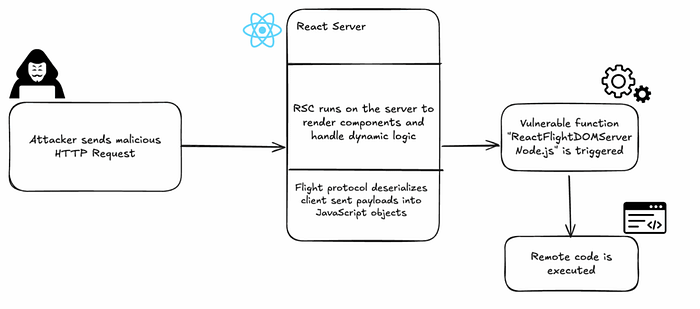
In simple words:
An attacker can send a specially crafted request to a vulnerable server and make it execute attacker-controlled code.
No password. No account. No user interaction.
Just a malicious request.
That's why it's rated Critical severity.
The Technical Idea:
React Server Components use a system to transfer data between client and server. The server converts incoming data into usable objects — a process called deserialization.

The problem?
> The server didn't properly validate what it received. > Attackers could send "fake" data that tricks the server. > The server executes it as real instructions.
Imagine a security guard who accepts any ID card without checking if it's fake. That's what happened here.
What Can Attackers Do?
If exploited successfully, attackers can:
- Execute commands on the server
- Install malware or backdoors
- Steal sensitive data
- Deploy crypto-miners or ransomware
- Move deeper into internal networks
Basically, full server compromise.
Real-World Exploitation
Security researchers observed:
- Internet-wide scanning for vulnerable servers
- Quick weaponization after public disclosure
- Targeting of common development ports
- Automated exploitation attempts
This shows how fast threat actors move once a vulnerability becomes public.
How To Defend Against It
If you're a developer or admin, here are key defenses:
Patch Immediately
Update React and any dependent frameworks like Next.js.
Use a Web Application Firewall (WAF)
A WAF can block suspicious request patterns.
Monitor Logs
Watch for unusual requests or unknown processes.
Reduce Exposure
Avoid exposing development servers directly to the internet
What can we learn from this?
For me, this vulnerability highlights a few lessons:
- Never trust user input
- Even popular frameworks can have flaws
- Attackers move fast
- Patching is critical
- Real-world security is about prevention, not just detection
If you're learning Cyber Threat Intelligence, following cases like this helps you understand how threats evolve and how defenders respond.
Final thoughts
React2Shell is a reminder that technology moves fast — and so do attackers.
Security isn't something you add later. It has to be part of development from the start.
If you're in cybersecurity, keep learning, keep observing, and stay curious. Real incidents like this are some of the best teachers.