June 6, 2026
Digital Transformation or Risk Transformation?
The manufacturing sector is undergoing a fundamental transformation. Asset Performance Management (APM) platforms powered by Artificial…

Haroon Rashid
4 min read
- 1 Digital Transformation or Risk Transformation? "Asset Performance Management (APM) in the Age of AI: Why OT Cybersecurity Is the Foundation of Industry 4.0"
- 2 The Data Foundation of Modern APM
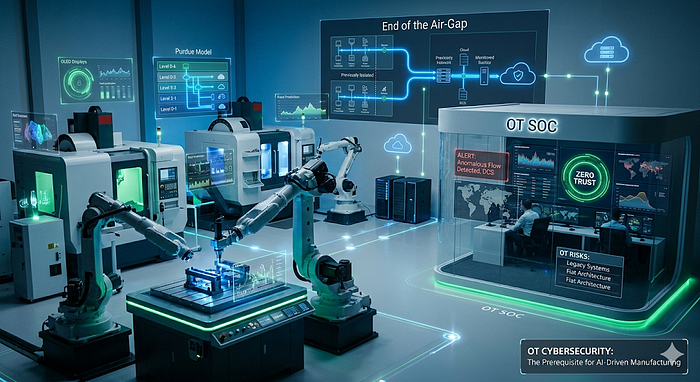
- 3 The End of the Air-Gapped Myth
- 4 OT Systems Were Never Designed for Today's Threat Landscape
- 5 OT Risk Assessment Must Be the Starting Point
Digital Transformation or Risk Transformation? "Asset Performance Management (APM) in the Age of AI: Why OT Cybersecurity Is the Foundation of Industry 4.0"
The manufacturing sector is undergoing a fundamental transformation. Asset Performance Management (APM) platforms powered by Artificial Intelligence (AI), Machine Learning (ML), and Industrial IoT are enabling organizations to move beyond traditional corrective maintenance toward predictive and prescriptive maintenance strategies.
For decades, maintenance teams have relied heavily on reactive approaches — repairing equipment after failure — or preventive maintenance schedules based on time intervals. Today, AI-driven APM solutions are changing that paradigm by continuously analyzing operational and maintenance data to predict failures before they occur and recommend optimal actions to maximize asset reliability, availability, and safety.
However, there is a critical question that many organizations overlook in their digital transformation journey:
Can your cybersecurity posture support your APM ambitions?
The Data Foundation of Modern APM
Modern APM platforms derive their intelligence by ingesting data from multiple operational and business systems, including:
- Distributed Control Systems (DCS)
- SCADA and OPC data sources
- Process historians
- Risk-Based Inspection (RBI) systems
- Operator rounds and field inspections
- Enterprise Resource Planning (ERP) maintenance modules
- Safety and reliability management systems
- Condition monitoring solutions
- Industrial IoT sensors
When these diverse data sources are aggregated and analyzed, AI models can identify degradation patterns, predict failures, recommend maintenance actions, and optimize operational performance.
The business benefits are substantial:
- Reduced unplanned downtime
- Increased asset reliability
- Extended equipment life
- Lower maintenance costs
- Improved process efficiency
- Enhanced operational safety
This is the promise of Industry 4.0.
The End of the Air-Gapped Myth
Historically, Industrial Control Systems (ICS) operated in isolated environments. Many organizations still believe that operational technology (OT) networks are effectively air-gapped and therefore protected from cyber threats.
That assumption is no longer valid.
To realize the full value of AI-enabled APM, organizations must connect operational assets to enterprise systems, cloud platforms, analytics engines, and external service providers. Data must move seamlessly between plant-floor systems and advanced analytics environments.
Every new connection expands the attack surface.
The reality is that modern manufacturing facilities now operate in highly interconnected ecosystems where IT, OT, cloud platforms, and third-party services continuously exchange data.
Organizations seeking the benefits of AI and Industry 4.0 cannot avoid connectivity — but they must secure it.
OT Systems Were Never Designed for Today's Threat Landscape
One of the biggest challenges facing industrial organizations is that many OT systems were designed decades ago with reliability and availability as primary objectives.
Cybersecurity was not a design consideration.
Many industrial assets still contain:
- Legacy operating systems
- Unsupported hardware
- Insecure communication protocols
- Shared accounts
- Limited authentication capabilities
- Flat network architectures
Connecting such systems directly or indirectly to cloud-based APM platforms without adequate security controls introduces significant operational risk.
A successful cyberattack against an industrial environment can result in far more than data loss.
It can lead to:
- Production outages
- Environmental incidents
- Regulatory violations
- Equipment damage
- Worker safety risks
- Significant financial losses
For OT environments, cybersecurity is not merely an IT issue — it is a business continuity and safety issue.
OT Risk Assessment Must Be the Starting Point
Before deploying any APM platform, organizations should conduct a comprehensive OT cybersecurity risk assessment.
This assessment should identify:
- Critical assets and processes
- Communication pathways
- Existing vulnerabilities
- Threat exposure
- Third-party connectivity risks
- Cloud integration risks
- Potential business impacts
The objective is not to stop innovation.
The objective is to enable innovation securely.
Organizations that perform cybersecurity assessments after deployment often discover architectural weaknesses that become expensive and disruptive to remediate.
Security must be embedded during design — not added later.
Securing Every Layer of the Purdue Model
Many organizations focus their cybersecurity efforts on enterprise networks while neglecting lower levels of the industrial architecture.
This approach is insufficient.
A secure APM implementation requires protection across every layer of the Purdue Model, from enterprise systems down to control devices and field instrumentation.
Key focus areas include:
- Network segmentation and micro-segmentation
- Secure OT-to-IT data flows
- Controlled cloud connectivity
- Asset inventory and visibility
- Secure remote access
- Identity and access management
- Continuous vulnerability management
- Secure industrial protocols
- Backup and recovery mechanisms
Most importantly, organizations should adopt a Zero Trust approach.
In modern industrial environments, trust should never be assumed based on network location alone.
Every user, device, application, and connection must be continuously verified and monitored.
Zero Trust is no longer a future aspiration for OT — it is a current necessity.
Security Controls Alone Are Not Enough
Many organizations believe that deploying firewalls, antivirus solutions, and security policies completes their cybersecurity journey.
It does not.
Cybersecurity controls reduce risk, but they do not eliminate it.
Industrial environments require continuous visibility and monitoring because threats evolve continuously and attackers often remain undetected for extended periods.
This is where operational cybersecurity maturity becomes critical.
Why Manufacturing Needs an OT Security Operations Center
As manufacturing organizations centralize operations through Manufacturing Centers of Excellence (MCoE), cybersecurity visibility must become equally centralized.
An OT Security Operations Center (OT SOC) should provide:
- 24/7 monitoring of OT assets
- Centralized threat detection
- Security event correlation
- Anomaly detection
- Threat intelligence integration
- Incident investigation capabilities
- Cross-site cybersecurity visibility
An effective OT SOC requires personnel who understand both cybersecurity and industrial operations.
Traditional IT SOC analysts often lack familiarity with industrial processes, control systems, safety requirements, and operational constraints.
Dedicated OT-focused L1 and L2 analysts can dramatically improve threat detection and response capabilities while minimizing operational disruption.
Incident Response: The Capability You Hope Never to Use
Despite the best preventive measures, incidents will occur.
The difference between resilient organizations and vulnerable ones is their ability to respond effectively.
For manufacturing organizations, maintaining an Incident Response (IR) retainer service should be considered a strategic requirement rather than an optional expense.
When an OT incident occurs, time becomes critical.
Organizations need immediate access to specialists who understand:
- Industrial control systems
- Malware containment in OT environments
- Forensic investigation
- Safety implications
- Plant recovery procedures
Unlike traditional IT incidents, OT incidents can directly impact production and safety.
Every hour of downtime can translate into substantial financial losses and operational consequences.
Final Thoughts
The future of manufacturing belongs to organizations that successfully combine AI, Industrial IoT, cloud computing, and advanced analytics to optimize asset performance and operational efficiency.
But digital transformation without cybersecurity is simply risk transformation.
As organizations invest in APM platforms and Industry 4.0 initiatives, cybersecurity must be treated as a foundational design principle — not an afterthought.
The organizations that will lead the next industrial revolution are not those that connect the fastest. They are the ones that connect securely, monitor continuously, and build cyber resilience into every layer of their operations.
In the era of AI-driven manufacturing, OT cybersecurity is not an enabler of transformation — it is the prerequisite for it.