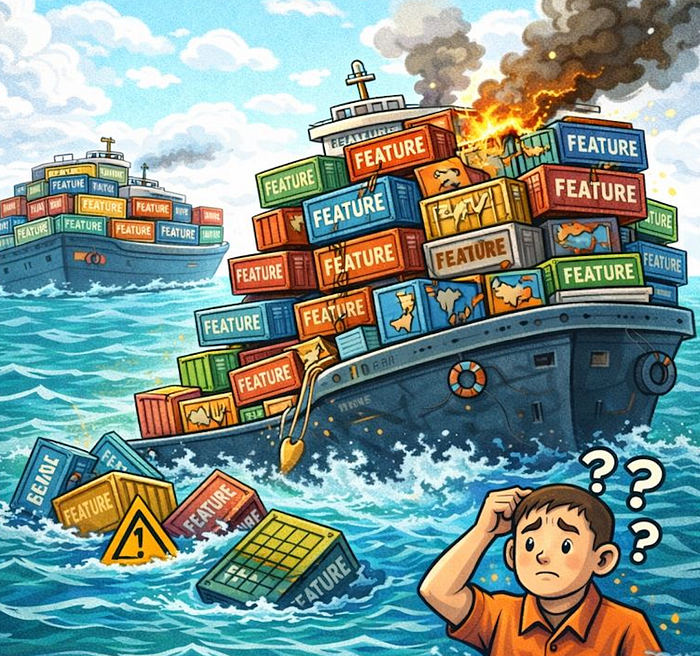
We celebrate every new feature shipped. We measure success in story points burned, tickets closed, and roadmap milestones achieved.
But beneath this velocity, a slower, more dangerous thing is happening:
We are making our systems harder to understand, harder to operate, and easier to break.
And we usually don't realize it until production starts screaming.
Let me show you how this happens — using a very common "simple" system.
The Innocent Beginning
We started with a straightforward requirement:
"Build a service that consumes files and distributes the data to a microservice."
Simple.
So we built:
• One file • One microservice • One flow • One payload • One happy path
Life was good.
The code was readable. The logs made sense. Failures were debuggable. On-call sleep was peaceful.
Then Features Happened
Business evolved. Requirements grew. And our system "scaled".
Phase 1 — Single File → Single Microservice
Already done. Works fine.
Phase 2 — Multiple Files → Single Microservice
"Just loop through the files."
Phase 3 — Single File → Multiple Microservices
"Add routing rules."
Phase 4 — Multiple Files → Multiple Microservices
"Add dynamic config."
Now suddenly:
| Before           | Now                       |
| ---------------- | ------------------------- |
| 1 flow           | 12+ execution paths       |
| 1 payload        | Dynamic payload generator |
| Simple config    | Rule-based mapping engine |
| One failure mode | 20+ failure patterns      |
| One consumer     | Fan-out architecture      |
But nothing looks broken.
So we kept shipping.
The Payload Monster
Originally the API payload was:
{
  "account_id": "123",
  "amount": 500
}
Then features came:
• Default parameters • File-based overrides • Dynamic routing keys • Service-specific formats • Versioned schemas • Partial enrichment • Conditional fields
Now payload generation looks like:
if file_type == A:
   use payload_v2 unless override present
if destination == B:
   remove field X, add field Y
if kafka:
   wrap in envelope
if webhook:
   sign payload
if retry:
   change idempotency key
Payload generation quietly became a rules engine.
But we still call it "mapper".
Communication Explosion
Originally: ➡️ REST API.
Now:
• REST APIs • Kafka topics • Webhooks • Retry DLQs • Callback acknowledgements
Each medium has:
• Different failure behavior • Different retry semantics • Different ordering guarantees • Different idempotency rules
So a "file processed successfully" now means:
Successfully by which transport? For which service? For which retry state?
But our monitoring still says:
"File processed."
Lies.
How it looked like
The Acknowledgement Chaos
Originally:
Process file → Acknowledge file → Done.
Now:
| Question | Nobody knows |
| ------------------------------------------ | ------------ |
| Ack after reading? | Maybe |
| Ack after sending? | Depends |
| Ack after all microservices succeed? | Sometimes |
| Ack if Kafka accepted but consumer failed? | 🤷♂️ |
| Ack if webhook timeout but API succeeded? | 🤷♂️ |So files get:
• Acknowledged too early • Or too late • Or never • Or twice
And no one trusts reprocessing anymore.
What Actually Broke
Nothing "crashed".
But the system became:
• Hard to reason about • Impossible to simulate • Dangerous to change • Expensive to operate • Terrifying to on-call
Every feature increased business capability and decreased system clarity.
This is not a bug problem.
This is a design debt problem.
The Real Lesson
We didn't build bad engineers.
We built:
• Feature-first systems • Behavior-last architecture • Implicit contracts • Hidden state machines
We shipped more. And we understood less.
A Better Question to Ask
Instead of:
"Can this system support multiple files to multiple microservices?"
We should ask:
"Can an on-call engineer predict what will happen for any given file?"
If the answer is no — you are already shipping worse software.
The Golden Contract
(For Any File → Multi-Service Distribution Platform)
A Golden Contract defines what must never change, no matter how many features you add.
Without it, your system will become unpredictable even if it "works".
1. There Is Exactly One Source of Truth for File State
A file must have a single canonical lifecycle:
RECEIVED → VALIDATED → DISTRIBUTING → COMPLETED
                    ↘ FAILED (terminal)
Every microservice, transport, retry, and consumer must refer to this same state.
❌ No local success flags ❌ No "temporary done" ❌ No consumer-defined success
If a file is COMPLETED, it means:
Every intended destination has succeeded.
Nothing else is allowed to redefine success.
2. A File Is A Workflow — Not A Payload
A file is not just data.
It is a state machine.
Each file must have:
| Attribute        | Mandatory     |
| ---------------- | ------------- |
| file_id          | Immutable     |
| schema_version   | Explicit      |
| routing_plan     | Deterministic |
| expected_targets | Precomputed   |
| idempotency_key  | Stable        |
| retry_budget     | Fixed         |
Once computed, routing_plan must never change during processing.
This prevents "Heisenbugs" where retries go to different services.
3. All Fan-Out Is Pre-Declared
Before sending anything, the system must know:
file → [service A, service B, service C]No dynamic discovery during runtime.
No "maybe this service too".
This allows:
• Accurate acknowledgements • Safe retries • Deterministic recovery • Correct monitoring
4. Acknowledgement Is Outcome-Based, Not Transport-Based
You do NOT acknowledge because:
• Kafka accepted it • API returned 200 • Webhook responded
You acknowledge ONLY when:
All intended services have confirmed processing success.
Transport success ≠ Business success.
5. Exactly-Once Processing Is a Contract, Not a Hope
Every dispatch must be:
| Rule          |
| ------------- |
| Idempotent    |
| Deterministic |
| Replayable    |
| Safe to retry |
| Correlatable  |
Every service must accept:
(file_id, target_service) as the idempotency keyNo custom dedup rules.
No local hacks.
6. Failure Is Explicit and Terminal
There are only two terminal states:
• COMPLETED • FAILED
No "partial success" terminal states allowed.
Partial success is a transient state, never terminal.
7. Observability Mirrors the State Machine
Metrics, logs, dashboards, alerts must reflect:
file_id → state → target → attempt → outcomeNot:
• Topic lag • API latency • Queue depth
Those are transport signals, not system truth.
8. Any New Feature Must Pass the Contract
Every new feature must answer:
| Question                     |
| ---------------------------- |
| Does routing change?         |
| Does state machine change?   |
| Does idempotency change?     |
| Does ack logic change?       |
| Does retry semantics change? |
If yes — it is a breaking design change, not "just a feature".
Final thought — Why This Matters
Without a Golden Contract:
• Retries corrupt data • Acks lie • Reprocessing becomes dangerous • On-call becomes archaeology • Velocity creates fragility
With it:
• Features scale • Failures are boring • Replays are safe • Systems stay explainable