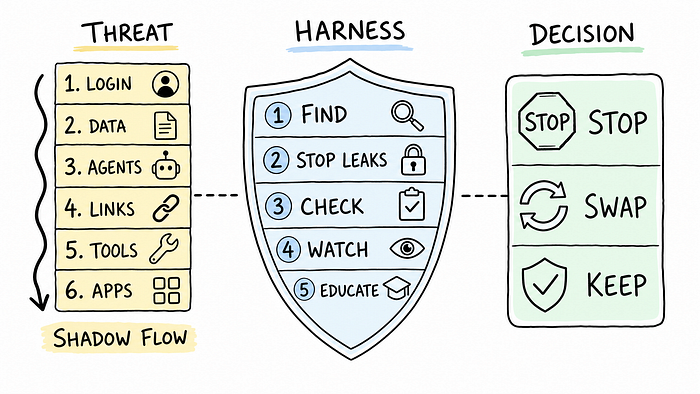

Smart AI tools are everywhere. But they can create hidden dangers for businesses. Learn how to manage Agentic Shadow AI and build a secure enterprise governance framework using the Harness system.
More and more companies use AI tools. This is great for work. But it also brings a new problem: "Agentic Shadow AI". A term I invened to reflect the reality. This means people use AI apps without their company knowing. It's like using a personal phone for work. It's becoming a big security risk.
Why People Use Shadow AI ?
- Speed: People want to work faster and skip long approval steps.
- Better Features: Public tools often have more features than internal ones.
- Ease of Use: Public AI is often easier and more intuitive to use.
- Anonymity: Some feel safer asking personal or sensitive questions to a public AI.
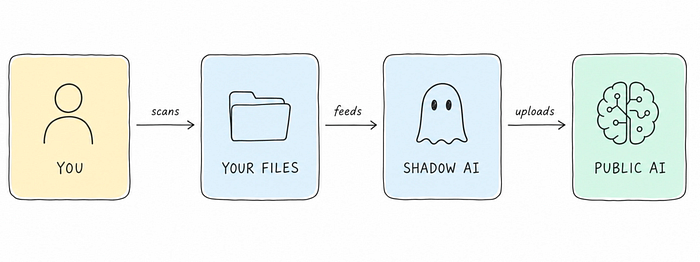
Agentic Shadow AI is different from old Shadow IT. Shadow AI tools don't just save your data. They use it, learn from it, and can remember it. Imagine you paste a secret company plan into a public AI. That plan could then show up in someone else's AI answers. This is a big problem.
This issue is growing fast. Many companies have had their secrets leaked because of Shadow AI. This costs a lot of money. It also hurts their name. Most people at work now use AI every day. But only a few use tools their company has approved. This means there's a gap. People want helpful AI. Companies need safe AI.
This article will show how Agentic Shadow AI affects company systems. It focuses on smart AI programs called agents. It suggests a harness. This is a strong system to manage AI. It makes approved AI easy to use. It also helps companies see data flows, who is using AI, and if rules are being followed.
The main idea : don't ban AI. Learn to manage it smartly.
What is Shadow AI?
It means using AI tools or apps at work without official permission. The real danger is not just asking public AI tools simple questions. It's about sharing private company data with these tools. This is very different from old Shadow IT for three big reasons:
First, AI systems don't just hold data. They actively use it, learn from it, and can keep it. If you put company data into an AI tool by mistake, it can show up to other users. It can also stay in the AI's memory. This can expose your company's secrets. For example, a marketing team might use a public AI to write ad copy. If they paste customer lists into it, those lists could be at risk.
Second, AI is being used very quickly. The use of new AI tools has exploded. Hundreds of different AI apps are now used in companies. This speed is much faster than how companies usually set up rules. don't mentioning the security rules updates.
Third, Shadow AI can lead to bad choices. If AI creates information from tools that aren't checked, and this information is used in company work, it can cause big mistakes. It can also steal company ideas. For instance, a finance team might use an unapproved AI to analyze sales data. If the AI makes a wrong prediction, it could cost the company a lot.
Often, people don't mean to cause harm with Shadow AI. They just want to work faster. They want to use the newest tools. They skip the long steps to get tools approved. This creates a problem: the best tools are the ones people want to use right away. But companies find it hard to approve them quickly. This means the whole approval process in companies should be review.
How Shadow AI Can Hurt Your Company
Shadow AI is not just about following rules. It's about how your company's computer systems are built. To manage it well, you need to know where Shadow AI can pop up. You need to know where to put safety checks.
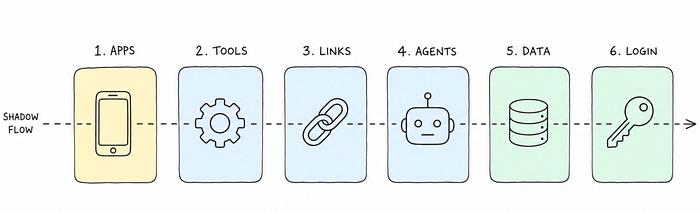
Shadow AI can show up in six different parts of a company's systems. Each part has its own risks. Each needs special rules.
We can look at this in six simple steps.
- Apps layer: People use personal AI apps for work.
- Tools layer: Work software now has built-in AI that might use your data.
- Links layer: Tech teams might link AI tools together without checking safety.
- Agents layer: Smart AI programs can now act on their own.
- Data layer: Secret company info can leak out.
- Login layer: Unmanaged logins can let AI into your systems forever.
Building a "Harness": A Plan for Safe AI Use
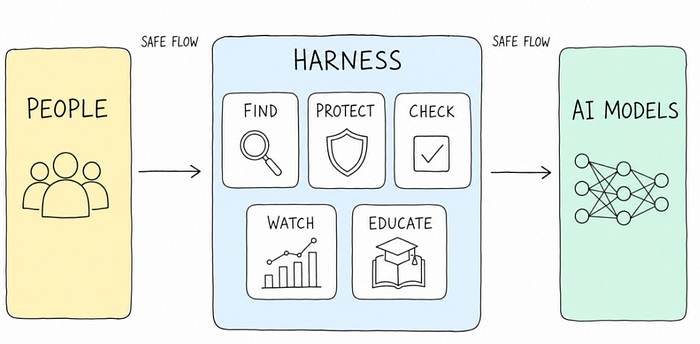
To deal with Shadow AI, companies need a harness. This is a system that sits between people and AI tools. It helps manage, control, and follow rules. Its goal is to turn Shadow AI from a danger into a useful, controlled tool.
The harness has several key parts. Each part helps with a different Shadow AI risk:
- FIND: Always find and list all AI tools, models, and apps in the company. This helps you see what's being used. For example, a tool that scans your network to find all AI apps employees are using.
- STOP LEAKS: Stop private data from going to unapproved AI. This includes checking what people type into AI tools. It also means sorting data by how secret it is. For instance, a system that warns you if you try to paste a customer list into a public AI chat.
- CHECK: Manage all AI logins in one place. This includes people, AI tool keys, and AI agent logins. It makes sure only approved people and tools use AI.
- WATCH: Keep full records of all AI use. This includes what people ask, what AI answers, and what AI agents do. This helps with rules and knowing who did what. For example, a log that shows every time an AI agent accesses a company database.
- EDUCATE: Teach everyone about safe AI use. This means regular training on company policies and best practices. For instance, workshops on how to use approved AI tools and spot risks. This is key.
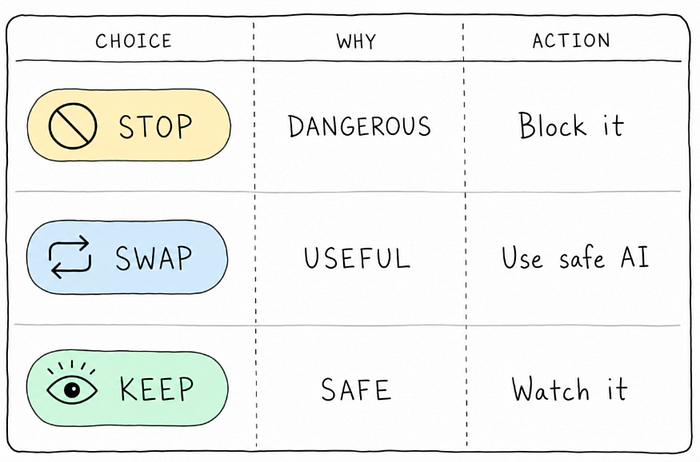
What to Do: Stop, Swap, or Keep
Companies need a clear way to handle Shadow AI. This plan has three main choices: STOP, SWAP, or KEEP. Each choice fits different risks and company needs.
STOP: Use this for very serious rule breaking. When data goes to dangerous AI without control. Or when smart AI agents get into systems without permission. If unapproved agents use company databases. To STOP, you block access right away. You tell people to use approved tools instead. This means you need tools to be able to block on demand.
SWAP: Use this when there's a real need for an AI tool. And when your company has a safe, approved option. Or can create one. This applies to personal AI accounts or unapproved AI transcription. You move people to the company's approved tool. You also show them how to use it. The reality is that profiles that do tech watch need something access to latests tools to test them.
KEEP: Use this for tools that are truly helpful. When the risk is small and can be managed. And when there's no similar tool inside the company. This could be special AI tools for code review. Or unique AI tools that handle data safely. To KEEP, you do a full security check. You make data agreements. You add the tool to your AI list. And you watch it closely. Again, you need to find the right tools to enable to watch all this tools.
This plan helps companies manage Shadow AI in a smart way. It balances new ideas with safety and rules.
Key Risks to Watch
Data Leaks: Your company data could be used to train public models. This happened at Samsung when source code was shared with ChatGPT
Security Holes: Popular tools like N8N or OpenClaw can have security flaws.
License Issues: Using software at work might break its personal-use license. This can lead to legal and financial risks.
Hidden AI: Software you already use might add AI features without you knowing.
Regulatory Risk: Using unapproved tools can break laws like the GDPR or the AI Act. Gartner estimates that over 40% of organizations will face such issues by 2030
Remember a few best practices:
- Use Approved Tools: Only use AI tools that your company has checked and approved.
- No Personal Accounts: Never use personal accounts for work AI tasks.
- Check Licenses: Always check if a tool is allowed for business use.
- Disable Telemetry: Turn off "usage data" sharing in your AI tools.
- Be Careful with Downloads: AI models from sites like Hugging Face can sometimes run hidden, dangerous code.
Take Aways
Shadow Agent AI is a big puzzle. You need a smart plan to solve it. First, learn the risks. Then, build your harness. Finally, use a clear plan to decide. This helps you stop just reacting. You can start leading. This keeps your data safe. It also lets you use AI the right way.
I have seen this before. It is like when cloud tools first started. Waiting to fix things costs more. It also works less well. People feel safer with outside tools. They think no one is watching. This is a big point. Company tools must be safe. They must also be easy to use. They should help, not limit. Even with good internal AI, people still use outside tools. We must make the safe way the easiest way.
Good companies use AI to help workers. They do not use it to control them. They invest in clear and flexible systems. This lets teams use AI fully. It also protects the company. The goal is for humans and AI to work well together. The harness helps. It does not hold back. Turn your risks into strengths. The future belongs to those who can manage the shadows.
Thank you for reading. See you in the next one.
If this was useful, the clap button helps more people find it ❤️.
I write about agentic AI governance, agent architecture, optimisation and the infrastructure decisions that separate production systems from demos → Subscribe
Deploying long-running agents in a regulated environment? Let's talk → LinkedIn