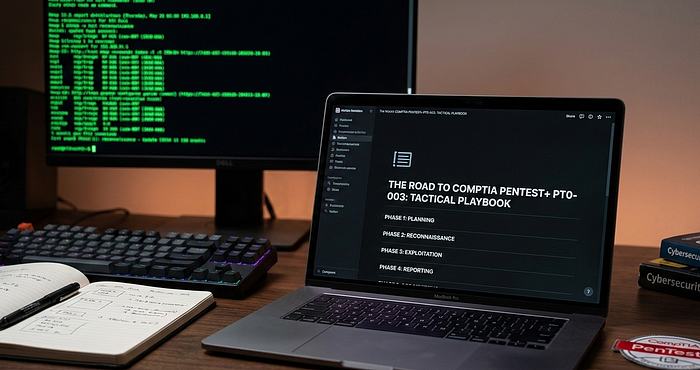

A personal tactical playbook for aspiring penetration testers
There's a saying in the security world: a great penetration tester isn't just someone who knows the tools — they're someone who knows how to think. That distinction matters more than most people realize when you're preparing for CompTIA's PenTest+ (PT0–003) certification.
I've been building what I call a Tactical Playbook — a structured, mission-driven approach to mastering every phase of the penetration testing lifecycle. It's not just exam prep. It's a way of developing the organized, methodical mindset that real-world security assessments demand.
Here's how I broke it down.
Why "Mission Files"?
A penetration test is, at its core, an operation. You have objectives, constraints, targets, and timelines. You gather intelligence, exploit weaknesses, and report findings to decision-makers. That framing — operational, deliberate, phase-by-phase — is exactly why I chose to organize my study material into Mission Files rather than chapters or flashcard decks.
Each Mission File corresponds to a critical phase of the PenTest+ pathway. Together, they form a complete picture of what it means to execute a high-level security assessment — from the first conversation with a client all the way to the final report.
The Mission Files
Mission 0: Pre-Test Before anything else, you need a baseline. This mission covers the foundational knowledge required to even begin thinking like a penetration tester — networking fundamentals, basic security concepts, and the mental model that ties everything together.
Mission 1: Penetration Testing — Before You Begin Scoping, rules of engagement, legal considerations, and threat modeling. The work you do before you ever touch a keyboard often determines whether an engagement succeeds or fails.
Mission 2: Applying Pre-Engagement Activities This is where theory meets paperwork — and paperwork matters. NDAs, statements of work, permission to test. Understanding these documents protects both the tester and the client.
Mission 3: Enumeration and Reconnaissance Intelligence gathering is the backbone of any successful engagement. Passive recon, OSINT techniques, DNS enumeration, and footprinting — knowing your target before they know you're watching.
Mission 4: Scanning and Identifying Vulnerabilities Active scanning, service enumeration, and vulnerability identification using tools like Nmap, Nessus, and Nikto. This phase transforms raw recon into actionable attack surface.
Mission 5: Conducting PenTest Attacks The heart of the operation. Exploitation techniques, privilege escalation, lateral movement, and maintaining access. This is where the methodology gets put to the test.
Mission 6: Web-Based Attacks SQL injection, XSS, CSRF, directory traversal, and more. Web applications remain one of the most targeted attack surfaces, and this mission covers them thoroughly.
Mission 7: Enterprise Attacks Active Directory attacks, credential harvesting, Kerberoasting, Pass-the-Hash, and pivoting through enterprise environments. This is the territory where real engagements live and die.
Mission 8: Specialized Attacks Wireless attacks, IoT vulnerabilities, social engineering, and physical security assessments. Modern penetration testing extends far beyond the network perimeter.
Mission 9: Performing Penetration Testing Tasks Pulling it all together — scripting, automation, custom payloads, and executing full-chain attacks in simulated environments. Practical application of everything learned.
Mission 10: Reporting and Recommendations The mission isn't over until the report is written. Documentation, risk ratings, executive summaries, and remediation guidance. A finding that can't be communicated clearly might as well not exist.
Final Mission: Practice Exam Full simulation under exam conditions. Timed, realistic, and unforgiving — exactly the way it should be.
More Than an Exam
I want to be clear about something: the PenTest+ certification is a means, not an end. The real goal of this playbook is to build the thinking patterns that make someone effective in the field — the ability to move through an engagement systematically, adapt when things don't go as planned, and always know what phase you're in and what comes next.
The exam will test your knowledge. The methodology will carry you through your career.
Access the Full Playbook
Want to explore the Tactical Playbook in full detail? I've made the entire Notion site publicly accessible — every Mission File, notes, tools, and resources included.
🔗 Road to CompTIA PenTest+ (PT0–003) — Tactical Playbook
Feel free to bookmark it, reference it during your studies, or use it as a template for building your own structured study system.
Final Thoughts
If you're on your own road to PenTest+, I hope this breakdown gives you a useful mental map for the journey. Break it into phases. Treat each topic like a mission with objectives to complete. And remember that the certification is just one milestone — the mindset you build along the way is what will actually make you dangerous (in the best possible way).
I genuinely hope everything I've shared here makes sense. And if you're studying for the PT0–003 right now — good luck. You've got this.