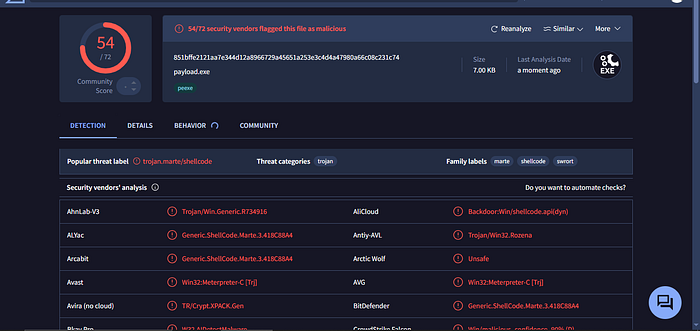

AFTER

What Is Static Analysis?
Static analysis is a malware detection technique in which security systems evaluate a file without executing it. Detection engines compare binaries against known malicious signatures, byte patterns, hashes, metadata indicators, and structural characteristics. Some tools also apply lightweight emulation to enrich static inspection.
This approach is fast and scalable, making it a core component of endpoint protection platforms and malware triage pipelines.
Why Static Analysis Can Be Bypassed
The fundamental weakness of static analysis is its reliance on known patterns. If a file does not match an existing signature or recognizable structure, static detection alone may fail to classify it as malicious.
From a Blue Team standpoint, this is not theoretical — real-world threat actors routinely alter binaries to change their static fingerprint while preserving functionality. This makes static-only detection fragile when facing novel or modified samples.
Research Objective
The goal of this research is to demonstrate the limitations of signature-based static detection and highlight why defenders must rely on layered detection strategies rather than single-signal conclusions.
As part of this defensive research, I implemented a simple binary transformation technique to show how minimal changes can significantly alter static characteristics.
Research Implementation (For Defensive Study)
The implementation is publicly available here:
This project demonstrates how encoding a binary changes its static representation, causing traditional signature-based scanners to lose visibility. The purpose is not weaponization, but to give defenders a concrete artifact for studying:
- Why static signatures fail
- How attackers evade early-stage detection
- What compensating controls are required
This technique can also be chained with other transformations, which further reinforces the defensive lesson: static analysis should never be treated as a final verdict.
Operational Impact
A common misconception in security operations is that zero detections in multi-engine scanners implies legitimacy. This assumption is incorrect.
Static evasion techniques — combined with loaders, staged execution, or memory-only execution — allow malicious code to bypass both static and limited sandboxing approaches. When relied upon alone, this creates blind spots that attackers exploit at scale.
Defensive Best Practices
To address these limitations, Blue Teams should:
- Use isolated execution environments Execute unknown binaries in controlled virtual machines or sandboxes to observe runtime behavior.
- Prioritize behavioral detection Monitor process creation, memory allocation, system calls, file writes, and network activity.
- Perform deeper technical analysis For research and incident response, apply debugging, syscall tracing, and full behavioral profiling.
- Correlate across layers Combine static signals with behavioral, memory, and anomaly-based detections to reach reliable conclusions.
Conclusion
Static analysis is a valuable first layer, but it is fundamentally insufficient against transformed or novel binaries. This research demonstrates — in a controlled and transparent manner — why Blue Teams must assume static evasion is trivial and design detections accordingly.
Understanding how evasion works is essential to building resilient detection, not bypassing it.