
June 3, 2026
The Vulnerability Trap: Why 50 Low Findings Can Be Safer Than One Critical Vulnerability
After conducting numerous penetration tests and security assessments, I’ve noticed a common pattern.

Arun K
2 min read
Once an assessment is complete, stakeholders often ask:
How many findings did we get?
or
How does this compare with our previous assessment?
These are fair questions. Vulnerability counts provide a quick snapshot of security posture and help track remediation progress.
Here lies the blind spot.
The number of vulnerabilities identified does not necessarily reflect the actual risk facing the organisation.
Attackers don't care how many findings appear on a dashboard. They care about the one weakness that gives them access.
When Numbers Become Misleading
To understand why vulnerability counts can be misleading, consider the following scenarios:
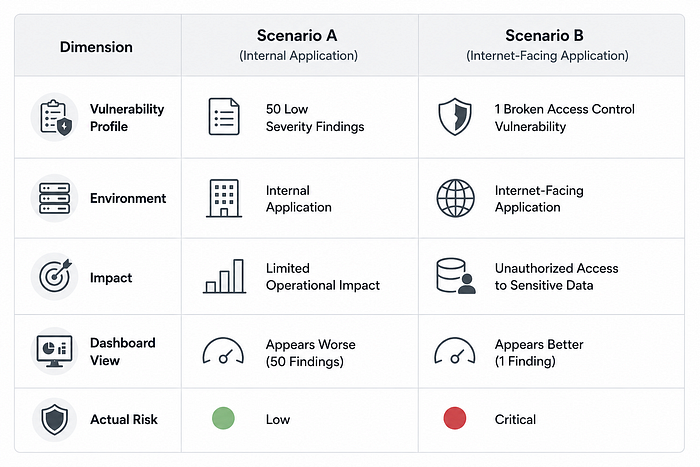
On paper, Scenario A looks worse.
In reality, Scenario B is far more dangerous.
A single vulnerability that exposes customer data or enables unauthorised access can create significantly more risk than dozens of low-severity findings combined.
This is why mature security programs focus on risk, not just vulnerability counts.
The Findings That Actually Matter
Most assessments uncover a mix of low-risk issues:
- Missing security headers
- Information disclosure findings
- Minor configuration weaknesses
- Best-practice gaps
While these should be addressed, they rarely represent the greatest threat.
What truly changes an organisation's risk profile are vulnerabilities such as:
- Broken Access Control
- Authentication Bypass
- Privilege Escalation
- Sensitive Data Exposure
- Business Logic Flaws
I've seen applications with dozens of low-severity findings where the real concern was a single authorisation flaw that allowed unauthorised access to critical functionality.
The vulnerability count looked manageable.
The business risk was not.
Context Matters More Than Severity
Security teams often rely on CVSS scores and severity ratings to prioritise remediation.
While useful, these metrics should never be viewed in isolation.
Before prioritising a finding, ask:
- Is the application internet-facing?
- Does it process sensitive information?
- How easy is exploitation?
- What would be the business impact?
- Would customer trust or compliance be affected?
A Medium-severity issue on a critical production system may deserve immediate attention, while a High-severity finding in a test environment may not.
Context transforms vulnerability data into meaningful risk.
Security Reports Should Drive Decisions
One mistake I frequently observe is treating security reports as scorecards.
The goal of a penetration test is not to produce the highest number of findings.
A good report should answer four questions:
- What can be exploited?
- What business functions are affected?
- What should be fixed first?
- How can risk be reduced effectively?
The most valuable reports are not the ones with the most findings.
They are the ones that help organisations make better security decisions.
The Bottom Line
Organisations rarely suffer security incidents because they have too many vulnerabilities. They suffer incidents because a critical risk was not identified, prioritised, or remediated in time.
Penetration tests, vulnerability assessments, and security tools are important. But their true value is not measured by the number of findings they produce.
Their value lies in helping organisations understand risk and focus on what matters most.
Security programs do not succeed because they discover more vulnerabilities. They succeed because they identify, prioritise, and remediate the risks that matter most.
Stop counting vulnerabilities.
Start managing risk.
What are your thoughts? How does your organisation balance vulnerability counts against actual business risk?