
Modern applications need to balance security and user experience. Access tokens that never expire are dangerous. Tokens that expire too fast frustrate users.
This is exactly the problem refresh tokens are designed to solve.
Yet, they're also one of the most misunderstood and misused parts of authentication systems.
Let's fix that.
What Problem Do Refresh Tokens Solve?
Access tokens (JWTs, bearer tokens) are meant to be:
- Short-lived
- Frequently rotated
- Easy to validate
But if an access token expires every few minutes, users would need to log in constantly. That's not acceptable.
Refresh tokens exist to renew access tokens securely without forcing re-authentication.
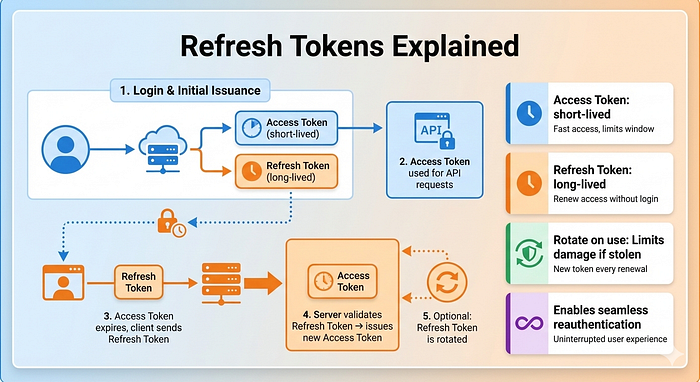
How Refresh Tokens Work (Simple Flow)
- User logs in successfully
- Server issues:
- Access token (short-lived, e.g., 5–15 minutes)
- Refresh token (long-lived, e.g., days or weeks)
3. Client uses the access token for API requests
4. When the access token expires:
- Client sends refresh token
- Server issues a new access token
5. User continues without logging in again
Access Token vs Refresh Token
Access Token
- Short lifespan
- Sent with every API request
- If stolen, damage should be limited
Refresh Token
- Long lifespan
- Used only to obtain new access tokens
- Must be protected very carefully
A refresh token is more sensitive than an access token.
Common Mistakes Developers Make
These mistakes show up again and again in real projects:
1. Refresh Tokens That Never Expire
Long-lived tokens without expiration turn a temporary leak into permanent access.
2. Storing Refresh Tokens in LocalStorage
If an attacker gains XSS access, they get your refresh token and keep renewing access forever.
3. No Refresh Token Rotation
Reusing the same refresh token repeatedly makes token theft extremely dangerous.
4. No Server-Side Tracking
If the server doesn't know which refresh tokens are valid, revocation becomes impossible.
Refresh Token Rotation (Best Practice)
Rotation means:
- Every time a refresh token is used, a new one is issued
- The old refresh token is invalidated immediately
This way:
- Reuse of an old refresh token signals compromise
- Stolen tokens become useless after one use
Rotation turns token theft into a detectable event, not a silent failure.
Secure Storage: Where Refresh Tokens Belong
The safest option for most web apps:
- HTTP-only cookies
Secureflag enabled- Proper
SameSiteconfiguration
Why?
- Not accessible via JavaScript
- Reduced XSS risk
- Automatically sent with requests
Mobile apps typically use secure OS-level storage instead.
When to Revoke Refresh Tokens
You should revoke refresh tokens when:
- User logs out
- Password is changed
- Suspicious activity is detected
- Token reuse is detected during rotation
Revocation is how you regain control in a stateless system.
Final Takeaway
Refresh tokens are not optional anymore. They are a core security mechanism in modern authentication systems.
Done right, they:
- Improve security
- Protect users
- Preserve UX
Done wrong, they:
- Extend breaches
- Hide attacks
- Undermine your entire auth model
Short-lived access tokens + rotated refresh tokens = safer systems.