
Introduction
Security researchers have identified a concerning client-side behavior in Telegram's mobile applications that could inadvertently expose users' real IP addresses through a single, seemingly innocuous tap. The issue centers on how MTProto proxy configuration links are handled by Telegram's Android and iOS clients, particularly when these technical links are disguised to appear as ordinary username mentions.
While the underlying mechanism — proxy validation — serves a legitimate technical purpose, the combination of text formatting capabilities and automatic connection behavior creates a security risk that disproportionately affects users who rely on anonymity, including journalists, activists, and researchers operating in hostile environments.
This analysis examines the technical behavior, assesses the security implications, and discusses both Telegram's response and practical mitigation strategies for users.
Technical Background
MTProto Proxy Links in Telegram
Telegram supports a specialized link format designed to simplify proxy configuration for users attempting to bypass network restrictions or censorship. These proxy configuration links follow a standardized URL structure:
https://t.me/proxy?server=<IP>&port=<PORT>&secret=<SECRET>The intended functionality is straightforward: when a user clicks such a link, Telegram automatically configures the specified MTProto proxy without requiring manual entry of connection parameters. This feature has become widely adopted in regions where Telegram faces blocking, with proxy links frequently shared through public channels and private messages.
Text Formatting and Link Masking
Telegram's messaging system allows rich text formatting where the displayed text can differ significantly from the underlying hyperlink target. This capability, common in modern messaging platforms, enables users to create cleaner, more readable messages by hiding lengthy URLs behind descriptive text.
However, this same formatting feature can be leveraged to present proxy configuration URLs in a deceptive manner. A proxy link can be masked with username-like display text, such as:
@exampleuserTo the recipient, this appears identical to a standard Telegram username mention or profile reference — a common, low-risk interaction pattern that users encounter regularly. The visual distinction between a legitimate username and a disguised proxy link is effectively nonexistent in the message interface.
Username-Like Link Abuse Scenario
The Deceptive Presentation
The core of this security concern lies in how easily proxy configuration links can be disguised as harmless username mentions. When an attacker crafts a message containing a proxy link formatted to display as a username, the visual presentation is indistinguishable from legitimate user references that appear throughout normal Telegram conversations.
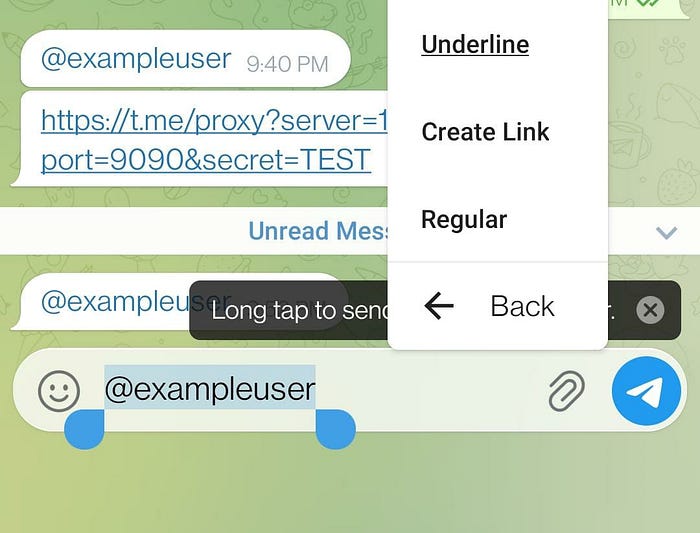
As shown in the screenshot above, the formatted text appears as a standard username mention. Users have been conditioned through countless interactions to recognize this format as a safe, non-intrusive element — typically leading to a user profile view. This established trust pattern creates the foundation for the confusion vector.
Attack Vector Mechanics
An attacker seeking to expose a target's real IP address could distribute specially crafted proxy links through various channels:
Public Group Discussions: In active group conversations where username mentions are frequent, a disguised proxy link blends seamlessly with normal discourse. Users routinely tap username references to view profiles or understand context, making this interaction pattern automatic and unquestioned.
Private Message Campaigns: Direct messages can be crafted to include what appears to be references to mutual contacts, community figures, or relevant usernames, encouraging the recipient to tap for more information.
Channel Posts and Announcements: Public channels often reference community members, moderators, or notable figures. A disguised proxy link in such contexts appears contextually appropriate and attracts natural user interaction.
Reply Chains and Threads: In threaded discussions, username mentions help users follow conversation flow. Embedded proxy links in these contexts exploit users' expectation of navigational assistance.
The effectiveness of this vector relies entirely on social engineering rather than technical exploitation. The attacker needs only the ability to craft a formatted message and leverage contexts where username interactions are expected and routine.
Why Users Are Vulnerable
Users expect tapping a username to be a safe, read-only action that displays a profile. This expectation is reinforced through thousands of legitimate interactions over time. The cognitive pattern becomes automatic: see username format, tap to view profile, gather context, return to conversation.
Breaking this established pattern requires either explicit visual differentiation (which is absent) or user awareness of the underlying risk (which is not widespread). The attack succeeds precisely because it exploits the gap between user expectations and actual client behavior.
Observed Client-Side Behavior
Automatic Proxy Validation Process
Testing conducted in a controlled laboratory environment revealed specific client-side behavior when proxy links are opened on Telegram mobile applications. Upon tapping a disguised proxy link, the following sequence occurs automatically:
Initial State Transition: The Telegram client immediately enters a "Checking…" state, indicating that proxy validation has begun.
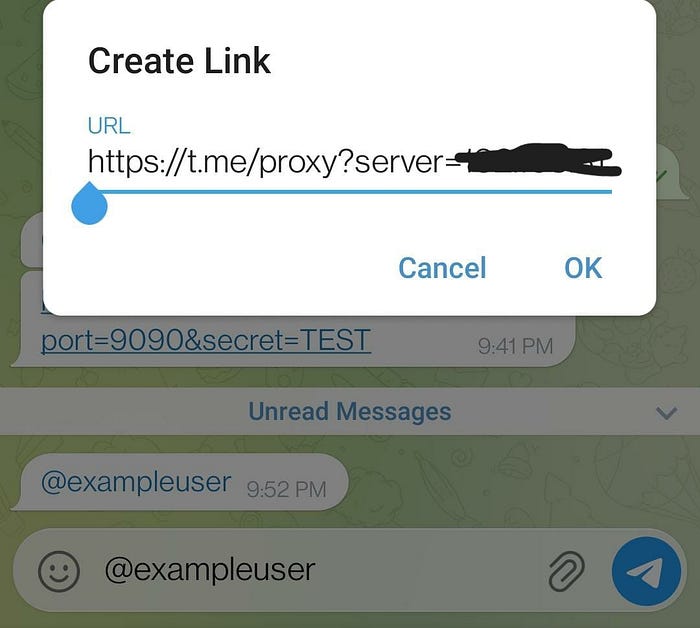
As demonstrated in the screenshot, this validation state appears without any prior confirmation dialog or warning that a proxy connection is being attempted. The user receives no opportunity to cancel or reconsider the action before the validation process begins.
Connection Initiation: During this validation phase, the client attempts to establish a direct outbound network connection to the server specified in the proxy configuration link.
Timing and Bypass Characteristics: Two critical technical details define this behavior:
- The connection attempt occurs before the proxy is actually added to the user's active configuration
- The connection bypasses any existing proxy settings the user may have previously configured
This means that even users who are already routing their Telegram traffic through a trusted proxy will have their real IP address exposed during this validation attempt, as the check happens outside the protection of their current proxy configuration.
Laboratory Confirmation
In a controlled testing environment, researchers configured a server to listen on the port specified in a test proxy link, but deliberately did not implement actual proxy functionality. This allowed observation of the raw connection behavior without introducing the complexity of a functional proxy handshake.
When a test device tapped the disguised proxy link, the listening server received incoming connection attempts containing binary data consistent with MTProto handshake protocol patterns.
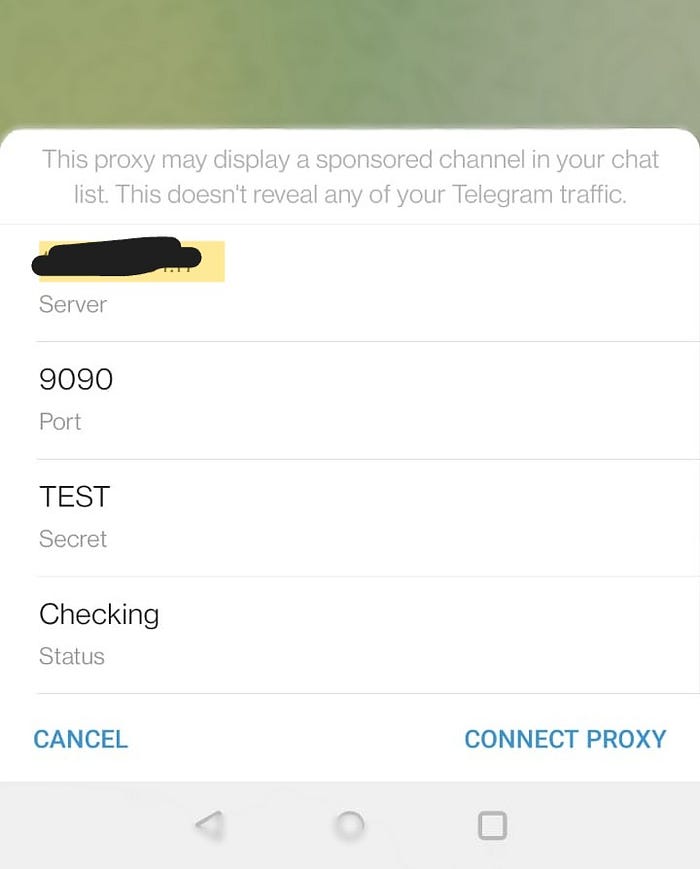
This observation confirmed two important technical points:
- Direct Client Origin: The connection originated directly from the Telegram mobile client, not from a web browser, system component, or other application. The binary protocol data matched MTProto handshake patterns specific to Telegram's client implementation.
- Validation-Phase Timing: The connection attempt occurred as part of the validation process itself, independent of whether the proxy configuration ultimately succeeded or was accepted by the user.
Connection Persistence Despite Failure
Perhaps most significantly, testing revealed that even when proxy validation failed — as it inevitably would with a non-functional proxy server — the initial outbound connection had already been established, and the client's real IP address had already been transmitted to the destination server.
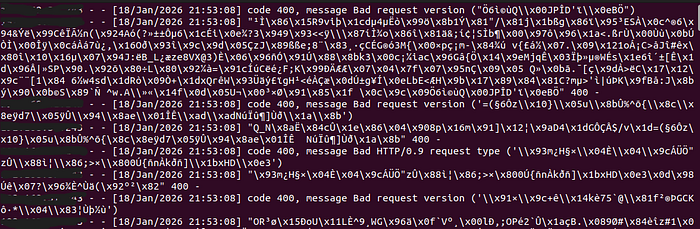
As shown above, the proxy validation ultimately fails and the user receives a failure notification. However, from a security perspective, the damage has already occurred. The server operator has successfully captured the connecting IP address during the validation attempt, regardless of the final outcome.
Comparison to Known Vulnerability Patterns
Security researchers have noted similarities between this behavior and automatic NTLM authentication leaks observed on Windows systems, where a single interaction with a specially crafted UNC path or resource triggers an outbound authentication request without explicit user consent.
In both cases, what appears to be a simple, safe navigation action results in the automatic transmission of identifying information to a potentially hostile endpoint. The user performs what they perceive as a read-only operation (viewing a profile, accessing a file share) but the system responds by initiating an authenticated or identifying connection.
Security Impact & Risk Assessment
Direct Technical Impact
The most immediate consequence of this behavior is the exposure of the user's real IP address to the operator of the proxy server specified in the disguised link. This exposure occurs before any actual proxy connection is established and before the user has any opportunity to review or reject the proxy configuration.
Critically, this exposure affects even users who have already configured Telegram to use a trusted proxy, as the validation check bypasses existing proxy settings.
Secondary Risk Factors
Approximate Geolocation: An IP address provides a basis for approximate geographic location determination, typically accurate to the city or regional level through GeoIP databases. For users in environments where their physical location constitutes sensitive information — journalists operating in hostile territories, activists organizing in authoritarian states, researchers investigating powerful entities — this represents a significant privacy compromise.
OSINT Correlation and Deanonymization: IP addresses serve as valuable correlation points in open-source intelligence gathering. When combined with other observable data points — posting times, linguistic patterns, topic expertise, interaction networks — an exposed IP address can contribute to identifying a previously anonymous user across platforms or linking separate online personas to a single individual.
An adversary who captures IP addresses from multiple interactions over time can build a behavioral profile, correlate activity patterns across platforms, and potentially attribute anonymous communications to specific individuals or organizations.
Targeted Harassment and Denial-of-Service: Knowledge of a user's real IP address enables various forms of targeted attacks:
- Network-layer denial-of-service attempts aimed at disrupting the user's internet connectivity
- Geographically-informed harassment campaigns that leverage knowledge of the user's physical location
- Coordination with local threat actors who can act on location information
- Social engineering attacks that incorporate location-specific details to enhance credibility
Infrastructure Mapping: For users accessing Telegram through organizational or institutional networks, the exposed IP address may reveal not just individual identity but also institutional affiliation. A researcher accessing Telegram from a university network, a journalist from a newsroom, or an activist from an NGO office may inadvertently disclose their organizational connection.
Elevated Risk Populations
While this issue affects all Telegram users in principle, certain populations face disproportionate and potentially severe consequences:
Journalists and Investigative Researchers: Individuals investigating sensitive topics — corruption, organized crime, human rights abuses, corporate malfeasance — often rely on Telegram's proxy features specifically to protect their identity and location from surveillance by the subjects of their investigations. Circumventing these protections exposes them to retaliation, intimidation, or violence.
Political Activists and Dissidents: Users coordinating activism, organizing protests, or expressing dissent in authoritarian environments depend on anonymity for personal safety. IP exposure could enable state actors to identify, locate, and target individuals for arrest, harassment, or worse.
Human Rights Defenders: Organizations and individuals working on human rights documentation in conflict zones or repressive regimes face grave risks if their location or identity is compromised. The ability to communicate securely is often a matter of physical safety.
Privacy-Conscious Users in Restricted Networks: Individuals using proxies to bypass censorship or surveillance may be specifically monitored for such attempts. Discovery of their real network location could result in legal action, employment consequences, or targeting for enhanced surveillance.
Attack Viability Assessment
The behavior exhibits several characteristics that increase its viability as an attack vector:
Low Technical Barrier: The attack requires no sophisticated technical exploitation, no zero-day vulnerabilities, and no complex infrastructure. An attacker needs only the ability to craft a formatted Telegram message and access to a server with a public IP address.
Minimal User Interaction: Only a single tap is required, on an element that appears completely benign and familiar. No additional confirmation dialogs interrupt the automatic connection process.
Immediate Results: The IP exposure occurs within seconds of the user's tap, providing immediate feedback to the attacker.
Silent Operation: The user receives no clear warning that they are about to initiate an outbound connection to an arbitrary server. The "Checking…" state appears only after the process has begun.
Scalability: An attacker can distribute disguised proxy links to large audiences simultaneously through public channels, groups, or coordinated messaging campaigns.
These factors combine to make this a particularly concerning threat from a security modeling perspective. The attack surface is broad, the barrier to exploitation is low, and the potential impact on high-risk users is severe.
Telegram's Response
Telegram has provided an official response to this research, offering both technical context and future mitigation plans.
Official Position on Technical Behavior
Telegram's statement emphasized that the ability to observe connecting IP addresses is inherent to how internet services function at a fundamental level. Any website operator, proxy server administrator, or network service provider can see the IP addresses of users who establish connections to their infrastructure.
From this technical perspective, Telegram argued that the proxy validation behavior is consistent with standard internet connectivity patterns. When a user attempts to add any proxy service — whether through Telegram or any other application — the proxy server operator necessarily observes the connecting IP address as part of the connection establishment process.
The company noted that this characteristic is not unique to Telegram or to proxy services specifically, but rather represents a fundamental aspect of TCP/IP networking and internet communication.
Acknowledged User Experience Concerns
Despite this technical framing, Telegram acknowledged the potential for user confusion created by the specific combination of text formatting capabilities and automatic proxy validation behavior. The company recognized that users may not reasonably expect that tapping an apparent username mention would trigger a network connection to an arbitrary server specified in a hidden URL.
This acknowledgment represents an important distinction: while the underlying network behavior may be technically standard, the user experience surrounding it creates unexpected security implications that differ from users' mental models of how username interactions should function.
Planned Client-Side Warnings
In response to these concerns, Telegram confirmed plans to introduce warnings when users interact with proxy configuration links. These warnings are intended to make disguised proxy links more visible to users, providing clear indication that the action will initiate a proxy connection attempt rather than simply navigating to a user profile.
The stated goal is to bridge the gap between user expectations (viewing a profile) and actual behavior (initiating a network connection), giving users an opportunity to recognize the true nature of the interaction before proceeding.
Implementation Timeline
However, at the time of this analysis, Telegram has not provided a specific timeline for when these client-side warnings will be fully implemented and deployed across all supported platforms (Android, iOS, and potentially desktop clients).
The current production versions of Telegram's mobile applications continue to exhibit the automatic connection behavior without intervening warnings. Users relying on Telegram's proxy features for security-critical anonymity remain exposed to this risk until the warnings are deployed and widely adopted through application updates.
Mitigation & User Awareness
User-Side Defensive Practices
Until Telegram implements comprehensive client-side warnings across all platforms, users — particularly those with elevated privacy requirements — should adopt defensive practices to minimize exposure risk:
Link Target Verification: Before tapping any username-like text or Telegram link, use the platform's long-press (or equivalent) functionality to inspect the actual target URL. Most mobile messaging applications, including Telegram, support preview functionality that reveals the true destination of a formatted link.
Proxy configuration links will reveal their t.me/proxy?server=... structure when examined through this preview mechanism, making them distinguishable from legitimate username references before interaction.
Heightened Caution with t.me Domain: Exercise additional scrutiny when encountering any content that resolves to the t.me domain, particularly in unexpected contexts or from unfamiliar sources. While many legitimate Telegram features use t.me URLs, this domain should trigger enhanced verification when encountered in ambiguous or suspicious circumstances.
Proxy Link Risk Classification: Treat all proxy configuration links — even those from apparently trusted sources — as high-risk interactions from a privacy perspective. Even legitimate, well-intentioned proxy links trigger the same validation behavior and therefore represent potential IP exposure events.
Users should verify proxy sources through independent channels before adding them, rather than clicking proxy links embedded in messages.
System-Level VPN Implementation: Consider implementing system-level VPN connections rather than relying exclusively on Telegram's in-app proxy features. A properly configured system-level VPN protects the user's real IP address even during Telegram's proxy validation phase, as the outbound connection will originate from the VPN endpoint rather than the user's actual network location.
This defense-in-depth approach ensures that even if Telegram's application-level proxy validation bypasses in-app proxy settings, the system-level VPN still provides protection.
Contextual Skepticism: Exercise heightened caution regarding username mentions that appear in unusual contexts, from unexpected senders, or in situations where a profile reference seems incongruous with the surrounding conversation flow.
Legitimate username mentions typically fit naturally within conversation context. References that seem forced, out-of-place, or unexplained may warrant additional scrutiny.
Source Authentication: When receiving messages containing username-like elements from contacts you know personally, consider verifying through alternative channels if the reference seems unusual for that contact's typical communication patterns.
Organizational Guidance for High-Risk Users
Organizations supporting journalists, activists, researchers, or other high-risk users should incorporate awareness of this behavior into their digital security training programs and operational security protocols:
Explicit Training: Users who depend on anonymity for safety should receive explicit instruction that clicking unknown links in Telegram — even those appearing as simple username mentions — carries IP exposure risk. This should be framed not as paranoia but as understanding the actual technical behavior of the application.
Standard Operating Procedures: Develop clear procedures for how users should handle proxy configuration, including:
- Only using proxies from pre-verified, organizationally-approved sources
- Never clicking proxy links received through Telegram messages
- Manually configuring proxies using separately-communicated parameters
- Maintaining system-level VPN connections as baseline protection
Incident Response Planning: Organizations should establish protocols for responding to potential IP exposure incidents, including:
- Procedures for users who believe they may have clicked a disguised proxy link
- Assessment processes to determine whether location or identity compromise occurred
- Contingency plans for users whose location may have been exposed
Alternative Communication Channels: For users in highest-risk environments, consider whether Telegram with proxies remains an appropriate communication platform, or whether alternatives with different security models (such as Tor-based messaging or end-to-end encrypted platforms without proxy validation behaviors) would be more suitable.
Ethical Considerations
This research was conducted in full accordance with responsible disclosure practices and ethical research standards. Transparency regarding methodology and constraints is essential for proper interpretation of findings.
Controlled Environment Methodology
All testing was performed in a controlled laboratory environment using devices, network infrastructure, and Telegram accounts owned exclusively by the researchers themselves. No third-party users were involved in the testing process at any stage.
The research methodology involved:
- Test devices configured specifically for security research
- Isolated network segments designed for vulnerability analysis
- Controlled message exchanges between researcher-owned accounts
- Server-side listeners operated on researcher-controlled infrastructure
No deceptive targeting, real-world exploitation attempts, or unauthorized testing involving non-consenting parties occurred during this research.
No Operational Infrastructure Deployment
The research did not involve deploying actual proxy infrastructure accessible to public users or attempting to collect IP addresses from genuine Telegram users outside the research environment.
Laboratory verification used simple network listeners capable of confirming connection attempts and logging basic connection metadata, without providing proxy functionality or storing user data beyond what was necessary to validate the technical behavior.
Responsible Disclosure Process
Prior to public disclosure, this research was reported to Telegram through appropriate security channels, allowing the company opportunity to respond, provide technical context, and develop mitigation strategies.
Telegram's confirmation of plans to implement client-side warnings demonstrates that the responsible disclosure process enabled constructive engagement with the issue rather than creating adversarial dynamics.
Purpose and Intent
The purpose of this analysis is to advance security awareness and enable defensive understanding among Telegram's user base, particularly populations facing elevated risk due to their professional activities, political circumstances, or geographic location.
Publication aims to:
- Inform users of the current client behavior so they can make informed decisions
- Provide practical mitigation strategies that users can implement immediately
- Create public accountability for implementation of promised client-side warnings
- Contribute to broader understanding of how feature interactions create unexpected security implications
This research explicitly does not aim to:
- Provide attack tools or detailed exploitation instructions
- Encourage malicious use of the described behavior
- Undermine Telegram's legitimate security features or architectural choices
- Sensationalize or exaggerate the scope or severity of the issue
Educational Framework
The analysis is framed within an educational and defensive security perspective, emphasizing user protection rather than offensive capability development. The goal is to empower users to protect themselves while Telegram develops and deploys client-side warnings across all platforms.
Conclusion / Final Takeaway
The security concern identified in this research does not stem from a fundamental flaw in Telegram's proxy functionality itself, but rather from the convergence of legitimate features in ways that create unexpected security implications. The core issue is that proxy configuration links can be rendered visually indistinguishable from ordinary username mentions through text formatting, allowing a single tap to trigger an outbound connection before users receive any warning or confirmation prompt.
This behavior creates a meaningful security risk, particularly for users who rely on Telegram's proxy features specifically to protect their anonymity and location information from surveillance, targeting, or retaliation. The automatic nature of the proxy validation process, combined with the ease of disguising technical links as familiar social interactions, provides a low-barrier method for targeted IP address collection against high-value individuals.
Telegram's acknowledgment of the user confusion potential and commitment to implementing warnings represents a positive and constructive response. However, until these protections are developed, tested, and deployed across all client platforms, users with elevated privacy requirements should exercise heightened caution when interacting with any link-like content in Telegram.
Practical Recommendations Summary
For Individual Users:
- Verify link targets using long-press preview before tapping
- Implement system-level VPN protection as a baseline security measure
- Treat proxy configuration as a high-risk action requiring verification
- Exercise contextual skepticism about username references from unknown sources
For Organizations Supporting High-Risk Users:
- Incorporate this behavior into digital security training programs
- Establish clear protocols for proxy configuration from verified sources only
- Develop incident response plans for potential IP exposure events
- Continuously reassess whether Telegram remains appropriate for highest-risk communications
Broader Security Lessons
The broader lesson extends beyond this specific behavior: features that combine automatic technical operations with user-controlled presentation create opportunities for social engineering that may not be immediately apparent from analyzing either feature in isolation.
As messaging platforms continue to evolve with richer functionality — text formatting, link previews, inline media, interactive elements — the security implications of feature interactions deserve careful analysis, threat modeling, and transparent communication to users.
Security-critical applications must maintain alignment between user mental models and actual system behavior. When users expect action X (viewing a profile) but the system performs action Y (initiating a network connection), the gap becomes an exploitable vulnerability regardless of whether either individual behavior is technically sound.
Effective security requires not just technically correct implementation, but also user experience design that supports users' ability to make informed security decisions. Client-side warnings, confirmation dialogs, and clear visual differentiation are not merely convenience features — they are essential security controls that help users understand the consequences of their actions before those actions occur.