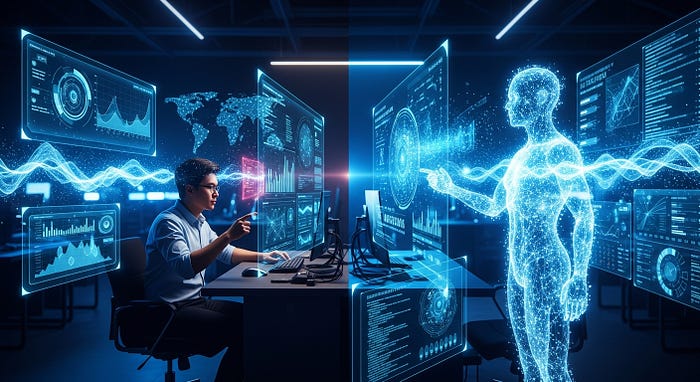

Cybersecurity has always been a race. Attackers move fast, defenders move faster, and somewhere in the middle sits the real challenge: making sense of overwhelming data before a threat becomes a crisis. For years, security teams have fought this battle with a combination of skilled analysts, alerting tools, threat intelligence feeds, and a lot of caffeine. But the scale of modern cyber risk has changed dramatically.
Organizations now generate enormous volumes of logs, alerts, endpoint signals, cloud events, identity records, network telemetry, and user behavior data. No human team, no matter how talented, can manually inspect everything in real time. That reality has opened the door for a new class of defenders: AI security analysts.
These are not robots replacing cybersecurity professionals. They are intelligent systems designed to support, accelerate, and sometimes automate the work that human analysts have historically done. Their rise is changing not just how security operations work, but how security itself is understood.
AI security analysts are becoming one of the most important developments in modern defense. They are helping teams detect suspicious behavior faster, reduce noise, prioritize incidents, and respond with more consistency. In many organizations, they are turning overwhelmed security operations centers into more agile, informed, and scalable defense hubs.
What makes this shift so significant is not just the technology itself. It is the fact that security has reached a point where speed, context, and scale matter more than ever. AI fits that environment naturally.
What Is an AI Security Analyst?
An AI security analyst is a system that uses artificial intelligence techniques to assist in cybersecurity tasks. Depending on the platform, it may analyze alerts, correlate events, identify anomalies, summarize incidents, recommend actions, or even automate parts of incident response.
Think of it as a digital teammate that never gets tired, never stops scanning, and can process massive amounts of information in seconds. It does not "think" like a human analyst, but it can recognize patterns, compare behaviors, and flag activity that looks unusual or risky.
In some environments, AI security analysts are built into security information and event management systems, extended detection and response platforms, cloud security tools, or identity monitoring tools. In others, they appear as conversational assistants that help analysts query data in plain language and generate incident summaries.
The important point is this: the AI security analyst is not a single product. It is a role, a capability, and a new layer in the cybersecurity stack.
Why the Demand Is Growing
The rise of AI security analysts did not happen by accident. It is a direct response to several pressures hitting security teams at the same time.
First, the attack surface has exploded. Companies no longer defend just a few servers and laptops. They defend cloud workloads, mobile devices, SaaS applications, APIs, remote employees, third-party access, and shadow IT. Every new technology adds more telemetry and more risk.
Second, the volume of alerts has become unmanageable. Security tools are great at detecting possible issues, but they are often too sensitive. That creates a flood of alerts, many of which are false positives or low priority. Human analysts spend too much time sorting through noise.
Third, attackers are faster and more automated than before. Phishing campaigns, credential stuffing, malware deployment, reconnaissance, and lateral movement can all happen at machine speed. Human-only defense often cannot keep up.
Fourth, there is a talent shortage. Skilled security analysts are in high demand, and many organizations struggle to staff 24/7 operations. AI helps fill the gap by covering repetitive work and extending the reach of existing teams.
Finally, boards and executives now expect stronger security outcomes with better efficiency. They want reduced risk, faster response, and better visibility without endlessly increasing headcount. AI is appealing because it promises scale.
The Core Jobs AI Security Analysts Can Do
AI security analysts are most effective when they take over repetitive, high-volume, and time-sensitive tasks. These are the areas where machine assistance has the greatest impact.
One of the most valuable functions is alert triage. Security tools may generate thousands of alerts, but only a small number require immediate attention. AI can help sort those alerts by severity, confidence, asset importance, user history, and behavioral context.
Another major function is event correlation. A single failed login might mean nothing. But a failed login followed by a suspicious token request, followed by an unusual geolocation, followed by a privilege escalation attempt is a different story. AI is good at connecting those dots across data sources.
AI can also assist with anomaly detection. It can identify unusual patterns in network traffic, endpoint behavior, user logins, file access, cloud permissions, or data movement. The value here is not just spotting something "odd," but spotting it early enough to matter.
Incident summarization is another powerful use case. Security incidents often involve hundreds of log lines, alerts, and actions. AI can turn that raw data into a concise timeline, helping analysts understand what happened much faster.
AI systems can also recommend next steps. For example, they may suggest isolating a device, disabling an account, revoking a token, blocking an IP, or opening a high-priority investigation ticket. In more mature environments, they can even trigger response playbooks automatically under defined conditions.
Threat hunting support is another promising area. Instead of manually writing every query from scratch, analysts can ask AI to search for suspicious behavior, identify outliers, or generate hypotheses based on observed indicators.
How They Change the Security Operations Center
The security operations center has traditionally been a place of constant pressure. Analysts sit in front of alert dashboards, tickets, and logs, trying to decide what matters first. AI changes that rhythm.
Instead of spending most of the day on sorting and searching, analysts can spend more time on investigation and decision-making. The AI handles the heavy filtering. The human handles the judgment.
This shift improves efficiency in several ways. Triage becomes faster. Context becomes clearer. Escalations become more consistent. Response times improve because analysts are not buried under irrelevant alerts.
AI also helps reduce burnout. Security operations can be exhausting, especially when teams face alert fatigue and repetitive work. By removing some of the most monotonous tasks, AI allows analysts to focus on higher-value work. That makes the job more sustainable.
Another benefit is consistency. Humans are affected by fatigue, stress, distraction, and experience gaps. AI applies rules and learned patterns the same way each time. That does not make it perfect, but it does make it consistent.
There is also a training advantage. Junior analysts can learn faster when AI explains why an alert matters, what behavior looks suspicious, and what evidence supports a decision. In that sense, AI becomes a teaching layer, not just a productivity tool.
Why Human Analysts Still Matter
The rise of AI security analysts does not mean the end of human security work. It means the work is changing.
Security is not only about pattern recognition. It is also about judgment, context, ethics, business impact, and adversarial thinking. Human analysts understand organizational nuance in ways AI cannot fully replicate.
For example, an AI may identify an unusual access pattern. A human may know that the behavior is actually related to a planned migration or emergency maintenance window. Without that context, AI could raise unnecessary alarms.
Humans are also essential in ambiguous situations. Attackers deliberately blend into normal activity. They disguise malicious actions as routine behavior. They use legitimate tools for illegitimate purposes. A skilled analyst can interpret subtle cues, challenge assumptions, and ask the right questions.
There is also the matter of trust. In high-stakes environments, people need to know why a system reached a conclusion. If an AI says a host is compromised, the team needs to understand what evidence drove that assessment. Human oversight remains critical.
And when it comes to decision-making, accountability stays human. If an organization isolates a production system, notifies customers, or reports an incident to regulators, those actions need responsible human approval.
The future is not AI versus humans. It is AI plus humans, with each doing the work they are best suited for.
The Best AI Security Analysts Are Augmented, Not Autonomous
One of the most important ideas in this space is augmentation. The strongest security teams are not handing over control to a black box. They are building systems where AI supports human expertise.
That means the AI might handle first-pass triage, but a human confirms the response. The AI might correlate events, but a human interprets the business impact. The AI might draft an incident summary, but an analyst reviews it before escalation.
This model is safer, more flexible, and more realistic. Full autonomy sounds impressive, but cybersecurity is too adversarial and too high-stakes to depend entirely on machine judgment.
Augmentation also creates a feedback loop. Human analysts correct the AI. The AI learns from those corrections. Over time, the system improves. That is how mature security operations evolve: not by replacing expertise, but by scaling it.
Common Technologies Behind AI Security Analysts
Several technologies power this new generation of security tools.
Machine learning is one of the foundations. It helps identify patterns in large datasets and detect anomalies that might not be obvious through static rules alone.
Natural language processing is another key capability. It allows analysts to ask questions in plain language, summarize incidents, or extract meaning from unstructured text such as email content, chat logs, or ticket notes.
Large language models have added a new dimension. They can explain events, draft reports, create investigation summaries, and help translate technical findings into business language. This is especially helpful for teams that need to communicate quickly with executives or non-technical stakeholders.
Behavioral analytics is also important. Instead of looking only at signatures or known indicators, these systems track how users, devices, and applications normally behave. Deviations from that baseline can reveal compromise.
Graph-based analysis is increasingly useful too. Threats often involve relationships between identities, devices, IP addresses, files, and domains. Mapping those relationships can reveal attack paths and hidden connections.
Automation engines tie everything together. Once the AI identifies a likely issue, the automation layer can execute playbooks, open tickets, isolate assets, or notify the right team.
The Benefits for Organizations
The business case for AI security analysts is compelling.
They improve speed. Faster triage and faster investigation lead to faster response, which often means smaller incidents and lower damage.
They improve scale. A small team can cover more data, more assets, and more alerts without growing at the same pace as the environment.
They improve consistency. AI helps standardize how alerts are handled and how evidence is summarized.
They improve focus. Human analysts can spend time on meaningful investigations instead of endless noise.
They improve resilience. When staff are unavailable, overloaded, or working across time zones, AI can continue monitoring and prioritizing.
They can also improve reporting. Security leaders need dashboards, trends, and summaries that make sense at a glance. AI can help turn messy operational data into something readable and actionable.
From a budget perspective, AI can be attractive because it helps maximize the value of existing teams. It is often easier to justify a tool that multiplies analyst capacity than to justify endless headcount growth.
The Risks and Limitations
Despite the promise, AI security analysts are not magic. They have real limitations.
False positives still exist. An AI can misclassify activity and overreact to harmless behavior. That can waste time and create unnecessary disruption.
False negatives are even more dangerous. If an AI misses a subtle attack, teams may develop a false sense of security. That is why validation and human review remain essential.
Training data matters. If a model learns from incomplete, biased, or outdated data, its outputs can become unreliable. Security environments change constantly, so models must be maintained carefully.
Attackers can also try to manipulate AI systems. They may poison data, evade detection patterns, or exploit weaknesses in prompts and automated workflows. An AI system is itself part of the attack surface.
Explain ability is another concern. If a tool cannot justify its conclusions, analysts may struggle to trust it. In security, blind trust is dangerous.
Then there is privacy. AI systems often require access to sensitive logs, identities, communications, and endpoint information. That creates governance requirements around data handling, access control, retention, and compliance.
Cost can also become an issue. Advanced AI systems may require significant licensing, compute, integration, and tuning effort. They are not always a plug-and-play solution.
How Security Teams Should Adopt AI Responsibly
The smartest approach is gradual and intentional.
Start with low-risk, high-value use cases. Alert triage, incident summarization, and investigation support are good places to begin. These areas provide clear benefits without requiring full autonomy.
Keep humans in the loop for critical decisions. AI should assist with investigation and prioritization, not replace authorization and oversight.
Measure outcomes carefully. Track time to triage, time to containment, alert reduction, analyst workload, and false positive rates. The goal is not just "using AI." The goal is improving security performance.
Test the system against real scenarios. Security teams should challenge AI with benign edge cases, known incidents, and adversarial simulations to understand where it fails.
Maintain clean data pipelines. Good AI depends on good data. If logs are inconsistent, incomplete, or duplicated, the AI will struggle.
Document response logic. Teams should know what actions the system can take, under what conditions, and who approved those workflows.
Train staff to work with AI. Analysts should understand how to prompt, verify, challenge, and interpret outputs. AI literacy is becoming a core security skill.
The New Skill Set for Security Analysts
The rise of AI is not shrinking the value of analysts. It is expanding the skill set required to be effective.
Modern security analysts increasingly need to understand automation, data interpretation, and AI-assisted investigation. They still need the fundamentals of networking, identity, endpoints, malware behavior, cloud security, and incident response. But now they also need to know how to use AI tools well.
That means asking better questions, checking outputs, spotting hallucinations, validating evidence, and integrating AI into established workflows. Analysts who can combine technical depth with AI fluency will be especially valuable.
Communication also matters more. AI may generate a summary, but a human still has to explain the risk, justify the decision, and coordinate the response. That requires clarity, confidence, and business awareness.
In practice, the best analysts of the future may not be the ones who know the most commands by memory. They may be the ones who know how to direct intelligent systems, validate findings, and make decisions under pressure.
What the Future Looks Like
The future security analyst will likely work alongside AI every day.
Routine investigations will become faster. Dashboards will become more conversational. Incident summaries will be generated automatically. Response playbooks will be more adaptive. Threat hunting will become more accessible.
Security operations will feel less like sifting through endless noise and more like steering an intelligent detection environment.
That said, the future will not be fully automatic. Cybersecurity is too dynamic, too adversarial, and too consequential for that. Attackers adapt. Business systems change. Regulations evolve. Human oversight will remain central.
What will change is the ratio. Humans will spend less time doing mechanical tasks and more time making strategic decisions. AI will absorb the operational load that has historically slowed teams down.
Organizations that embrace this model early will have an advantage. They will detect faster, respond better, and use their security talent more efficiently. The ones that ignore it may find themselves overwhelmed by scale.
The Real Story Behind the Rise
The rise of AI security analysts is not really a story about technology taking over cybersecurity. It is a story about security finally getting the assistance it has needed for years.
Cyber defense has become too large, too fast, and too complex to rely on manual effort alone. AI offers a practical answer to that problem. It helps teams see more, sort faster, and act sooner.
But the strongest message is this: AI is not replacing the security analyst. It is redefining the analyst's role.
The analyst of the future is less of a data janitor and more of a strategist, investigator, and decision-maker. AI handles the volume. Humans handle the judgment. Together, they create a stronger defense than either could alone.
That is why the rise of AI security analysts matters. Not because machines are taking over, but because security teams finally have a way to fight machine-speed threats with machine-speed support.
And in cybersecurity, that may be the difference between reacting late and responding in time.
Before You Go
If this article helped you think differently or gave you something practical to try, drop a "YES" in the comments. I genuinely read them, and they shape what I build and write next.
If you believe more people should see content like this, a clap and follow really helps. It supports independent creators and helps this work reach the right audience.
Thank you for taking the time to read till the end.
A Personal Note from Vijay Kumar Gupta
Hey, I'm Vijay Kumar Gupta.
I'm the Founder of EINITIAL24 and Digital GitHub, where I work on building practical tools, writing ebooks, and sharing real-world knowledge around technology, cybersecurity, automation, and digital growth.
I also run the In-Public Community on Discord, a space where builders, developers, and learners openly share ideas, experiments, and lessons — without fake hype or gatekeeping.
Beyond writing, I host a podcast on YouTube, where I talk about tech, startups, money, tools, and the realities behind building in public. I also write a regular newsletter on LinkedIn, sharing insights, learnings, and behind-the-scenes experiences that don't always make it into public posts.
You'll often find me:
- Sharing insights and experiments on Instagram and Facebook
- Publishing code, tools, and technical knowledge on GitHub
- Writing long-form articles on Medium
- Documenting my journey and work on my personal website
- Selling practical digital products and tools on Gumroad
- Publishing ebooks and guides on Kindle and Google Books
Everything I share is based on hands-on experience — what worked, what failed, and what I learned along the way. No sponsors, no shortcuts, just consistent effort to help others learn faster by avoiding the mistakes I already made.
If you'd like to support this work:
- Follow me across platforms where I share regularly
- Join the community and newsletter to stay connected
- And if this post helped you, clap, follow the writer, and share it with someone who might benefit
More tools, more stories, and more lessons coming soon. 🚀