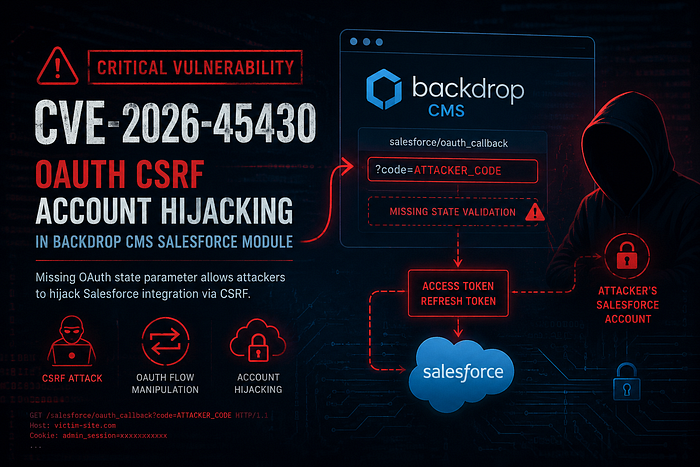
The issue exists because the OAuth authorization flow fails to implement proper CSRF protections using the state parameter required by RFC 6749.()
- CVE: CVE-2026–45430
- CWE: CWE-352 (Cross-Site Request Forgery)
- Affected Component:
backdrop-contrib/salesforce - Fixed Version:
1.x-1.0.1 - CVSS v3.1: 7.1 High ()
Official advisory: Backdrop Security Advisory CVE record: CVE-2026–45430
Understanding the Vulnerability
OAuth flows are built on trust.
That trust collapses if applications fail to validate the authorization process properly.
In the vulnerable implementation, the Salesforce OAuth flow did not generate or validate a cryptographically random state parameter. ()
The advisory describes the issue clearly:
"does not properly use a random state parameter" ()
This seemingly small omission introduces a CSRF condition directly into the OAuth authorization flow.
Why the OAuth state Parameter Matters
The OAuth state parameter exists specifically to prevent authorization CSRF.
Without it, the application cannot determine whether an authorization response actually belongs to the legitimate user session that initiated the login process.
Salesforce itself documents CSRF as a major risk in authorization workflows. ()
In secure implementations:
- The application generates a random state token
- The token is stored server-side
- The token is sent during OAuth authorization
- The callback validates the returned state value
In the vulnerable implementation, step 4 never existed.
Real Attack Scenario
This vulnerability is more dangerous than a normal CSRF.
The issue enables OAuth session binding attacks.
An attacker can:
- Start an OAuth authorization flow using their own Salesforce account
- Obtain a valid authorization code
- Send a crafted callback URL to a victim administrator
- Force the target website to exchange the attacker-controlled code for valid tokens
Example malicious request:
GET /salesforce/oauth_callback?code=ATTACKER_CODEBecause no state validation occurs, the application accepts the attacker's authorization code as legitimate.
At this point:
- the victim website becomes linked to the attacker's Salesforce account
- synchronization operations occur under attacker control
- sensitive data may be exposed
- record integrity can be compromised
This transforms a "simple CSRF" into a full OAuth trust violation.
Additional Security Weakness
The advisory also noted another important design issue.
The OAuth callback endpoint permissions were overly permissive:
'access arguments' => ['access content']According to the advisory, this made the callback accessible to most authenticated users and potentially anonymous users depending on site configuration. ()
That significantly increased the reachable attack surface.
CVSS Analysis
The vulnerability received a CVSS 3.1 score of 7.1 High. ()
Vector:
CVSS:3.1/AV:N/AC:H/PR:N/UI:R/S:U/C:H/I:H/A:LImportant details:
- Network exploitable
- No privileges required
- Requires user interaction
- High confidentiality impact
- High integrity impact
Even though the attack complexity is rated High, the practical exploitation path is realistic because OAuth callback phishing is extremely common in real-world environments.
The Patch
The issue was fixed in version 1.x-1.0.1. ()
The proper mitigation includes:
- generating cryptographically random OAuth state values
- validating returned state parameters
- restricting callback endpoint permissions
Conceptually:
if (!valid_oauth_state($_GET['state'])) {
    deny_access();
}
This single validation restores the integrity of the OAuth flow.
Why This Vulnerability Matters
Many developers think OAuth security is only about protecting tokens.
In reality, OAuth security starts much earlier; during authorization flow integrity validation.
A missing state parameter can completely break authentication trust boundaries.
This vulnerability is a strong example of how one overlooked security control can turn an integration feature into an account hijacking primitive.
Final Thoughts
OAuth implementations are security-critical infrastructure.
The state parameter is not optional defense-in-depth; it is a fundamental requirement of secure OAuth design.
CVE-2026–45430 demonstrates how authorization CSRF can evolve into full third-party integration compromise when trust validation is missing.
If your application implements OAuth:
- always validate
state - restrict callback exposure
- verify redirect ownership
- treat OAuth flows as authentication boundaries
Small mistakes in OAuth logic often become high-impact vulnerabilities.
Muhammedali Aliyev | swordmein