
Senior developers aren't losing value — they're just stepping back to beginner status in a new arena. And most of us aren't prepared for that reset. Seniority used to be about abstraction. Now it's about precision. The two are fundamentally different skills — and if you spent a decade optimizing for one, you might be starting from scratch on the other.
I have a colleague who has been in Tech for over 10 years with experience at big tech companies as a Senior Engineer (Backend) and recently failed to get a job after participating in a system design interview. He did so with no issues due to experience and lack of fundamental knowledge but because he offered a solution to the interviewers but the interviewers did not believe it was the right idea.
He was visibly shaken up after that interview when we caught up for coffee the other day.
"My solution was clean, scalable, and well thought out. I did solve the problem…it just was not their problem."
After I caught up with him, he lost the job to someone far less experienced. The other candidate only had 3 years experience in the industry. The difference was simple: The other person had experience working with the exact tools, frameworks, and ecosystem as the interviewers' team.
There are no grand theories or "perfect systems" — just an immediate fit.
My experience in watching this scenario reveals that there has been a shift going on that is slowly transforming the Tech industry today.
So What Actually Broke? (It's Not "AI Changed Everything")
The easy, lazy answer is to blame the AI wave. I've seen a hundred takes that start and end there. But that framing is mostly wrong, and believing it prevents you from doing anything useful about your situation.
The real culprit is something I'd call context collapse.
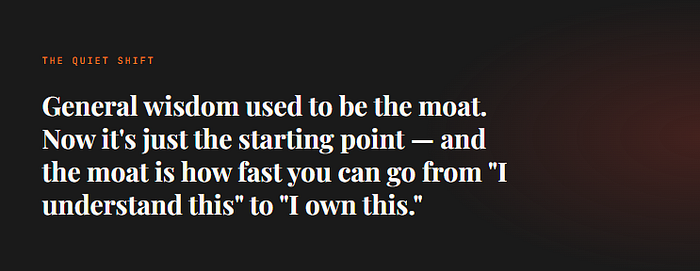
For years, decades, even seniority was built on transferable capital: broad system design experience, pattern recognition accumulated over years, the institutional memory of knowing what not to build. These were genuinely valuable things, and companies rewarded them.
But the contract quietly changed.
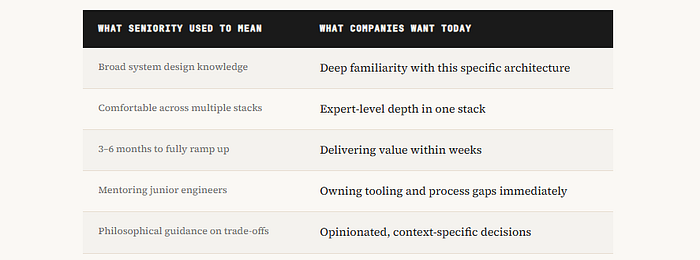
Senior Engineers Are Still Interviewing Like It's 2015
Here's where I'll say something that might sting a little: a significant chunk of senior engineers are still playing by rules that have quietly expired.
The old interview playbook optimized for clean abstractions, textbook architectures, and the kind of measured "it depends" wisdom that signals deep experience. And it worked — for a long time.
But watch what companies are actually rewarding now:
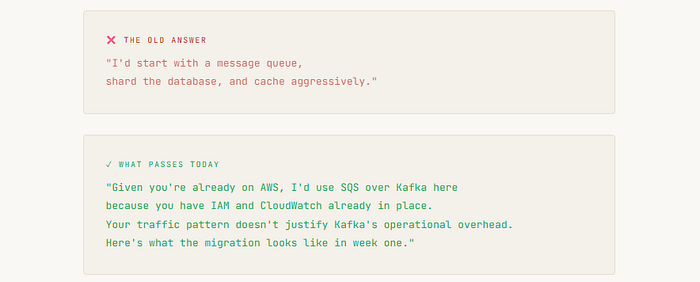
Same underlying knowledge. Completely different framing. One signals broad experience. The other signals that you've already solved their specific problem somewhere before — or that you'll waste zero time getting up to speed.
Confidence in context now beats correctness in the abstract. That's a hard adjustment to make if your instincts were trained in an era that rewarded the opposite
AI Didn't Replace You — It Commoditized What Made You Look Senior
Now, about AI. I said earlier that blaming AI is too easy, and I stand by that. But it's not entirely irrelevant — it just plays a more specific role than people claim.
AI didn't take senior engineers' jobs. What it did was quietly devalue the signals that looked like seniority from the outside.
Things that once required years of accumulated experience — remembering specific syntax across languages, knowing common architectural patterns, explaining trade-offs between competing approaches — an LLM can now surface in seconds. That doesn't make a senior engineer worthless. But it does mean those things no longer differentiate them in the way they once did.

This Isn't Just Startups — Big Tech Does It Too
I want to be clear that this isn't some quirk of scrappy, impatient startups. The same dynamic plays out at scale.
Meta restructured multiple teams specifically to favor engineers who could be immediately productive within product verticals, rather than those who needed time to build context across the broader system. Amazon's legendary bar-raiser interview process may screen for a high standard — but internally, the engineers who thrive are the ones who master Amazon's specific way of building things, fast.
Experienced engineers who joined both companies reported the same cognitive dissonance: I knew how to build systems. I just didn't know how they build systems. And that gap mattered far more than I expected.
What You Can Actually Do About It
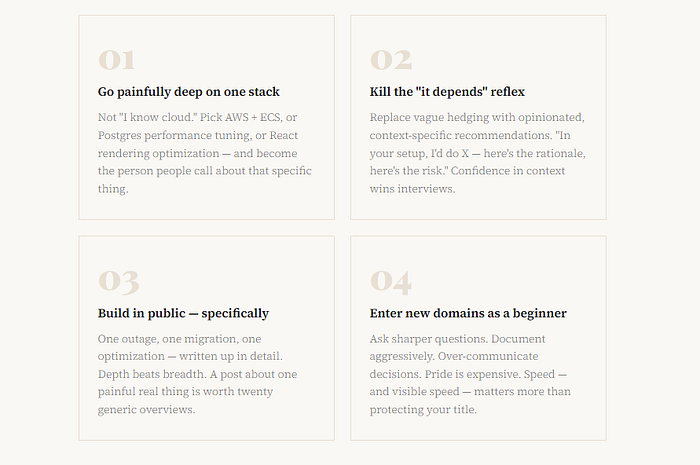
I'm not writing this to leave you in a dark room. Here are four things that actually move the needle — not inspirational platitudes, but concrete adjustments.
The Uncomfortable Truth Worth Sitting With
Seniority is no longer a shield. It's not a guarantee of respect, relevance, or even basic competence signaling when you walk into a room with an unfamiliar system. The senior engineer who survives this shift isn't the one who knows the most in the abstract. It's the one who adapts the fastest without pretending they already know. That combination — intellectual humility paired with genuine speed — is the actual differentiator right now.
That's hard. That's genuinely humbling. And it's where the industry is heading whether we like it or not.
Pretending that shift didn't happen won't shield you from it. But recognizing it for what it is — and choosing to adjust with intention — is still completely in your control.
Thanks for Reading!
If you found this useful: Clap for the article, it helps others discover it Follow me for more practical guides on analytics, web development, and real-world engineering solutions Leave a comment if you'd like a deep dive into any specific Matomo feature
I regularly share hands-on content about: Information technology, / Web, / Analytics, / NodeJS / Nest.js / React / Next.js, / System design, / real project learnings.