
The rise of AI , Agents and Cloud is accelerating Voice innovation and Transformation in many forms . We should expect to be less transport focussed only and becomes a programmable, policy-aware, AI-native built on IMS, 5G Core exposure, edge computing, and hybrid AI execution across device, edge and cloud. 3GPP already positions IMS as the service platform for VoLTE and VoNR; ETSI MEC formalises low-latency edge execution close to radio access; GSMA Open Gateway is standardising the commercial exposure of network capabilities such as identity, location and quality-on-demand; and 3GPP has now added an AI/ML Enablement Service in Release 19.
Turning Voice into a trusted software platform
Telco's must monetise AI-enhanced calling itself:
- In-call translation, captions
- Intelligent call steering
- Enterprise AI agents
- Branded Verified calling
- Multimodal support sessions
- Network-backed identity checks that OTT voice stacks cannot easily reproduce.
"AI voice in telecom" explicitly frames IMS data channel as a route to real-time translation, transcription, AI call agents and call screening inside the call session, while GSMA Open Gateway exposes the identity and network quality primitives that make those experiences more trustworthy and commercially distinctive.
For architects, the key design choice is equally clear: hybrid wins by default. Live conversational loops should remain as close as possible to the user or the mobile core; high-latency or non-critical work should move to regional or hyperscale cloud; and devices should increasingly handle local wake-wording, VAD, fallback STT/TTS, privacy pre-processing and limited offline assistance. Operationally, the biggest shift is from AI as an application to AI as an operating discipline. Voice transformation will fail if the model layer is treated as the architecture. The stack must include identity, tool mediation, policy enforcement, content safety, observability, provenance, cost control, model evaluation, fallback routing, and telecom-grade service continuity.
A final governance point matters immediately. In the EU, AI Act implementation is phased: general-purpose AI obligations and governance requirements already entered the timeline before full roll-out. At the same time, GDPR, the ePrivacy Directive, the European Electronic Communications Code and NIS2 remain highly relevant to telco voice data, session metadata, resilience and customer communications.
Industry demand and drivers
The strategic force behind telco voice transformation is not one trend but the convergence of five.
- The first is cloud-native voice modernisation. IMS remains the service platform behind VoLTE and VoNR.
2. The second is network exposure as a monetization layer. 5G Core already includes exposure, policy and authentication functions such as the NEF, PCF and AUSF, and 3GPP's capability-exposure work is aimed at allowing applications to leverage and influence network capabilities. GSMA Open Gateway turns that direction into commercial API packages, including Number Verification, SIM Swap and Quality on Demand.This is strategically important because AI voice products become more defensible when they can use network-backed identity, network-backed QoS and network-backed location rather than only internet application context.
3. The third is realtime AI maturity. OpenAI's realtime stack is built for live low-latency audio and can connect via WebRTC, WebSocket and SIP; Google's Live API is designed for real-time voice and vision interaction; and Microsoft's Voice Live API integrates speech recognition, generative AI, TTS, action triggers and avatars into a single low-latency voice interface. That means the architecture problem has shifted from "can the models do this?" to "where should each part of the pipeline run, and who controls trust, cost and service assurance?".
4. The fourth is carrier-edge viability. ETSI MEC exists precisely to place compute close to access networks, and current operator and hyperscaler platforms now present multiple execution venues: AWS Wavelength for low-latency workloads at CSP edges, Google Distributed Cloud for on-premises and air-gapped execution, Azure Operator Nexus for carrier-grade hybrid deployment, and operator-native edge and core stacks
5. The fifth is trust pressure. Synthetic voice abuse is accelerating. The FCC has already confirmed that AI-generated voices fall under existing unlawful robocall restrictions in the US, while GSMA is pushing Open Verifiable Calling to bind caller identity and intent more tightly into voice communications. NIST has separately highlighted the continuing need for reliable synthetic-speech detection and argues that provenance tracking and synthetic-content detection are important governance mechanisms. For telcos, this makes trust a product requirement, not a legal afterthought.
The Voice Business Models
For business it means new strategies and arenas of growth .
- The first is revenue expansion through premium voice propositions: multilingual calling, in-call assistance, authenticated enterprise calling, industry-specific voice agents, and exposed network capabilities sold alongside AI services.
- The second is Operational leverage: better containment in care journeys, more efficient agent assist, faster post-call summarization, and AI-driven network automation.
- The third is Service differentiation: lower-latency, more reliable, policy-governed voice experiences that can be delivered inside native telephony sessions rather than as fragile over-the-top workarounds.
Enterprise Architecture blueprint
The fundamental principle of architecture is separate the call-critical path from the call-adjacent path, and place each function where its latency, privacy and resilience profile best fits. The call-critical path should include session control, VAD, streaming STT, turn management, short-horizon reasoning, moderation, selective tool use and low-latency TTS.
The call-adjacent path should include retrieval over larger corpora, post-call summarisation, quality analytics, training, evaluation, billing enrichment, and bulk governance workflows. This pattern is strongly implied by current low-latency voice APIs, telco-edge platforms, and cloud-native IMS capabilities.
In telco terms, the architecture has five interacting planes. The session plane contains access, SIP/WebRTC mediation, IMS and SBC functions. The network plane contains the 5G Core itself, including policy, exposure and authentication. The AI execution plane contains device, edge and cloud runtimes for STT/TTS, multimodal reasoning, orchestration and tool use. The trust plane contains identity, safety, provenance and audit. The operations plane contains tracing, evaluation, SLOs, cost telemetry and lifecycle automation. 3GPP's 5G system overview, IMS voice architecture, capability exposure work and AI/ML enablement work all point in this direction; vendor platforms then provide the currently shippable implementation venues.
Reference architecture
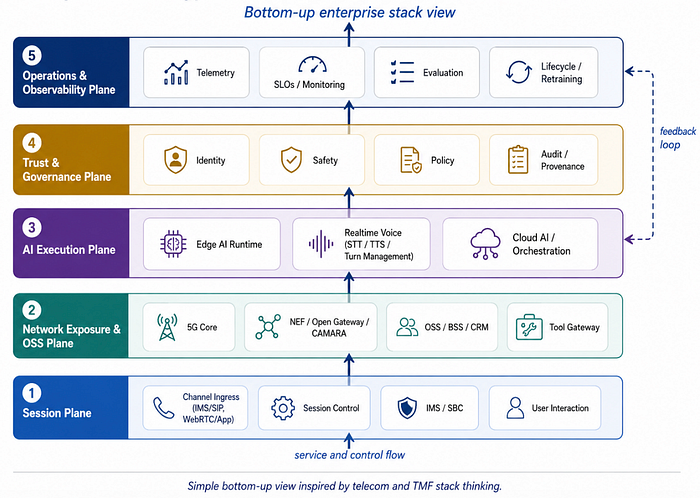
- The session ingress should accept both native telco and internet-native channels. For operators that want to stay inside traditional voice journeys, IMS and SIP remain primary. For web, app and CPaaS journeys, WebRTC and WebSocket ingress matter. OpenAI's SIP support is strategically notable because it shows how modern realtime model sessions can be bound directly to telephony call flows, while Microsoft's Voice Live API uses WebSockets for server integration and remains compatible with Azure's realtime event model.
2. The network integration layer should be treated as a first-class product capability, not as back-office plumbing. The 5G system overview explicitly calls out policy control, network exposure and authentication functions, while Open Gateway standardises commercially useful APIs such as Number Verification and Quality on Demand. In architectural terms, that means the AI orchestrator should not call the NEF or CAMARA endpoints directly from a model runtime. Instead, a bounded tool gateway should expose vetted actions such as "verify subscriber", "check SIM swap risk", "request QoD", "fetch device location", "open CRM case", or "handover to agent".
3. The AI execution layer should be split by latency class. On-device functions should include wake-word detection, local VAD, packet buffering, acoustic clean-up, partial PII masking, and degraded-mode STT/TTS where available. The edge tier should run live STT/TTS, interruption handling, language locking, short-turn reasoning, tool pre-checks, and fast safety policy. The regional cloud tier should handle heavier reasoning, cross-call memory, knowledge retrieval, summarization, evaluation, model routing and long-horizon workflows.
4. The multimodal layer should be optional but native. Google's Live API is already designed for voice and vision; OpenAI's realtime models support image input in live sessions; Microsoft's Voice Live stack brings speech, avatars and action triggers into one interface; and Ericsson's AI voice use cases explicitly include customer support sessions where cameras and visual cues can augment a live call. For telcos, the important design point is not to make every call multimodal. It is to design a session architecture in which vision, device telemetry, network quality, and location can be added without replacing the voice control plane.
5. The observability layer must unify telecom and AI telemetry. AI observability is now formal enough that OpenTelemetry has semantic conventions for generative AI and agent spans, Microsoft Foundry captures inputs, outputs, tool usage, retries, latencies and costs. In a telco implementation, every production session should join at least these identifiers: customer pseudonym, SIP Call-ID or IMS session ID, model session ID, tool invocation IDs, policy decision ID, and billing reference. That is the only way to debug cross-domain failures such as "translation succeeded but QoD request failed" or "tool call returned but speech loop breached latency SLO".
The deleivery path for industry must be hybrid: device for local privacy and resilience, edge: for conversational critical path, cloud: for heavy reasoning and optimisation and performance: 3GPP resilience and performance . Edge-first should be reserved for premium, regulated or in-call augmentation scenarios where latency, data locality or resilience to WAN disruption is decisive.
Cloud-first is appropriate for rapid launch, non-carrier-grade bots, and early-career experimentation, but becomes harder to defend at scale once QoE, audit and unit economics come under pressure.
Security, trust and governance
The security baseline must start with the telecom substrate. 5G service-based architecture relies on mutual authentication and TLS between network functions and token-based authorisation using OAuth 2.0, while 3GPP's 5G security work continues to extend assurance specifications across core functions. The architectural implication is that AI services attached to voice sessions should inherit telco identity and policy context through controlled interfaces rather than bypassing it through side channels.
Identity for AI voice should be multi-layered. GSMA Open Gateway and CAMARA now provide Number Verification and related fraud-prevention APIs, and Ericsson's silent-authentication pattern shows how passwordless or low-friction verification can use network-held subscriber knowledge rather than weaker SMS OTP flows. For high-risk journeys, that network layer should be combined with device posture, SIM-change checks, session history.
Policy enforcement should be model-adjacent, not model-embedded. Provider guardrails are valuable: Bedrock Guardrails can filter harmful content and protect sensitive information; Azure AI Content Safety moderates harmful text and image content; and Google and Microsoft both now frame AI governance as a formal enterprise control plane. But a telco still needs a provider-neutral policy gateway of its own for action authorization, retention checks, emergency-call exceptions, disclosure rules, customer-consent enforcement, and jurisdiction-specific routing.
Provenance and audit need special attention because the medium is voice. NIST's AI RMF and related guidance explicitly point to provenance tracking and synthetic-content detection as mechanisms that improve information integrity and accountability, while C2PA's Content Credentials aim to provide cryptographically secure provenance for digital assets, including audio. In practice, live telephony still needs additional operator controls because provenance standards for stored media do not by themselves verify the caller in real time. The best design is therefore dual-track: real-time caller trust through telco identity and verified-calling controls, plus post-event content provenance and audit through signed artefacts, model/version logs, retrieval traces and immutable decision records.
Synthetic-voice defence has to be layered for the same reason. NIST has noted the need for reliable synthetic-speech detection in realistic conditions; the FCC has ruled that AI-generated voices fall under existing unlawful robocall restrictions; and GSMA's Open Verifiable Calling is an operator-led attempt to reintroduce cryptographic trust into voice identity.
Compliance should be designed as a matrix, not a checklist. In the EU, GDPR and the ePrivacy Directive set the baseline for personal data and electronic communications privacy; the EECC shapes electronic communications obligations; NIS2 raises expectations on security and resilience; and the AI Act adds risk-based AI obligations and transparency requirements, with milestones already in motion and content-transparency rules applying from 2 August 2026.
Telecom-specific obligations must remain hard constraints. Emergency communications and lawful interception are not optional side cases; they are core duties in many markets. 3GPP continues to maintain IMS emergency-session specifications, and ETSI's lawful-interception committee exists precisely because communications providers operate under explicit legal obligations. Architecturally, that means AI orchestration must never obscure emergency routing, lawful intercept triggers, or regulator-mandated evidence flows.
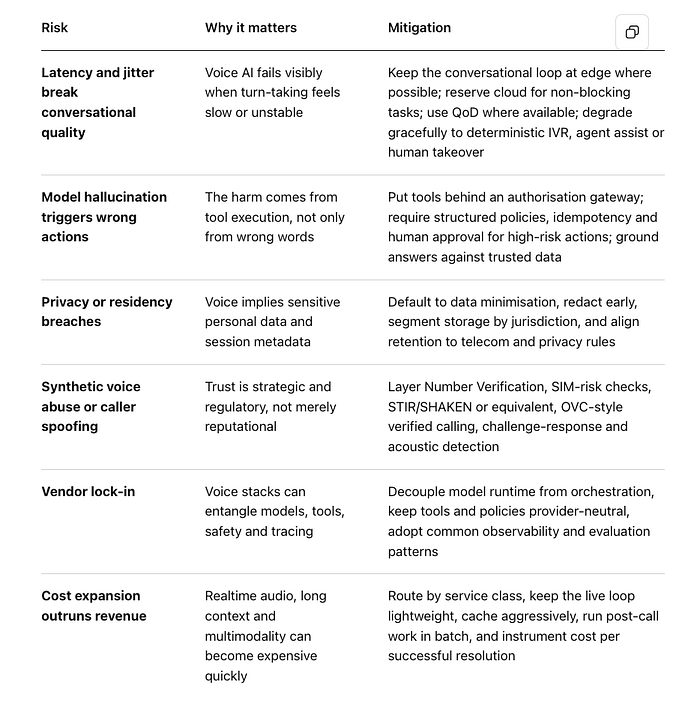
Risk Framework
As CSP accelerate to integrate Voice and AI , the governance and Risk control will be critical . A definitive and transparent communication on whether voice is AI voice to real verified voice becomes a key in today's trust deficit economy.
KPI Framework
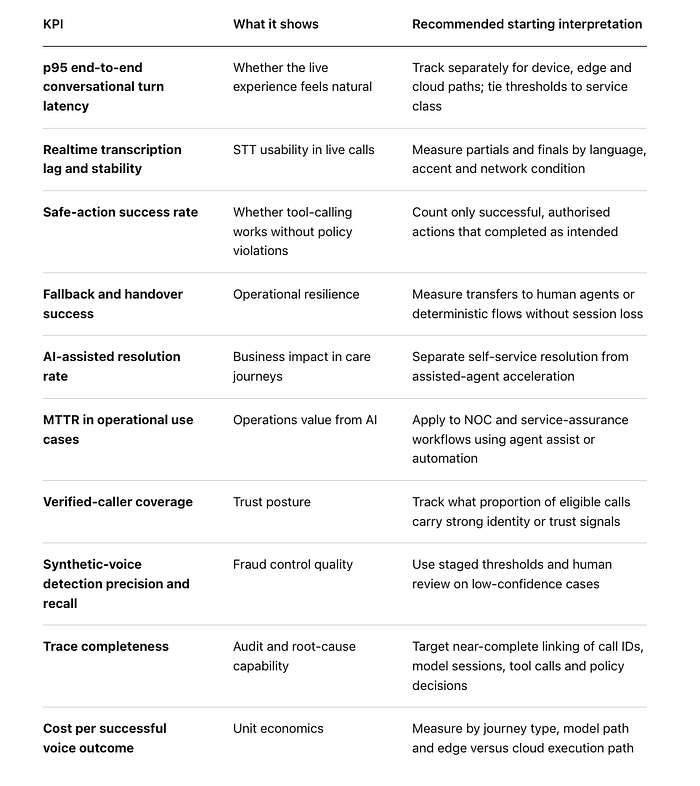
And of course you should define and build new service KPI framework to deliver it . Remember
What gets measured gets delivered .
Conclusion:
The right way to think about telco voice through 2030 is not AI inside the contact centre. It is voice as a network-grade digital platform. IMS, 5G Core exposure, MEC and network identity finally give operators a route to offer AI voice experiences with a mix of trust, quality control, latency discipline and regulatory adaptability that is difficult for pure OTT stacks to match.
The most important architectural decision is therefore not which model vendor to buy first. It is whether to build a voice transformation platform or a collection of demos. From an architecture perspective, the recommendation is decisive: adopt a hybrid reference stack now, keep the conversational critical path near the user or the mobile core, expose network capabilities through bounded tools, and make provenance, audit, identity and observability non-negotiable from day one.
Operators that do this well will arrive at 2030 with a reusable AI voice platform. Operators that do not are likely to accumulate brittle point solutions that are expensive to run, hard to trust and difficult to govern.
References:
https://www.gsma.com/newsroom/gsma_resources/ng-134-ims-data-channel-v3-0/