Password reset looks like a simple feature.
A user forgets their password, enters their email, receives a reset link, creates a new password, and continues using the application.
From the outside, the process feels safe.
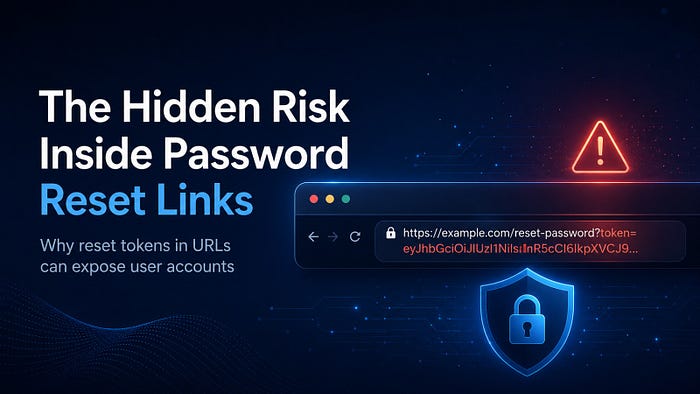
But behind this simple flow, there is one small detail that can create a serious security risk: the reset token inside the URL.
A typical password reset link may look like this:
https://example.com/reset-password?token=abc123
At first glance, this seems normal. Many applications use this pattern. The problem is not that reset links exist. The problem starts when the token inside the link becomes exposed.
A password reset token is not just a random string. For a short time, it can act like a temporary key to the user's account. If someone gets access to that token before it expires, they may be able to reset the password without knowing the original password.
That is why password reset security should never be treated as a small support feature. It is part of application security.
How can reset tokens leak?
Reset tokens in URLs can appear in places developers may not think about.
They can be saved in browser history. They may appear in server logs. They can be captured by analytics tools. They may leak through Referer headers when a user clicks another link from the reset page. They can also be exposed through screenshots, shared devices, or third-party scripts running on the page.
In many cases, the user may never know that the token was exposed.
This is what makes the issue dangerous. The reset flow may look secure on the screen, but the token may already be stored or shared somewhere else in the background.
Why this matters for real applications
Modern applications depend heavily on account recovery. SaaS platforms, customer portals, admin dashboards, healthcare systems, ecommerce stores, and mobile apps all need password reset flows.
If the reset process is weak, attackers may not need to break the login system directly. They can target the account recovery process instead.
A weak password reset flow can lead to account takeover, privacy violations, unauthorized access, and loss of user trust.
For businesses, this is not only a technical problem. It can also become a compliance, reputation, and customer trust issue.
What developers should do
Password reset tokens should be designed carefully.
A secure reset token should expire quickly. It should be usable only once. It should be generated with strong randomness. It should be invalidated after use. The system should apply rate limiting to prevent abuse. After a password reset, old active sessions should also be invalidated.
Developers should also avoid exposing reset tokens to unnecessary systems. Reset pages should be kept clean, especially from third-party tracking scripts. Sensitive token values should not be logged. Applications should also use HTTPS everywhere.
The goal is simple: even if someone tries to abuse the reset process, the system should limit the damage.
A better way to think about password reset
Password reset is not just an email feature.
It is a high-risk security workflow.
When a user clicks a reset link, the application is temporarily trusting that link as proof of access. That means the token inside the link must be protected with the same seriousness as a login credential.
Small mistakes in this flow can create big security problems.
So before launching any web app or mobile backend, developers should ask:
Is the reset token short-lived? Is it one-time use? Can it leak through logs or analytics? Are old sessions invalidated after reset? Is the reset page free from unnecessary third-party scripts?
If the answer is no, the account recovery system needs improvement.
Final thought
A password reset link may look harmless, but the token inside it can become a temporary key to the account.
Secure authentication does not end at the login page. It also includes every recovery path that can give access back to the user.
That is why password reset security deserves more attention than it usually gets.
Original detailed guide: https://sentrixhub.com/password-reset-tokens-in-urls-security-risks/