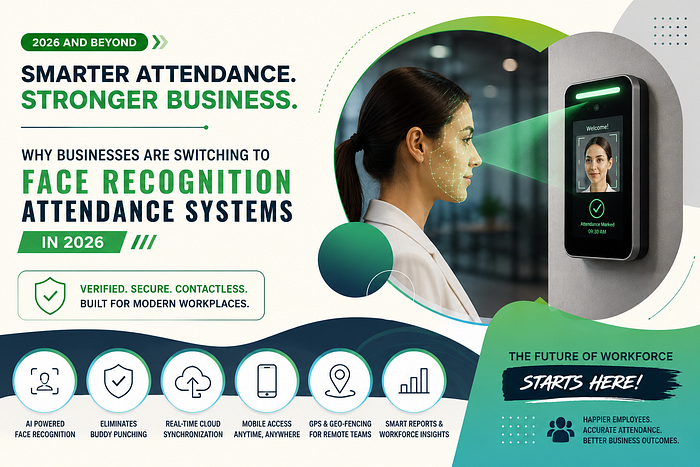

The modern workplace is changing faster than ever before. Businesses are adopting automation, artificial intelligence, cloud computing, and smart workforce management tools to improve productivity and stay competitive. Among these innovations, one technology that is rapidly transforming workforce operations is the face recognition time clock.
In 2026, companies are no longer satisfied with outdated attendance methods that rely on manual entries, swipe cards, or traditional fingerprint devices. These systems often create problems like buddy punching, payroll errors, long check-in queues, and inaccurate attendance records. To solve these issues, organizations are increasingly investing in a smarter facial recognition clock in system that combines AI-powered security with real-time workforce monitoring.
The shift is not just about convenience. Businesses now need attendance solutions that are secure, contactless, scalable, and suitable for hybrid work environments. A face recognition attendance system offers all these advantages while improving transparency and operational efficiency.
As workforce management becomes more digital in 2026, face recognition technology is quickly moving from a "nice-to-have" feature to an essential business tool.
The Rise of Smart Workforce Management in 2026
Over the last few years, the way businesses manage employees has changed dramatically. Hybrid work models, remote teams, flexible schedules, and distributed offices have become the new normal.
Traditional attendance systems were not designed for this level of flexibility. Many businesses discovered that manual tracking methods could no longer keep up with modern workforce demands.
This is why companies are turning toward intelligent workforce management systems powered by artificial intelligence and biometrics.
A modern face recognition time clock allows businesses to:
- Monitor attendance in real time
- Track employees across locations
- Eliminate attendance fraud
- Improve payroll accuracy
- Automate workforce reporting
Businesses in 2026 are focusing heavily on efficiency and automation. Face recognition attendance systems align perfectly with these goals because they reduce manual work while providing accurate workforce data instantly.
What is a Facial Recognition Clock In System?
A facial recognition clock in system is an AI-based attendance solution that identifies employees using their facial features and automatically records their attendance.
Employees simply stand in front of a camera, and the system instantly verifies their identity. The process takes only a few seconds and requires no physical contact.
The technology works through:
- Facial mapping algorithms
- Artificial intelligence
- Machine learning
- Cloud-based synchronization
Unlike traditional systems, face recognition uses unique facial patterns that are difficult to duplicate or manipulate.
This makes the system:
- Highly secure
- Extremely accurate
- Faster than conventional attendance methods
In 2026, businesses are prioritizing systems that provide both convenience and security, which explains the growing popularity of facial recognition attendance solutions.
Top Reasons Businesses Are Switching in 2026
1. Elimination of Buddy Punching and Attendance Fraud
Buddy punching remains one of the biggest hidden costs for businesses. Employees sometimes mark attendance for absent coworkers using cards, passwords, or older biometric systems.
A face recognition time clock completely eliminates this issue because facial features are unique to every employee.
Modern systems also include:
- Liveness detection
- Anti-spoofing technology
- AI-powered fraud prevention
This ensures employees cannot use:
- Photos
- Videos
- Printed images
to fake attendance.
As businesses focus more on operational transparency in 2026, eliminating attendance fraud has become a major priority.
2. Demand for Contactless Attendance Solutions
The demand for touch-free workplace technology has increased significantly in recent years.
Traditional fingerprint systems require physical contact, which creates hygiene concerns and increases device wear over time.
A facial recognition clock in system allows employees to mark attendance without touching any surface. This creates a cleaner, safer, and more convenient workplace environment.
Businesses now view contactless systems as part of their long-term workplace modernization strategy rather than a temporary trend.
3. Growth of Hybrid and Remote Work
One of the biggest reasons businesses are switching in 2026 is the rise of hybrid work models.
Employees are no longer confined to a single office location. Teams now work:
- Remotely
- On-site
- Across multiple branches
- In the field
A cloud-enabled face recognition system allows businesses to track attendance from anywhere.
Many systems now include:
- Mobile attendance apps
- GPS verification
- Geo-fencing capabilities
This flexibility makes workforce tracking significantly easier for modern organizations.
4. Real-Time Workforce Visibility
Businesses in 2026 rely heavily on real-time data for decision-making.
A smart face recognition time clock provides instant workforce insights such as:
- Employee attendance
- Shift status
- Late arrivals
- Overtime tracking
- Absenteeism reports
Managers no longer need to wait for manual updates or paperwork.
Real-time visibility improves:
- Workforce planning
- Productivity monitoring
- Operational efficiency
5. Faster and More Efficient Attendance Tracking
Nobody wants employees standing in long queues during office entry hours.
Modern facial recognition systems can identify employees within seconds, even during peak attendance periods.
This improves:
- Employee experience
- Office entry flow
- Shift management
Fast attendance processing becomes especially important for:
- Factories
- Corporate offices
- Retail stores
- Large enterprises
where hundreds or thousands of employees clock in daily.
6. Better Payroll Accuracy
Payroll errors can create frustration among employees and increase administrative workload for HR teams.
Since face recognition attendance systems automatically record precise attendance data, businesses can reduce:
- Salary disputes
- Manual corrections
- Payroll miscalculations
Accurate attendance records ensure fair and reliable payroll processing.
7. Increased Security and Access Control
In 2026, businesses are not just using face recognition for attendance — they're also using it for workplace security.
A facial recognition clock in system can integrate with:
- Door access systems
- Visitor management software
- Security monitoring platforms
This ensures only authorized individuals can enter restricted areas.
For industries handling sensitive operations or confidential data, this added security is extremely valuable.
Industries Rapidly Adopting Face Recognition Attendance Systems
Corporate Offices
Companies use face recognition systems to automate attendance and improve workforce transparency.
Manufacturing and Industrial Units
Factories with multiple shifts benefit from faster and more accurate attendance tracking.
Construction and Field Operations
Remote attendance and GPS verification help manage field workers efficiently.
Retail and Hospitality
Businesses use facial recognition to manage employee schedules during busy operating hours.
Healthcare and Educational Institutions
Hospitals and schools use the technology to improve attendance management and security.
Challenges Businesses Still Need to Consider
Even though the technology is highly beneficial, businesses should still address certain concerns.
Privacy and Data Protection
Employees may worry about how facial data is stored and used.
Businesses should ensure:
- Encrypted storage
- Secure cloud systems
- Compliance with data protection laws
Initial Setup Investment
Face recognition systems may require higher upfront costs compared to traditional attendance systems.
However, long-term savings from automation and fraud reduction usually justify the investment.
The Future of Facial Recognition Attendance Systems
The future of workforce tracking is becoming increasingly intelligent.
Upcoming advancements may include:
- AI-powered workforce analytics
- Emotion and behavior analysis
- Multi-biometric authentication
- Smart office integration
In the coming years, face recognition systems will likely evolve into complete workforce management platforms rather than simple attendance tools.
Businesses adopting this technology early will gain a strong operational advantage in an increasingly digital workplace.
Conclusion
Businesses in 2026 are switching to face recognition time clock systems because traditional attendance methods can no longer meet the demands of modern workforce management.
A smart facial recognition clock in system offers:
- Better accuracy
- Real-time tracking
- Enhanced security
- Contactless convenience
- Improved operational efficiency
As organizations continue embracing automation and AI, face recognition attendance systems are becoming an essential part of smarter workforce management.
For businesses looking to improve productivity, reduce fraud, and modernize operations, the transition to facial recognition technology is no longer a future trend — it's happening right now.
FAQs
1. What is a face recognition time clock?
It is an AI-powered attendance system that identifies employees using facial recognition and records attendance automatically.
2. Why are businesses adopting facial recognition clock in systems in 2026?
Businesses are switching to improve accuracy, eliminate fraud, support hybrid work, and automate workforce management.
3. Can face recognition systems prevent buddy punching?
Yes, facial recognition uses unique biometric data, making it extremely difficult for employees to fake attendance.
4. Are face recognition attendance systems suitable for remote teams?
Yes, many systems support mobile attendance with GPS and cloud integration for remote workforce tracking.
5. Is employee data secure in facial recognition systems?
Modern systems use encrypted storage and secure cloud platforms to protect employee biometric data.