
Context
During a recent technical discussion within the CyberSphere Community, we explored a critical shift in modern attacks: attackers are no longer focused only on stealing passwords.
They are targeting tokens.
The focus was not authentication.
It was trust after authentication.
Not because login systems are weak.
But because once access is granted, systems rely on tokens to maintain that trust.
The session was designed for beginners and cybersecurity learners who want to understand how attackers bypass login completely by stealing authentication tokens.
Session Objective
The discussion focused on:
Understanding what authentication tokens are Breaking down how attackers steal and reuse tokens Explaining why token-based systems introduce new risks Understanding how defenders can secure token usage
What Token Theft Really Means
Token theft occurs when an attacker obtains a valid authentication token and uses it to access a system.
Tokens are used after login to maintain user sessions.
Examples include:
Session cookies JWT tokens OAuth access tokens
If a token is valid, the system assumes the user is authenticated.
No password required.
Why Attackers Prefer Token Theft
Modern systems rely heavily on tokens for authentication.
Tokens are:
Reusable Often long-lived Stored in browsers or applications Trusted by systems without reauthentication
Security systems monitor login attempts.
Token usage often appears legitimate.
Attackers don't break authentication.
They bypass it.
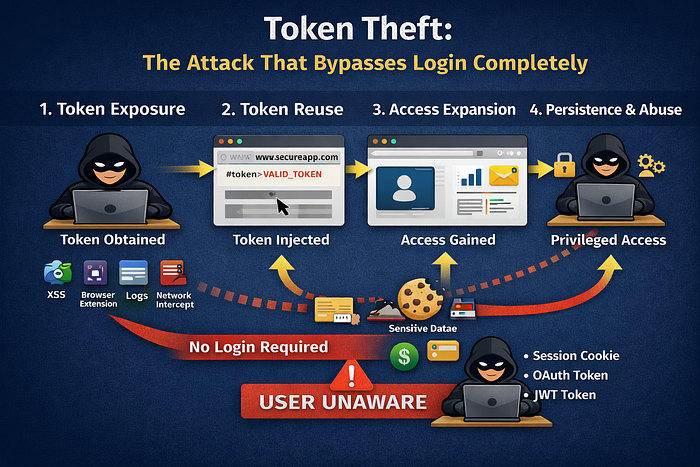
The Four Phases of Token Theft
1. Token Exposure
The attacker obtains the token.
This can happen through:
XSS attacks Malicious browser extensions Insecure storage (local storage, logs) Network interception
The goal is simple:
Get the token.
2. Token Reuse
The attacker uses the stolen token.
They inject it into their own environment.
The system sees a valid token.
Access is granted.
3. Access Expansion
The attacker explores what access the token provides.
They check:
User privileges Connected services Available data
If the token belongs to a privileged account, the impact increases.
4. Persistence and Abuse
The attacker continues using the token until it expires or is revoked.
They can:
Access sensitive data Perform actions as the user Maintain long-term access
All activity appears legitimate.
Why Token Theft Still Works in 2025
Despite stronger authentication systems, token theft remains effective because:
Tokens are stored insecurely Token expiration is not enforced properly Monitoring focuses on login events Applications trust tokens blindly Developers prioritize usability over security
Authentication is strong.
Session management is weak.
What Defenders Should Actually Focus On
Instead of only securing login systems, organizations should:
Use short-lived tokens Implement secure storage mechanisms Bind tokens to devices or sessions Monitor abnormal token usage Revoke tokens after suspicious activity Avoid storing tokens in insecure locations
Security must extend beyond login.
The Beginner Mindset Shift
If you are learning cybersecurity, understand this:
Stealing credentials is not always necessary.
Stealing access is enough.
Tokens represent trust.
Attackers target trust.
Key Takeaways
Tokens allow access without repeated authentication Token theft bypasses login completely Stolen tokens appear legitimate Monitoring token usage is critical Security must focus on session and token control
Attackers don't always log in.
Sometimes, they simply continue an existing session.
Closing Thought
The question is not:
"Is the login secure?"
The real question is:
"What happens after login?"
Because in modern attacks, that is where the real risk begins.
Acknowledgement
Thanks to Harsh Kanojia, Founder of the CyberSphere Community, for encouraging discussions focused on modern identity-based attack techniques and practical cybersecurity awareness.
Author
Naman Shah Cybersecurity postgraduate focusing on secure systems, threat modeling, and applied security education.