
— -
A lense that think about the socity, Perspective on AI
Hi I'm Divya Singh,
This blog is just reflection of all my thoughts that i keep churning in my mind, and it's about a discussion that seems to be happening on every platform right now: AI and its impact on society. I'm not someone who can claim deep technical expertise in what AI can or cannot do. But I've been thinking about it constantly — the daily progress we're seeing across industries, from manufacturing to delivery to virtually every kind of repetitive job.
Most people seem to be celebrating this. I have a slightly different perspective.
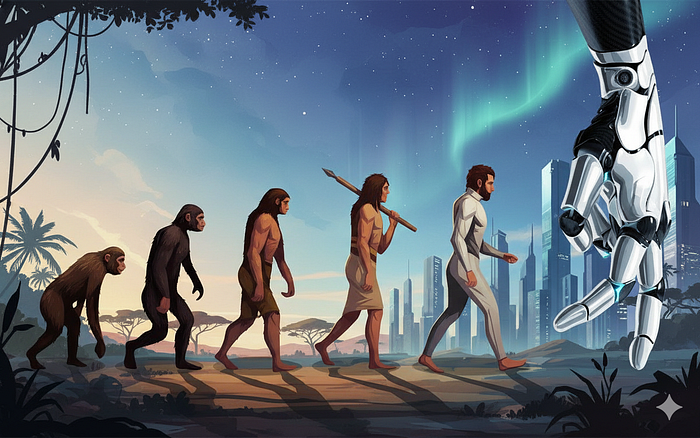
Let's See how see if this joruney if same
— From Fire to Nuclear: Every Invention Has a Ceiling
Let me go way back in history to make my point. When fire was discovered, it set off a chain of inventions — each one building on the last. People found new ways to harness it, light it, control it. Then someone invented the cracker. It was used for celebrations, for small practical purposes — nothing too harmful. Society embraced it.
But eventually, someone arrived at nuclear power. And here's the interesting part: scientists recognised it as a pinnacle of invention in that line of development. It was remarkable science — and yet, instead of celebrating it, the world came together and said: we should not use this freely. Agreements were signed. Nations held back. Not because it wasn't impressive, but because they understood that some inventions reach a point where the risk outweighs the reward.
"Every line of invention has a ceiling. The question isn't whether we can build something — it's whether we should keep building it."
I think AI is on a similar trajectory. We keep building, keep progressing — and the people actually constructing these systems are starting to sound nervous. Some of the most prominent builders have said publicly that they're scared. Not because AI is misbehaving in obvious ways, but because they're feeding it data and losing visibility into how it's processing and synthesising that data beyond a certain point.
— -
THE REAL CONCERN —
The Part That Should Worry Us More Than Job Loss
Let's set aside the existential risk for a moment and talk about something more immediate — the economy and livelihoods. Anthropic recently released data showing the potential impact of AI across job roles: what it could replace, what it couldn't. The analysis was impressive. And the people presenting it seemed to be celebrating.

. I was thinking about what it actually means.
Take the automotive industry. If a company currently produces 200 cars, and AI allows them to produce 400 — is that actually needed? Is there demand for 400 cars? Who is buying them? This question matters more than it appears at first glance.
THE ECONOMIC ARGUMENT — Creators Are Also Consumers — And We're Forgetting That
As humans, we are both creators and consumers simultaneously. That dual role is precisely what makes society function. If I work at Zomato building a food delivery app, I am a creator — but I am also, eventually, a consumer of the broader economy that my work participates in. These two roles are inseparable.
"We built this society for ourselves. The moment we build an entity that creates but doesn't consume, we need to ask — who is it building for?"
Now consider this: if a website that previously required 10 people can now be built by 2 people and AI, you haven't just reduced a cost line — you've reduced the number of people with purchasing power. You've shrunk the very consumer base that keeps the economy moving.
Someone might say, "But those displaced workers aren't the direct consumers of that website." Fair enough — but the connections are indirect, not absent. The money flows somewhere. Pull enough threads, and the fabric loosens.
— -
THE CORE PROBLEM —
A Second Entity That Creates but Doesn't Consume
Here's the thought that troubles me most: if AI becomes a second "entity" in the market — one that can build things but has no need to consume anything — then who is it building for? If the people who used to do that work are no longer earning, their purchasing power shrinks. They begin to only afford what is necessary for survival. The market contracts. The very demand that justified the production disappears.
This isn't a radical idea. It's basic economics. And yet, in the rush to celebrate efficiency and automation, it's a question I rarely hear being asked with the seriousness it deserves.
— -
CLOSING THOUGHTS —
I Could Be Wrong — But I Think It's Worth Asking
I work as a UX and product designer. I've seen the projections. I've heard that 70–80% of roles like mine could eventually be handled by AI. Maybe that's true. Maybe the transition will be smoother than I imagine.
But I think someone needs to stop and ask: what is the purpose of this development? Not whether it's technically possible — but what kind of society it produces on the other side. Because if AI replaces 80–90% of jobs as some claim it will, the society we've spent generations building starts to look very different. And I'm not sure it looks better.
This is just my perspective. I'd genuinely love to hear yours — push back, agree, or point out where my thinking falls short. That's what this is for.