
Traditional security tooling — static scanners, signature-based detection engines, and manual penetration testing — was designed for a world of conventional applications, predictable infrastructure, and human-driven workflows.
That world is changing rapidly.
Today's systems increasingly rely on:
- autonomous AI agents
- LLM-powered workflows
- MCP servers
- AI coding assistants
- cloud-native infrastructure
- complex software supply chains
- compiled binaries without source access
At the same time, attackers are evolving just as quickly.
Modern threats are no longer limited to:
- SQL injection
- XSS
- dependency vulnerabilities
We're now seeing:
- prompt injection attacks
- repo poisoning
- AI workflow hijacking
- AI supply chain manipulation
- firmware-level exploitation
- autonomous agent abuse
- binary-level vulnerabilities hidden deep inside compiled systems
And while enterprise security vendors race to adapt, some of the most innovative security tooling is quietly emerging from the open-source community.
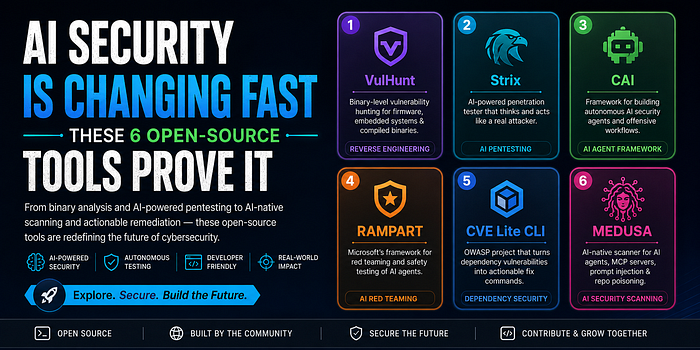
In this article, we'll explore five powerful open-source cybersecurity tools that are pushing security in entirely new directions — from binary vulnerability hunting and AI-powered penetration testing to AI-native security scanning and developer-first remediation workflows.
These are not just traditional scanners with new branding.
Many of these tools fundamentally rethink how security testing works.
Note
BlackArch Linux We also provide a ready-to-deploy BlackArch Linux VM that can be launched instantly on AWS, GCP, or Azure. No installation, setup, or dependency management required — just spin it up and start using a full arsenal of penetration testing and security auditing tools in minutes.
Kali GUI Linux Our Kali GUI Linux VM comes fully pre-configured with a graphical interface, making it easy for both beginners and professionals to get started. Deploy directly on AWS, GCP, or Azure with zero setup — no installation hassles, just immediate access to a complete offensive security toolkit.
Browser-Based Kali Linux We offer a browser-based Kali Linux environment that runs entirely in the cloud. Simply deploy and access it from your browser — no downloads, no local setup, no compatibility issues. Deploy directly on AWS, GCP, or Azure with zero setup — no installation hassles, just immediate access to a complete offensive security toolkit. Perfect for quick testing, learning, and remote security operations from anywhere.
ParrotOS Linux Our ParrotOS Linux VM is optimized for security, privacy, and development workflows. Available for instant deployment on AWS, GCP, and Azure, it eliminates the need for manual installation — giving you a secure, ready-to-use environment in just a few clicks.
1. VulHunt — Binary-Level Vulnerability Hunting Without Source Code
Modern software ecosystems increasingly rely on compiled binaries:
- firmware
- embedded systems
- proprietary applications
- third-party software
- closed-source infrastructure
But analyzing compiled software securely is extremely difficult — especially without access to source code.
That is exactly the problem VulHunt was designed to solve.
Developed by Binarly's Research team, VulHunt Community Edition is an open-source vulnerability hunting framework built specifically for:
- compiled binaries
- firmware analysis
- low-level reverse engineering
- binary security research
Unlike traditional source-code scanners, VulHunt works directly on:
- machine code
- intermediate representations (IR)
- decompiled binaries
This makes it highly valuable for:
- firmware analysts
- reverse engineers
- malware researchers
- supply-chain security teams
Why VulHunt Is Interesting
Most modern security tooling focuses heavily on:
- APIs
- cloud security
- web applications
- dependency scanning
Binary-level vulnerability hunting remains significantly underdeveloped in open-source ecosystems.
VulHunt helps fill that gap.
Its multi-layered analysis engine correlates insights across:
- disassembled code
- decompiled representations
- IR analysis
to improve vulnerability discovery accuracy.
The framework also includes a Lua-powered rule engine that allows researchers to define reusable vulnerability hunting logic for:
- buffer overflows
- unsafe memory operations
- authentication bypasses
- firmware weaknesses
- low-level binary behaviors
Real-World Use Cases
VulHunt is especially useful for:
- firmware security research
- third-party software auditing
- supply-chain analysis
- reverse engineering workflows
- embedded device security
- UEFI module analysis
Installation
git clone https://github.com/vulhunt-re/vulhunt.git
cd vulhunt
cargo make --profile release build
./target/release/vulhunt-ce --help
Why It Matters
As software supply-chain risks continue growing, binary-level visibility is becoming increasingly important.
VulHunt represents a growing trend toward:
deeper infrastructure-level security analysis beyond traditional application scanning.
We already published a detailed guide on VulHunt covering its architecture, binary analysis engine, firmware vulnerability hunting workflows, installation process, and open-source contribution setup. For a deeper explanation and hands-on walkthrough, you can check out our full blog.
2. Strix — The AI-Powered Pentester That Behaves Like a Real Attacker
Traditional security scanners often operate using:
- predefined signatures
- rule-based checks
- static vulnerability matching
But real attackers don't behave like static scanners.
They:
- explore applications dynamically
- chain vulnerabilities together
- manipulate workflows
- test business logic
- Validate exploitability manually
Strix was designed around this exact idea.
Instead of acting like a conventional scanner, Strix behaves more like an autonomous penetration tester.
It actively:
- navigates applications
- explores attack surfaces
- manipulates requests
- tests authentication flows
- validates exploit paths
- generates proof-of-concepts
This makes it feel closer to:
an AI-assisted offensive security operator than a traditional vulnerability scanner.
What Makes Strix Different
1. Proof-of-Concept Validation
Most scanners produce noisy findings.
Strix attempts to validate issues using real exploitation workflows before reporting them.
This significantly reduces false positives.
2. Multi-Agent Security Testing
Strix can deploy multiple agents simultaneously across:
- APIs
- frontend flows
- infrastructure
- authentication systems
This creates broader and faster attack surface coverage.
3. Real Offensive Security Workflows
The framework includes:
- browser automation
- HTTP proxying
- terminal access
- Python execution
- reconnaissance tooling
- static + dynamic analysis
This allows Strix to simulate real attacker behavior rather than simple pattern matching.
Vulnerabilities Strix Can Discover
Strix supports detection for:
- IDOR vulnerabilities
- privilege escalation
- XSS
- SSRF
- SQL injection
- JWT issues
- business logic flaws
- deserialization bugs
- authentication weaknesses
Installation
curl -sSL https://strix.ai/install | bashConfigure environment:
export STRIX_LLM="openai/gpt-5.4"
export LLM_API_KEY="your-api-key"
Run scan:
strix --target https://your-app.comWhy It Matters
Security testing is increasingly moving toward:
- AI-assisted automation
- autonomous exploration
- continuous offensive validation
Strix represents one of the clearest examples of this shift happening in real-world tooling.
We already wrote a detailed guide on Strix explaining its AI-powered penetration testing workflows, browser automation, proof-of-concept validation system, installation steps, CI/CD integration, and contribution process. For a complete walkthrough and practical examples, check out our full blog.
3. CAI — The Open-Source Framework for AI Security Agents
AI is transforming cybersecurity rapidly.
But most security tooling still assumes humans remain fully in control of:
- testing
- investigation
- exploitation
- remediation workflows
CAI (Cybersecurity AI) takes a radically different direction.
Built by Alias Robotics, CAI is an open-source framework for building:
- AI-powered security agents
- autonomous pentesting systems
- offensive AI workflows
- AI-driven security orchestration
Think of it as:
an operating system for cybersecurity AI agents.
What CAI Enables
CAI agents can:
- perform reconnaissance
- discover vulnerabilities
- execute workflows
- coordinate with other agents
- automate security tasks
- assist human operators
The framework includes:
- 300+ AI model integrations
- multi-agent orchestration
- OpenTelemetry tracing
- tool integrations
- guardrails
- human-in-the-loop controls
Core Architectural Ideas
CAI uses:
- agents
- tools
- handoffs
- collaboration patterns
- execution cycles
- tracing systems
- guardrails
This creates highly flexible autonomous security workflows.
Real-World Use Cases
CAI has already been used for:
- bug bounty automation
- OT security testing
- robotics security research
- CTF competitions
- AI-assisted red teaming
Installation
python3.12 -m venv cai_env
source cai_env/bin/activate
pip install cai-framework
Run:
caiWhy It Matters
CAI represents one of the strongest signals that:
cybersecurity is moving toward autonomous AI-driven operations.
The future likely includes:
- AI pentesters
- AI defenders
- AI-assisted SOC workflows
- autonomous agent collaboration
CAI is helping build that infrastructure early.
We already covered CAI in detail, including its autonomous AI agent architecture, offensive security workflows, multi-agent orchestration, installation guide, integrations, and open-source contribution setup. For a better understanding and a deeper technical explanation, you can read our complete blog.
4. RAMPART — Microsoft's Framework for Red Teaming AI Agents
As AI agents become more autonomous, security testing is becoming dramatically harder.
Traditional application security testing was never designed for:
- agentic AI systems
- autonomous workflows
- multi-step AI reasoning
- adversarial prompt interactions
- harmful AI behaviors
That's where RAMPART enters the picture.
Built by Microsoft, RAMPART stands for:
Risk Assessment & Measurement Platform for Agentic Red Teaming
It is a pytest-native security testing framework designed specifically for:
- AI agents
- LLM applications
- adversarial AI testing
- safety evaluation
- harm-category validation
What Makes RAMPART Important
Most AI applications today are barely tested for:
- jailbreak resistance
- adversarial prompting
- harmful outputs
- unsafe workflows
- autonomous misuse
RAMPART introduces structured testing for:
- adversarial attacks
- benign failures
- AI safety behaviors
- security evaluation assertions
inside normal developer workflows.
Key Features
RAMPART provides:
- pytest-native integration
- evaluation-driven assertions
- harm-category testing
- AI safety validation
- red teaming workflows
- developer-friendly APIs
This makes AI security testing feel more like:
normal software testing infrastructure.
Why It Matters
As AI systems gain:
- filesystem access
- terminal execution
- API control
- autonomous reasoning
security testing must evolve beyond traditional AppSec models.
RAMPART is one of the earliest serious frameworks targeting:
structured security testing for agentic AI systems.
5. CVE Lite CLI — The OWASP Project Reimagining Dependency Security
Dependency security tooling has a serious UX problem.
Most scanners:
- dump CVEs into dashboards
- generate noisy CI failures
- create endless Dependabot PRs
- provide little remediation guidance
Developers often ignore the alerts entirely.
CVE Lite CLI approaches dependency security differently.
Instead of focusing primarily on detection, it focuses on:
actionable remediation.
Officially recognized as an OWASP Incubator Project, CVE Lite CLI is a local-first vulnerability scanner for:
- npm
- pnpm
- Yarn
- Bun
It scans lockfiles and generates:
- copy-and-run fix commands
- parent-aware dependency guidance
- offline advisory scanning
- transitive remediation suggestions
Why Developers Like It
The strongest feature is simple:
Instead of:
"This package is vulnerable."
It tells you:
"Run this exact command to fix it."
Example:
npm install lodash@4.17.21or:
npm update react-scriptsThat sounds simple, but it dramatically improves remediation workflows.
Key Features
CVE Lite CLI supports:
- offline advisory databases
- usage-aware reachability analysis
- SARIF generation
- HTML dashboards
- AI assistant integrations
- CI workflows
- transitive dependency analysis
Installation
npm install -g cve-lite-cliRun scan:
cve-lite .Generate report:
cve-lite . --reportWhy It Matters
The project reflects a major shift in AppSec philosophy:
detection alone is no longer enough.
Developer-focused remediation UX is becoming just as important as vulnerability discovery itself.
6. MEDUSA: AI-Native Security Scanning for AI Agents and MCP Ecosystems
As AI coding assistants and autonomous agents become deeply integrated into developer workflows, entirely new attack surfaces are emerging:
- prompt injection
- repo poisoning
- MCP manipulation
- AI workflow hijacking
- AI supply-chain attacks
Traditional security tools were never designed for these threats.
MEDUSA changes that.
MEDUSA is an AI-first security scanner built specifically for:
- AI agents
- MCP servers
- RAG pipelines
- AI coding assistants
- AI workflow systems
It includes:
- 9,600+ detection patterns
- prompt injection detection
- repo poisoning analysis
- AI context scanning
- MCP security analysis
- GitHub repository scanning
- AI supply-chain detection
One of its most interesting capabilities is detecting malicious instructions inside files like:
CLAUDE.md.cursorrulesAGENTS.mdmcp.json
These files are increasingly becoming attack vectors against AI systems.
We already published a detailed guide on MEDUSA Security Scanner covering prompt injection detection, repo poisoning analysis, MCP security scanning, GitHub repository scanning, installation, practical attack simulations, and contribution workflows. For a more detailed explanation and real-world examples, you can check out our full blog.
Final Thoughts
Cybersecurity tooling is undergoing a major transition.
The industry is moving from:
- static scanning
- reactive security
- human-only workflows
toward:
- AI-assisted testing
- autonomous security agents
- AI-native threat detection
- developer-first remediation
- supply-chain intelligence
- binary-level analysis
The most interesting part is that many of these innovations are happening in open source first.
Tools like:
- VulHunt
- Strix
- CAI
- RAMPART
- CVE Lite CLI
- MEDUSA
are not just incremental improvements.
They represent entirely new models for how security testing may work over the next decade.
And right now, most developers still haven't heard of them.
Thank you so much for reading
Like | Follow | Subscribe to the newsletter.
Catch us on
Website: https://www.techlatest.net/
Newsletter: https://substack.com/@techlatest
Twitter: https://twitter.com/TechlatestNet
LinkedIn: https://www.linkedin.com/in/techlatest-net/
YouTube:https://www.youtube.com/@techlatest_net/
Blogs: https://medium.com/@techlatest.net
Reddit Community: https://www.reddit.com/user/techlatest_net/