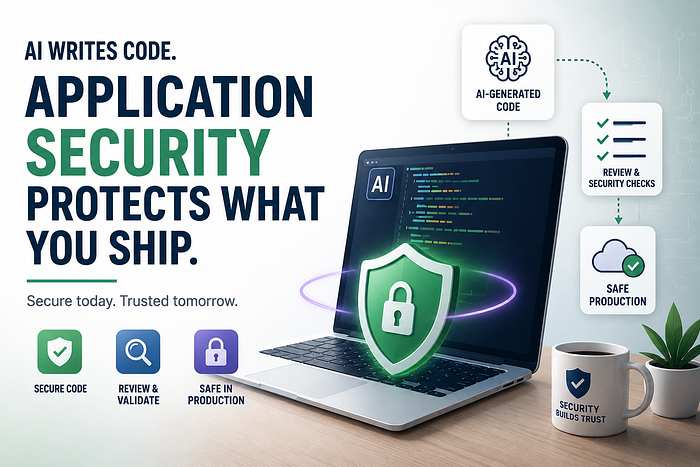
AI-assisted development has moved well past the experimental stage. Developers across startups, enterprises, and critical infrastructure vendors are using AI coding assistants daily to generate APIs, authentication flows, infrastructure templates, and entire application components. The productivity gains are real and measurable. But beneath the velocity lies a growing application security problem that the industry is systematically underestimating.
Functionality Is Not Security
There is a critical distinction that gets lost under deadline pressure. A working implementation is not necessarily a secure one.
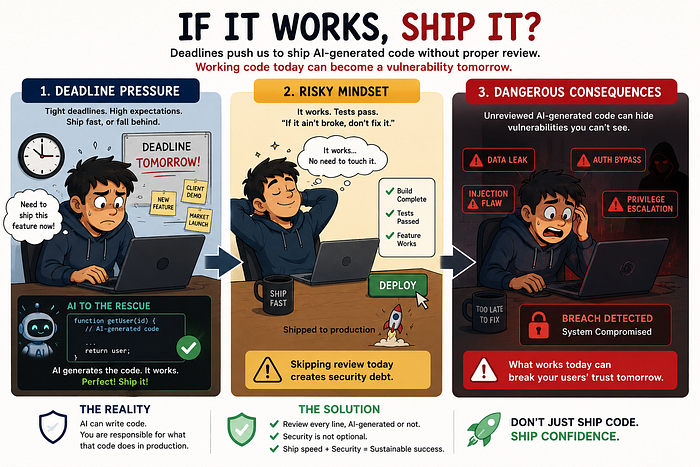
When developers accept AI-generated code, the typical validation criteria are functional. Does it compile? Does it pass tests? Does it produce the expected output? These are necessary checkpoints, but they are not sufficient.
A generated authentication flow can function perfectly while still containing broken authorization logic, weak session handling, hardcoded secrets, or missing input validation. A generated API can perform exactly as specified while exposing insecure deserialization or excessive permissions.
The real danger is not that AI produces insecure code. It is that AI-assisted workflows are quietly normalizing security-blind software development, where functional correctness becomes the implicit measure of implementation quality.

The Scale Problem: Vulnerabilities Propagate Faster Now
Before AI-assisted coding, insecure patterns spread slowly. Mistakes were largely localized, tied to individual developers, specific codebases, or limited knowledge transfer.
That dynamic has changed.
A single insecure AI-generated pattern, whether weak JWT handling, misconfigured CORS policies, or insecure API authorization, can now propagate rapidly through shared prompts, generated scaffolding, copied implementations, and organization-wide tooling adoption. AI does not just increase development speed. It increases vulnerability propagation speed as well.
This fundamentally changes the risk surface for application security teams.
The Psychological Risk: Automation Bias
The most concerning dimension of this problem is not technical. It is cognitive.
Humans naturally develop trust in systems that repeatedly appear competent. In software development, this manifests as developers assuming the AI probably handled it correctly, or that because it passed testing it must be fine.
Over time, this erodes adversarial thinking, which is the exact mindset that application security depends on. Secure developers constantly ask what happens if input is malicious, what if authentication is bypassed, what if trust boundaries collapse. AI-assisted workflows, optimized for speed and completion, can unintentionally suppress that skepticism.
This phenomenon, known as automation bias, is already well-documented in aviation and healthcare. It is now emerging in software engineering, and the security implications are significant.
Where Responsibility Sits
Addressing this imbalance requires structural changes across multiple layers.
Organizations need to treat AI-generated code as untrusted by default, integrate AppSec into AI-assisted pipelines, and resist the cultural pressure to equate faster generation with reduced review requirements.
Developers need to maintain adversarial security thinking regardless of code origin, validating generated authentication and authorization logic manually, reviewing dependencies, and understanding the security implications of what they ship.
AI model creators need to prioritize secure-by-default generation strategies, not just functional correctness and completion probability.
The Risk Ahead
The next significant application security incident may not originate from a sophisticated zero-day exploit. It may emerge from millions of lines of rapidly generated, insufficiently reviewed AI-assisted code quietly accumulating across production environments industry-wide.
Security debt is unlike technical debt in one important way. It typically remains invisible until it is actively exploited.
The goal is not to slow AI adoption. The productivity gains are too material to dismiss, and AI will become deeply embedded in engineering workflows regardless.
The goal is responsible acceleration, ensuring that application security practices evolve at the same pace as AI-assisted development and not lag behind it by years.
Because if AI is going to help build the infrastructure of the future, security must be part of the generation process itself, not something teams remember to check afterward.