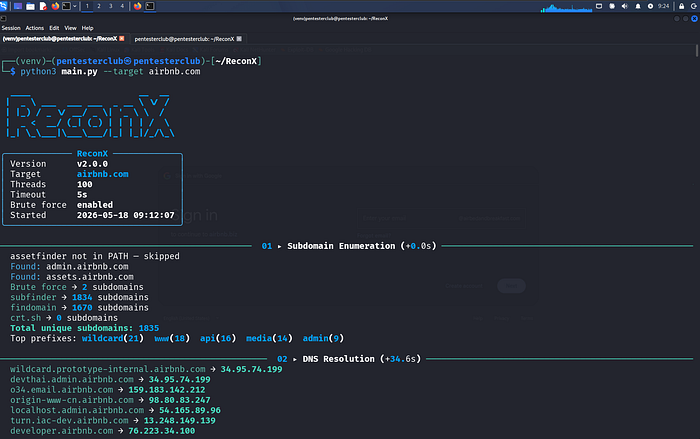
Bug bounty hunters spend countless hours repeating the same reconnaissance steps every single day — subdomain enumeration, alive host checks, port scanning, screenshot collection, vulnerability checks, and organizing results. While manual recon teaches valuable skills, scaling it across multiple targets becomes exhausting very quickly.
That's where ReconX comes into the picture.
Built as an automated reconnaissance framework, ReconX helps security researchers streamline bug bounty workflows and collect actionable intelligence faster. Instead of manually chaining dozens of tools together, ReconX centralizes the process into one organized automation pipeline.
The project is available on GitHub through ReconX GitHub Repository
What is ReconX?
ReconX is an automation-focused reconnaissance framework designed for:
- Bug bounty hunters
- Penetration testers
- Red team operators
- OSINT researchers
- Security enthusiasts
The framework automates multiple reconnaissance phases that are normally performed manually during target enumeration.
Rather than running individual tools one-by-one, ReconX orchestrates the workflow into a cleaner and more efficient process.
Why Recon Automation Matters
Modern attack surfaces are massive.
Organizations now operate:
- Hundreds of subdomains
- Multiple cloud services
- APIs
- CDN infrastructure
- Dev environments
- Exposed admin panels
- Third-party integrations
Manual reconnaissance simply cannot keep up at scale.
Automation provides several advantages:
- Faster target discovery
- Better coverage
- Consistent workflows
- Reduced human error
- Easier reporting
- Continuous monitoring possibilities
ReconX attempts to solve exactly this problem.
Key Features of ReconX
Based on the project's README and workflow design, ReconX focuses heavily on practical automation for real-world reconnaissance operations.
Automated Subdomain Enumeration
ReconX integrates multiple enumeration techniques to discover hidden subdomains efficiently.
This helps researchers identify:
- Forgotten applications
- Staging environments
- Development portals
- Admin dashboards
- API endpoints
Subdomain discovery remains one of the most valuable phases in bug bounty hunting.
Live Host Detection
Large organizations often have thousands of dead domains.
ReconX filters live assets automatically, allowing researchers to focus only on active targets.
This dramatically reduces wasted time.
Port Scanning Integration
Open ports reveal exposed services that may contain vulnerabilities or misconfigurations.
ReconX automates service discovery to help identify:
- Web servers
- SSH services
- Databases
- Remote management interfaces
- Internal panels accidentally exposed externally
Screenshot Collection
Visual reconnaissance is underrated.
ReconX includes screenshot automation to quickly identify:
- Login portals
- Admin interfaces
- Error pages
- Debug consoles
- CMS installations
- Internal dashboards
This makes asset triage significantly faster.
Organized Recon Workflow
One major problem with recon tooling is output chaos.
Researchers often end up with scattered files across multiple directories.
ReconX improves workflow organization by structuring reconnaissance data into manageable outputs.
This becomes extremely useful during:
- Large-scope bug bounty programs
- Red team operations
- Client assessments
- Long-term target monitoring
How ReconX Improves Bug Bounty Hunting
Recon is often the most time-consuming phase of bug bounty hunting.
Researchers may spend:
- 70% reconnaissance
- 20% validation
- 10% exploitation
Automation allows hunters to spend more time analyzing results instead of collecting them.
ReconX helps by:
- Reducing repetitive tasks
- Automating discovery pipelines
- Consolidating results
- Accelerating attack surface mapping
The result is a faster and smarter reconnaissance workflow.
Real-World Recon Workflow Using ReconX
A typical workflow may look like this:
- Input target domain
- Enumerate subdomains
- Check alive hosts
- Scan ports/services
- Capture screenshots
- Organize findings
- Analyze high-value assets manually
This combination of automation + manual validation is what modern bug bounty hunting increasingly relies on.
Strengths of ReconX
Simplicity
ReconX aims to simplify the recon process rather than overwhelm users with complicated configurations.
Time Saving
Automation significantly reduces repetitive manual effort.
Better Coverage
Combining multiple tools and workflows improves reconnaissance depth.
Beginner Friendly
New bug bounty hunters can learn structured recon methodologies more easily.
Scalable
Useful for both small targets and large enterprise attack surfaces.
The Growing Role of Automation in Cybersecurity
Frameworks like ReconX highlight a larger shift happening in cybersecurity.
Security professionals are moving toward:
- AI-assisted recon
- Automated pipelines
- Continuous attack surface monitoring
- Smart vulnerability prioritization
- Autonomous workflows
Recon automation is no longer optional for large-scale testing.
It is becoming a standard requirement.
Important Ethical Reminder
Reconnaissance should only be performed on:
- Authorized systems
- Approved bug bounty programs
- Lab environments
- Assets you own or have permission to test
Always follow program scope and responsible disclosure guidelines.
Final Thoughts
ReconX demonstrates how automation can dramatically improve reconnaissance efficiency for bug bounty hunters and penetration testers.
Instead of wasting hours repeating the same commands, researchers can focus on what actually matters:
- Finding vulnerabilities
- Understanding attack surfaces
- Prioritizing risks
- Producing meaningful security results
As attack surfaces continue to grow, frameworks like ReconX will become increasingly valuable in modern cybersecurity operations.
If you are interested in recon automation, workflow optimization, and bug bounty efficiency, ReconX is definitely worth exploring.
Project Repository: ReconX on GitHub