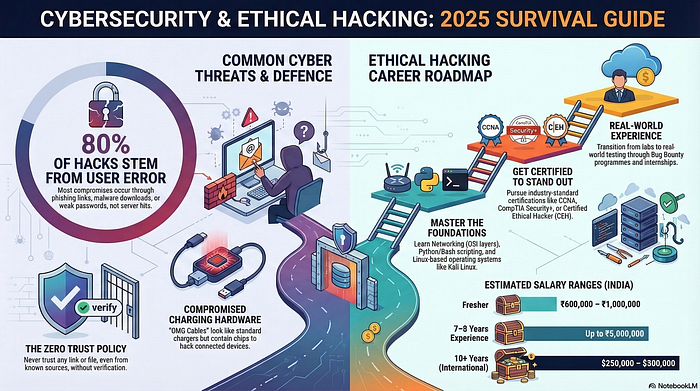

Introduction
A career changer spent fourteen months preparing for his first cybersecurity role. He completed three entry-level certifications. He finished two online learning platform paths from start to finish. He watched hundreds of hours of tutorial content covering networking fundamentals, operating system concepts, and introductory security topics. His notes were meticulous. His preparation felt thorough.
His job search produced six months of silence followed by rejections that never quite explained what was missing. When he finally received feedback from one interviewer, it was direct: the technical knowledge was adequate, but there was no evidence of practical judgment — no demonstrated experience with real environments, real ambiguity, or real problem-solving under conditions that courses cannot replicate.
He had prepared for cybersecurity and ethical hacking the way the certification industry told him to prepare. The certification industry, it turns out, is optimized for selling certifications — not for producing practitioners that hiring managers actually want.
The real issue is not knowledge acquisition. It is demonstrated capability — the evidence that you can function in real conditions, not just perform on structured assessments designed to be passed with sufficient preparation time.
Why the Certification-First Path Produces Knowledgeable Candidates Nobody Wants to Hire
The certification industry in cybersecurity has produced something genuinely useful and genuinely misleading simultaneously. It has produced a standardized vocabulary, a shared knowledge framework, and a set of verifiable credentials that allow employers to establish minimum baseline expectations efficiently. These are real benefits and they are not worth dismissing.
What the certification path has not produced, and was never designed to produce, is practical security judgment — the specific cognitive capacity that experienced practitioners develop through genuine engagement with real environments, real systems, and real ambiguity that structured learning cannot replicate.
Practical security judgment is what allows a practitioner to walk into an unfamiliar environment and make useful observations about it. To encounter a system they have never seen before and formulate intelligent hypotheses about where its security weaknesses might be. To read an alert and understand whether it represents a genuine threat, a misconfiguration, or expected behavior in this specific context. To communicate findings to a non-technical stakeholder in ways that produce appropriate organizational response rather than confusion or panic.
None of these capacities are developed by completing certification curricula. They are developed by working in real environments, making real mistakes, observing the gap between what course content suggested would happen and what actually happens in practice, and gradually building the intuitive pattern recognition that only genuine experience produces.
The hiring managers who make cybersecurity and ethical hacking hiring decisions — at organizations serious enough about security to hire carefully — have learned to distinguish between candidates who have accumulated credentials and candidates who have developed genuine capability. The signals they look for are not primarily credential lists. They are evidence of genuine engagement with real problems: a portfolio of work that demonstrates independent technical thinking, contributions to communities where real practitioners evaluate each other's work, specific examples of problem-solving that go beyond reproducing what a course demonstrated.
The intellectual insight that reframes the entire beginner roadmap question: certifications are a filter, not a signal. They establish that a candidate meets a minimum threshold and should not be immediately dismissed. They do not positively distinguish candidates in the way that demonstrated practical capability does. Treating certification completion as the primary career development investment is optimizing for passing the filter while underinvesting in the signal that actually influences hiring decisions among candidates who have already passed it.
The Practical Experience Gap and How to Close It Without a Job Title
The most common objection to the practical experience argument from people early in their cybersecurity career development is circular and genuine: practical experience requires opportunity, opportunity requires credentials or existing experience, and the person trying to get started has neither. The path to demonstrated capability seems to require demonstrated capability to access.
This objection is real but less constraining than it appears, because the cybersecurity field has an unusual characteristic that most professional fields do not share: a large and legitimate ecosystem of practice environments specifically designed to develop real skills outside of professional employment contexts.
Capture the flag competitions — structured security challenges where participants solve realistic technical problems across a range of cybersecurity domains — provide genuine problem-solving experience that produces genuine skill development and generates visible, verifiable evidence of capability. Performance in CTF competitions is taken seriously by technical hiring managers because the problems are real, the solutions require genuine understanding, and the results are not achievable by someone who only knows the surface of a topic.
Vulnerability research on programs with public scope — where organizations explicitly invite security researchers to find and responsibly disclose security issues in their systems — provides perhaps the most directly valued practical experience available to someone without professional employment. A submitted finding — even a low-severity one — is evidence of a complete security research process conducted on a real system. Multiple submitted findings across multiple programs constitute a portfolio of practical work that no certification list can match as evidence of genuine capability.
Building a home lab environment and documenting the work done in it — not as a performance of productivity but as a genuine record of real technical problem-solving — creates a visible body of work that demonstrates independent initiative and technical depth simultaneously. The specific contents of the lab matter less than the quality of the documentation and the complexity of the problems being worked on. A thoughtfully documented investigation of a specific vulnerability class in a home lab environment tells a hiring manager far more about a candidate's thinking than a completed course certificate does.
The practical example that makes this concrete: two candidates apply for the same junior security analyst role. The first has three entry-level certifications and no practical portfolio. The second has one entry-level certification, two accepted bug bounty submissions on public programs, and a documented home lab project investigating a specific class of misconfiguration vulnerability with write-ups that explain their methodology and findings. The second candidate is not more credentialed. They are more evidently capable, and in a field where judgment cannot be directly observed until someone is in the role, evidence of judgment is the most valuable thing a candidate can offer.
The Specialization Decision That Most Roadmaps Delay Too Long
Virtually every beginner cybersecurity roadmap treats broad foundational knowledge as the prerequisite to specialization — the recommendation being to spend the early phase of development building wide coverage across networking, operating systems, security fundamentals, and basic tooling before choosing a direction.
This sequencing is partially correct and significantly misapplied in most implementations. Foundational knowledge genuinely matters. You cannot be an effective penetration tester without understanding networking. You cannot be an effective security analyst without understanding operating system behavior. The foundations are not optional.
The problem is the duration that most roadmaps allocate to the foundation phase before allowing specialization to begin. Months, sometimes years, of broad study before the learner is encouraged to develop depth in any specific area. This sequencing produces practitioners who know a little about many things and are genuinely excellent at nothing — which is precisely the profile that hiring decisions at the junior level are least able to differentiate from other candidates with similar breadth and similar depth.
The more effective development path builds foundational knowledge and specialized depth in parallel — using a chosen specialization area as the primary learning context that makes foundational concepts concrete and memorable, rather than treating foundations as abstract prerequisites to be completed before relevant learning can begin.
A person learning penetration testing fundamentals as their specialization context learns networking because they need to understand how network enumeration works, not because networking is on the prerequisite list. They learn operating system concepts because they need to understand how privilege escalation paths work in real environments, not because the syllabus requires it before advancing. The foundational knowledge is acquired in service of genuine, motivated learning rather than as abstract preparation for learning that has not yet become relevant.
This parallel approach produces faster development of genuine capability, better retention of foundational concepts because they were learned in context rather than in isolation, and earlier development of the specialized depth that hiring decisions actually respond to.
The intellectual insight: the field of cybersecurity and ethical hacking is broad enough that genuine expertise in a specific area is more valuable than moderate competence across the entire field, and specialization should begin earlier than most roadmaps suggest — not after foundations are complete, but as the primary context within which foundational knowledge is developed.
What the Salary Data Is Not Telling You About Career Trajectory
The cybersecurity career compensation conversation is dominated by aggregate salary figures that are real and genuinely attractive — and that tell an incomplete story about what produces high career earnings over time in ways that significantly influence what early-career decisions are worth making.
Aggregate compensation figures represent the full range of the field — from the practitioner five years in doing largely routine work in a stable but undifferentiated role, to the specialist whose rare combination of technical depth, communication capability, and domain expertise commands genuinely exceptional compensation. These are not the same career outcome and they are not produced by the same development path.
The practitioners at the high end of the cybersecurity compensation range share characteristics that are worth examining specifically because they are not the characteristics that most entry-level roadmaps optimize for. They have genuine technical depth in a specific area rather than broad credential coverage. They can communicate complex technical findings in ways that non-technical decision-makers can act on — a capability that is surprisingly rare and therefore disproportionately valued. They have a visible track record in their specialization that precedes any specific role — a history of contributions, findings, research, or community involvement that establishes their reputation independently of their employment history.
The communication capability deserves specific emphasis because it is the most consistently underweighted component of long-term cybersecurity career development. Technical skill is the entry requirement. The ability to translate that technical skill into organizational value — to explain to a CISO what a finding means for business risk, to write a report that produces remediation action rather than confusion, to present in a board meeting with the clarity that technical depth combined with communication skill makes possible — is what produces the career trajectory that the high-end compensation figures represent.
Someone who spends their early career developing both technical depth in a specialization and the habit of written technical communication — through blog posts, CTF write-ups, bug bounty reports, or any other format that requires explaining technical thinking clearly to an audience — is building both components of the profile that high career earnings reflect. Someone who spends it accumulating credentials without developing communication capability is building only one.
Engagement Loop
In 48 hours, I will reveal a simple cybersecurity career stage assessment framework that most beginners skip entirely — and skipping it is the single most consistent reason technically capable people spend years developing skills that are not aligned with the specific career outcomes they are actually trying to reach.
CTA
If this reframed how you are thinking about your cybersecurity or ethical hacking career development and where the real leverage points are, follow for more honest analysis of what the field actually rewards versus what the certification and course industry is incentivized to tell you it rewards. Share this with someone at the beginning of their cybersecurity journey who is building their roadmap from certification lists — this perspective might save them a year of optimizing for the wrong signals.
Comment Magnet
What is one assumption you had about what cybersecurity or ethical hacking career development required — about which credentials mattered most, which skills were most valued, or what the primary obstacle to getting hired was — that real experience in the field completely overturned for you?