Subtitle: When public security advisories become development roadmaps for weaponized tools. A forensic architect's conclusion on the 27.2KB iCloud corruption.
[Editor's Note] This is the final installment of a trilogy analyzing a sophisticated attack that compromised an iPhone running iOS 18.5, leading to physical hardware tampering and ecosystem-wide iCloud data corruption.
- Part 1: When Authorization Breaches Availability: Analyzing the 27.2KB iCloud Sync Corruption with AI
- Part 2: AI is Not a Translator, It's Your Chief of Staff: How I Won a 120-Hour Logical War Against Apple
- Part 3: CVEs as Feature Catalogs (This Article)
- Part 4: Potential for iPhone eKYC/Face ID Hacking: How "Passcode Shouldering," "Selfies," and a Few Minutes Unattended Can Compromise Your Identity
Introduction: The "Unknown Part" Was Just the Entry Point
As a system architect analyzing the "Unknown Part" camera warning on a returned iPhone and the subsequent 27.2KB iCloud data corruption, one terrifying conclusion became unavoidable.
This was not the work of a lone hacker trial-and-erroring their way through iOS defenses. The precision of the data corruption and the bypass of multiple layers of security on iOS 18.5 points to something far more sinister: an automated, commercial-grade exploit kit.
This article explores a disturbing paradox in modern cybersecurity: how Apple's own transparency — publishing Common Vulnerabilities and Exposures (CVEs) — serves as a feature development roadmap for the creators of these automated attack tools.
1. The Paradox: CVEs as "Feature Catalogs" for Attackers
Publicly disclosing vulnerabilities (CVEs) is essential for defenders to patch systems. However, for highly skilled exploit tool developers, these disclosures are essentially "verified feature lists."
Weaponization via Patch Analysis
The moment Apple releases a security update, attackers begin reverse-engineering the patch. By comparing the patched code with the vulnerable version, they can isolate the exact flaw and develop a reliable exploit for unpatched devices — often within days.
Cataloging Vulnerabilities
Modern attack tools don't just rely on one exploit. They maintain a database of CVEs, cataloged by iOS version and device type. This transforms vulnerabilities into a menu of selectable "attack features."
2. The Threat of Automated, Version-Specific Selection
If the attack on my device was indeed carried out by such a tool, the implications are profound. It suggests the existence of kits capable of automatically scanning the target iOS version and selecting the most efficient "exploit chain" to achieve a specific goal.
The iOS 18.5 Kill Chain (Hypothetical Reconstruction)
For a device running iOS 18.5, the tool likely automated a chain similar to this:
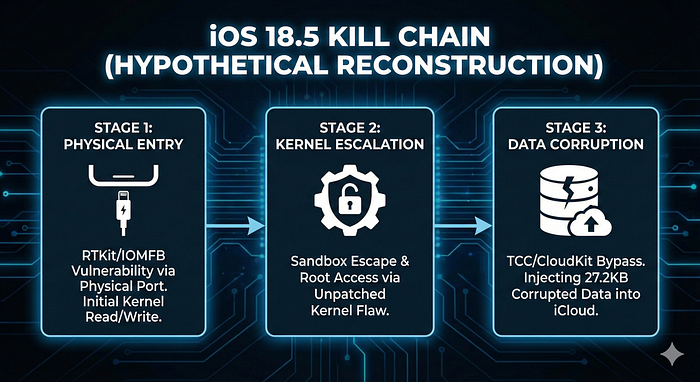
- Physical Entry (RTKit/IOMFB): Leveraging a memory corruption vulnerability (similar to CVE-2024–23296) in the real-time OS or frame buffer driver to gain initial kernel read/write capabilities via the physical camera port.
- Kernel Escalation: Using another unpatched kernel vulnerability to escape the sandbox and gain root-level access to the file system.
- Data Corruption (TCC/CloudKit Bypass): Utilizing a flaw in Transparency, Consent, and Control (TCC) logic (like CVE-2024–44131) to inject the 27.2KB corrupted data directly into iCloud databases without triggering user consent prompts.
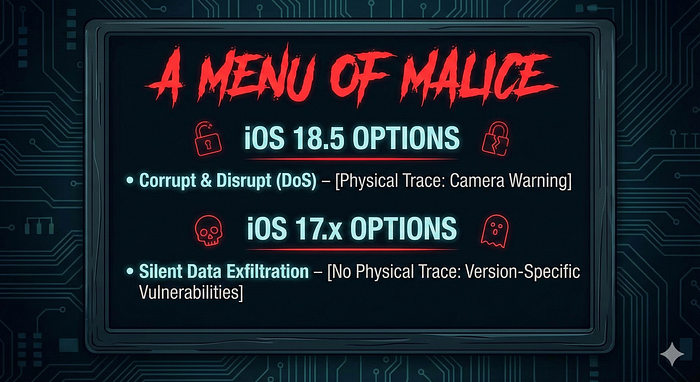
A Menu of Malice
The truly frightening aspect is the potential for a "menu-driven" attack.
- On iOS 18.5: The tool might select the "Corrupt & Disrupt (DoS)" option, accepting that it leaves a physical trace (the camera warning).
- On iOS 17.x: It might choose a different chain, perhaps offering a "Silent Data Exfiltration" option that leaves no physical warning indicators, utilizing a different set of version-specific vulnerabilities.
3. Conclusion: The "Department Store" of Automated Malice
The "Unknown Part" warning on the iPhone camera was not a sign of failure; it was the signature of a tool that prioritized logical destruction over physical stealth on that specific OS version.
We are no longer facing individual hackers. We are confronting an organized, automated ecosystem where:
- Apple's newest security advisories act as product requirement documents for exploit developers.
- Physical hardware programmers (like JCID) are integrated modules within larger software exploit suites.
- Attackers can select their desired outcome from a version-specific menu, democratizing advanced cyberattacks.
This reality shatters the assumption that "staying patched means staying safe." When vulnerabilities are weaponized faster than enterprises can deploy defenses, we must fundamentally rethink our reliance on OS-level security alone and prioritize architectural resilience — like end-to-end data integrity validation — in the cloud.

About the author
Ryu360 is a system architect and digital forensics specialist who focuses on uncovering structural security failures hidden behind formally "correct" system designs.
He analyzes real-world anomalies through forensic logs, behavioral inconsistencies, and adversarial architectural reasoning, with particular focus on identity-related systems such as iOS, Apple ID, Passkeys, and eKYC.
He has independently identified integrity anomalies within iCloud systems and engaged directly with Apple Product Security regarding architectural-level security issues.
His work centers on security design review, forensic analysis, and structural risk assessment rather than conventional software development.
If you believe your system or architecture may be affected by similar structural risks, you can contact him here: 👉 Consultation / Technical Inquiry Form https://forms.gle/btGiwS9ZRc3XhZL37
(All requests are reviewed individually. Some engagements may involve paid advisory work.)