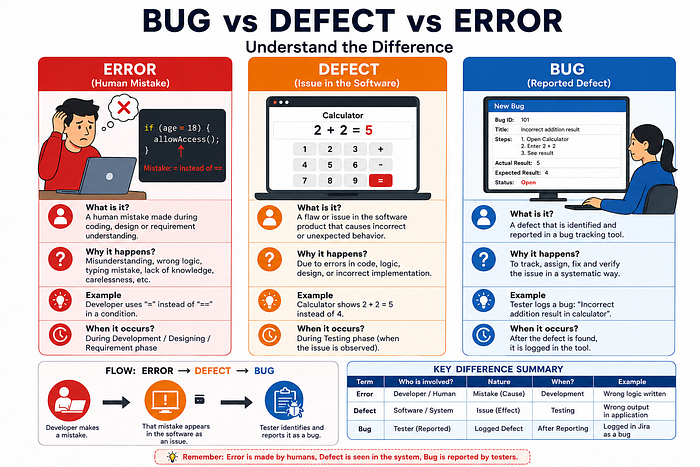
Software testing isn't just about finding issues — it's about understanding where they originate and how they evolve.
Three of the most commonly confused terms in QA are: 1. Error 2. Defect 3. Bug
Error:
An Error is a human mistake made during the software development process. Why Errors Occur? Errors typically arise due to:
- Misunderstanding requirements
- Lack of domain knowledge
- Poor logic or incorrect algorithm
- Typing mistakes (syntax errors)
- Time pressure or lack of experience
Example: A developer misunderstands the requirement: Requirement: "Allow login with email" Developer implements: "Login with username only" This mistake is an Error
Errors occur before the software is fully built — they are the root cause of problems.
Defect:
A Defect is a flaw in the software that occurs due to an error. Why Defects Occur? Defects appear when:
- Errors are not fixed during development
- Code is incorrectly implemented
- Integration issues occur
- Edge cases are not handled
Example: Continuing the previous scenario:
- Developer implemented login using username instead of email
- Now the system does not accept email login
This incorrect behavior is a Defect
Defects are visible issues in the system, usually found during testing
Bug:
A Bug is a defect that has been identified and reported by a tester. Why Bugs Are Important? Bugs are crucial because:
- They help track issues systematically
- They allow developers to fix problems efficiently
- They are documented in tools like Jira
Example:
Tester logs a report: "Login fails when using valid email credentials" Once reported, the defect becomes a Bug
A defect becomes a bug only after it is officially reported and tracked.
Conclusion:
- Error → Human mistake during development
- Defect → That mistake appears in the application
- Bug → Tester identifies and reports the defect