

We've all been there. You spend hours chaining together a beautiful, complex exploit. You submit the report, heart pounding, expecting a Critical severity payout.
Three days later, the triager downgrades it to a Medium.
Cue the endless back-and-forth comments arguing about CVSS vectors, theoretical attack complexities, and why they are wrong. It's exhausting, and worse — it rarely works.
If you want to stop fighting with triagers and start landing higher payouts, you need a fundamental mindset shift: Stop speaking in technical scores, and start speaking in business risk.
Free Read : Link
Here is how you translate your bugs into a language that program managers and security teams actually care about.
1. The CVSS Trap

CVSS is a technical calculator; it is not a measure of business reality. A vulnerability might technically be a low-severity information disclosure based on the CVSS matrix, but if that "information" is an exposed .env file containing the production AWS keys, the business is on fire.
Triagers and program managers are overwhelmed. They are staring at a queue of hundreds of reports. If your report just says "Path Traversal in Server," they see a generic technical flaw. If your report says "Path Traversal leading to full exposure of Production AWS Credentials," they see an immediate company emergency.
Rule of thumb: If you are relyiNext time you write a report, read it back to yourself and ask: "If I were the CEO of this company, would this report make me panic?" If the answer is no, stop typing, go back to your terminal, and dig deeper until you find the real risk.ng on a calculator to prove your bug is critical, you haven't dug deep enough yet.
2. The "Incident Response" Trigger
One of the smartest tactics shared recently by elite hacker Valeriy Shevchenko (Crevetco) on the Critical Thinking podcast is utilizing the Incident Response (IR) trigger.
When you find exposed credentials or data, don't just report the vulnerability. Safely validate that the credentials work, document them, and explicitly state in your report:
"These credentials are currently active. Your Incident Response team needs to investigate this immediately to determine how long they have been exposed, who else has accessed them, and whether they need to be rotated."
When you mention Incident Response, you are forcing the program to look past the technical bug and deal with the operational reality. You are no longer just a hacker submitting a ticket; you are acting like an internal Security Engineer helping them contain a breach. They cannot ignore that.
3. Escalate Safely
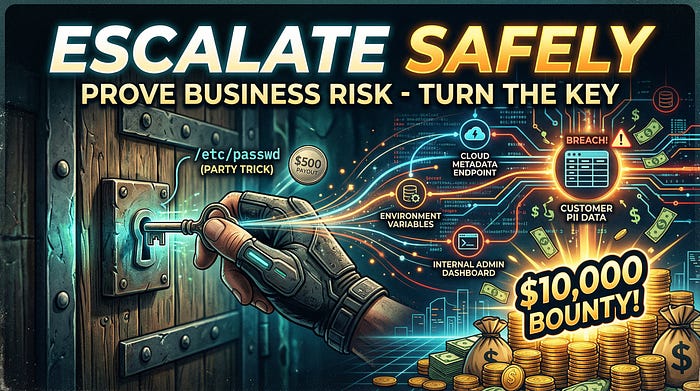
A vulnerability is a locked door with the key left in it. The business risk is what happens when someone turns the key.
If you find a Server-Side Request Forgery (SSRF) or a Local File Inclusion (LFI), do not stop at reading /etc/passwd. That is a party trick.
To prove business risk, take it one step further (within the scope rules):
- Can you hit the cloud metadata endpoint?
- Can you extract environment variables?
- Can you access internal admin dashboards?
Exposing a database containing customer PII (Personally Identifiable Information) turns a theoretical argument into a massive compliance and financial nightmare for the company. That is how a $500 payout turns into a $10,000 bounty.
4. The Golden Rule
Business risk is often transient. By the time a triager looks at your report two weeks later, the server might be down, the code might be pushed, or the credentials might be rotated.
If they cannot replicate it, they cannot prove the business risk, and you don't get paid.
Always record a video PoC (Proof of Concept). A video proves that at that exact moment in time, the vulnerability was active and the data was exposed. Triagers can pause the video frame-by-frame to see exactly what AWS keys, customer data, or internal systems were vulnerable. It is undeniable proof of impact.
The Takeaway
The best bug bounty hunters don't just find better technical bugs; they are better at selling the impact of the bugs they find.
Next time you write a report, read it back to yourself and ask: "If I were the CEO of this company, would this report make me panic?" If the answer is no, stop typing, go back to your terminal, and dig deeper until you find the real risk.