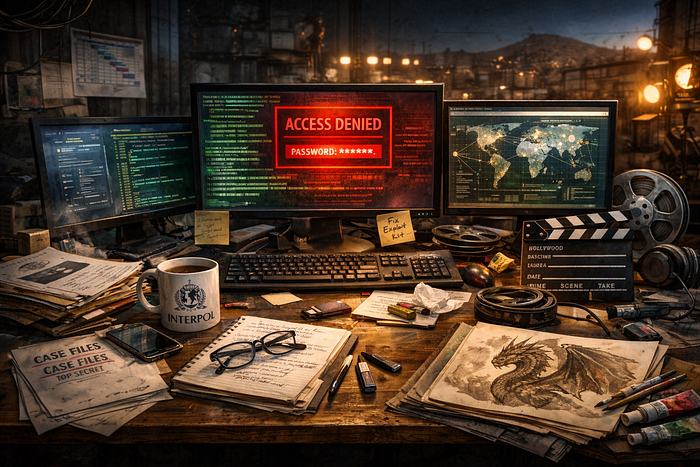

Let me tell you about the first time a Hollywood producer called me. I was sitting in my office, surrounded by too many monitors, not enough sleep, a nearly empty bottle of Mountain Dew, and a piece of fantasy art I was allegedly "working on" but mostly just staring at between emails. An LA number popped up on my phone and I ignored it at first because I've learned that nothing good comes from unknown area codes. I assumed it was spam, maybe someone trying to sell me a warranty for a firewall I didn't even own. Instead, it was a production assistant for a show I'd never heard of, asking if I would be interested in consulting to make their hacking scenes "more authentic." I actually laughed, out loud, alone in my office, because I had just spent the morning buried in old INTERPOL case files that were about as cinematic as a tax audit. But they were serious, and they were paying, and that is how I accidentally became the guy whose job is to explain to writers that computers do not, in fact, work like magic wands.
The first thing television gets wrong is the myth of the solo hacker genius. You know the one, the lone wolf in a dark room, pounding energy drinks, fingers flying across three keyboards at once while code scrolls by so fast it looks like the Matrix sneezed. I blame the movie Hackers from 1995 for this and several other cultural crimes. Real cybercrime is not a one-person act of brilliance, it is a team sport, and often a deeply unglamorous one. At INTERPOL, we tracked operations that had dozens of people involved, developers, infrastructure managers, money mules, and yes, ransomware groups with actual customer service departments. There were project managers involved, real ones, the kind who probably owned Gantt charts and lived inside spreadsheets. One of the largest cases I ever worked involved someone named "Vladimir" who turned out to be three different men named Vladimir and a woman in accounting who handled cryptocurrency laundering and complained in chat logs about her commute. There was no dramatic soundtrack, no ticking clock, just endless Slack messages, Jira tickets, and someone inevitably complaining that the exploit kit stopped working on Tuesdays for no apparent reason.
Then there is the infamous "enhance" problem, the scene that makes every investigator and analyst wince in unison. The detective slams their hand on the desk, orders the computer to "enhance," and somehow a blurry security camera image turns into a crystal-clear reflection off a victim's eyeball. I once got pulled into a discussion on Person of Interest because they wanted an AI to enhance an image, and I spent nearly an hour explaining digital resolution, pixel density, interpolation, and the immutable fact that you cannot create information that never existed. The director nodded, very thoughtfully, and then asked, "But what if the AI is really smart?" At some point you realize you are not there to win, you are there to negotiate damage. We compromised. The AI enhanced the image, but I insisted on dialogue mentioning probabilistic reconstruction and confidence levels. It was still nonsense, but at least it was educated nonsense, which is the best outcome you can hope for in Hollywood.
Everyone always asks about Mr. Robot, usually with the same hopeful tone people use when they want you to validate something they love. And fine, credit where it is due, Mr. Robot did a lot right. They used real commands, real tools, and actual consultants who cared about accuracy. The social engineering scenes were painfully accurate, especially the ones where access was gained not through genius code but by carrying a box and sounding like you belonged there. That is real, that is bread-and-butter work for anyone who has done this professionally. But the real reason Mr. Robot worked is because it was miserable. The hacking was tedious, the wins were ambiguous, the protagonist was barely functional, and everything felt exhausting. That part was accurate too. Most shows do not want miserable, they want cool, quippy, attractive hackers solving crimes in under an hour. I consulted on an episode of The Blacklist where a pacemaker was hacked, and the writer wanted the hero to "trace it back through the firewall" by typing very fast. I suggested instead that the hero call the hospital IT department and ask who had administrative access to the device network. The look I got was pure betrayal. We met somewhere in the middle, because that is always how it goes.
Real investigations do not look like television, and I say that with love and bitterness. Picture a conference room in Lyon in 2013 that smells like stale coffee and disappointment. Three laptops, one projector that had been "temporarily broken" for two years, and a whiteboard full of timelines that did not agree with each other. The case was a banking trojan hitting over a dozen countries with millions in losses. Very serious, very high stakes. We spent six hours correlating IP addresses with VPN exit nodes, cross-referencing timestamps to guess when the operator slept, and arguing about whether a specific Bitcoin transaction was a payment or a test. The big breakthrough was noticing code comments written in Romanian. No doors were kicked in, nothing was traced in real time, and most of the day was waiting on emails from legal attachés while trying not to fall asleep on video calls with people in inconvenient time zones. The highlight was when someone brought croissants.
Hollywood loves the hacking montage, where everything happens in ninety seconds and ends in either triumph or explosions. Real hacking is reconnaissance, and lots of it. Weeks of mapping networks, identifying software versions, checking known vulnerabilities, crafting phishing emails, waiting for someone to click, establishing persistence, escalating privileges, moving laterally, and then very carefully exfiltrating data so no one notices. And that is assuming nothing goes wrong. I once spent three months on a hospital penetration test where the entry point turned out to be an HVAC system on the same network as patient records, protected by a vendor default password that was literally "password123." Three months of work led to that moment. I billed for all of it, the client paid, and everyone involved learned something they wished they had learned earlier. Try selling that as prime-time television.
There is also a serious aesthetic problem with how hacking is portrayed. Somewhere along the line, Hollywood decided that all hacking must be green text on black backgrounds, as if the entire field froze in the 1990s. Real security tools are colorful, messy, and boring in the way all enterprise software is boring. Dashboards are blue, alerts are red, warnings are yellow, and everything looks suspiciously like Excel. I once suggested showing an actual SIEM dashboard on screen, which is the tool we really use, and was told it looked too much like accounting software. That is because cybersecurity is, in large part, accounting with consequences. It is emails, spreadsheets, dashboards, and Googling error messages. The rest is quiet panic.
Sometimes Hollywood accidentally gets things right, and those moments feel like small personal victories. Social engineering is often portrayed accurately, because humans really are the weakest link. The strongest technical controls in the world mean nothing if someone hands over credentials because the caller sounded confident and said they were from IT. Backups also get their rare moment in the spotlight, and that matters. Attackers target backups constantly because that is where the leverage is, and they are often less protected than live systems. Burnout is another accidental truth. The tired, disillusioned, slightly unhinged hacker trope exists for a reason. Healthy sleep habits are rare in this field, and emotional resilience is often held together with caffeine and gallows humor.
Consulting for Hollywood is mostly an exercise in controlled frustration. You get a script and fill it with comments explaining why things are impossible, illegal, or would take months. Most of that feedback gets ignored. You sit on calls explaining that "decrypting the encryption" is not a real phrase, and you offer something accurate in its place. They choose the nonsense because it sounds cooler. You die a little inside, then you cash the check, because realism does not pay the mortgage.
If I had complete creative control, which I never will, realistic hacking scenes would be painfully boring and deeply honest. Someone would type a command, wait, realize they made a typo, fix it, wait again, then watch output scroll by at a speed that invites existential dread. Progress bars would move slowly. Someone would check social media while waiting. That would be the scene. It would be accurate, and no one would give it an Emmy.
The real villains in cybercrime are not geniuses. They are persistent. Most of the serious actors I investigated were using slightly modified off-the-shelf malware, buying tools on forums, hiring freelancers, and making constant operational mistakes. They reused usernames, bragged in chat logs, logged in without VPNs "just this once," and left trails everywhere. They succeeded not because they were brilliant, but because their victims were careless. Unpatched systems, reused passwords, enabled macros, and ignored warnings did more damage than any elite hacker ever could. The myth of the genius attacker is comforting because it excuses failure. The reality is much less flattering.
So why do I keep doing it? Because occasionally, something real slips through. A legitimate technique, a real tool, a line of dialogue that makes professionals nod instead of cringe. Because Mr. Robot showed that accuracy and storytelling are not mutually exclusive. And yes, because the checks clear. I am not above admitting that. Mostly, though, I do it because I remember sitting in that conference room in Lyon, chasing IPs through VPNs, eating stale croissants, and knowing no one would ever believe this is what cybercrime investigation actually looks like. Now, sometimes, they do. And when they don't, when they want green text and countdown timers and magical AI buttons, I go home, look at my fantasy art, and remind myself that dragons are allowed to be unrealistic. Firewalls are not.