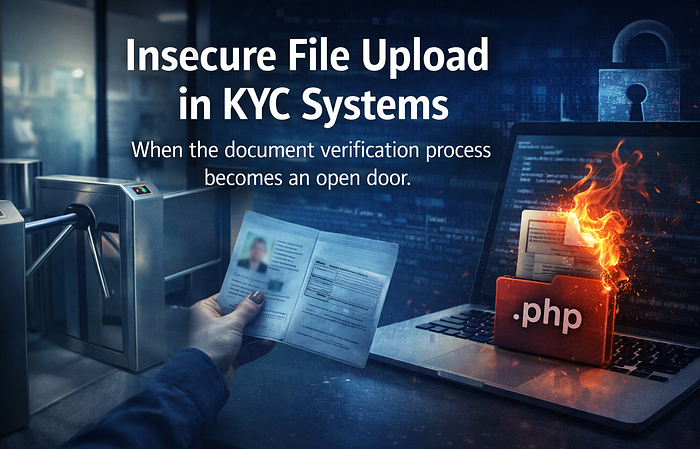

Every regulated financial platform eventually asks its users the same thing. Prove who you are. Upload your ID. Submit a utility bill. Send a selfie holding your passport. It is a necessary process, a legal requirement in most jurisdictions, and one of the most sensitive interactions a user has with a fintech platform. It is also, when built carelessly, one of the most exploitable features in the entire application.
The irony is pointed. The very process designed to verify identity and establish trust can become the entry point through which an attacker compromises the platform entirely.
Here is a straightforward way to picture it. A secure government building requires every visitor to submit their bag for inspection before entering. The security team checks bags carefully. One day, someone discovers that the inspection process only checks whether the bag looks like a normal bag from the outside. Nobody opens it. Nobody scans it. If the bag is the right shape and color, it passes. A visitor brings in a bag that looks completely ordinary but contains something dangerous inside. The inspection process ran correctly. It simply never looked at what mattered.
That inspection process is your file upload handler. And the bag that looks normal from the outside is a malicious file with a legitimate-looking name and extension.
File upload vulnerabilities exist across every industry that accepts documents from users. 1. Legal platforms processing court filings. 2. Healthcare systems collecting patient intake forms. 3. Insurance companies receiving claim documentation. 4. Educational institutions handling application materials. 5. HR platforms processing employee credentials. Any web application that accepts a file from a user and stores or processes it without rigorous validation is carrying this risk in some form.
In KYC systems specifically, the exposure is compounded by context. The upload feature is expected to handle sensitive documents. It processes files from every user who onboards onto the platform. It is often built under time pressure to satisfy regulatory timelines. And because it handles legitimate document types like JPEGs, PDFs, and PNGs, developers sometimes assume that restricting accepted file types is sufficient protection. It is not.
Technically, insecure file upload vulnerabilities manifest in several distinct and serious ways. File type validation based solely on the file extension or the MIME type declared in the request header is trivially bypassed because both are user-controlled values.
An attacker renames a PHP script as a JPEG, sets the content type header to image and JPEG, and submits it through the upload form. If the server saves the file with its declared extension and stores it in a web-accessible directory, the attacker can navigate to the file's URL and trigger server-side execution. The server runs the script with the permissions of the web application process, giving the attacker a foothold from which they can read files, execute commands, and move through the infrastructure.
Unrestricted file size limits create denial of service opportunities. An attacker submitting extremely large files repeatedly can exhaust server storage, memory, or processing capacity, degrading service for legitimate users. Predictable file naming, where the server stores uploaded files using the original filename or a simple transformation of it, allows attackers to overwrite existing files or predict the storage path of other users' documents. Storing uploaded files in a publicly accessible web directory rather than outside the web root means any uploaded file is directly reachable via URL, removing the need for execution to cause harm. A malicious document containing exploit payloads targeting the document parsing library the server uses to validate or preview uploads can compromise the server through the parsing process itself, a category of attack that has affected widely used PDF and image processing libraries in documented incidents.
A realistic scenario: a fintech lending platform builds a KYC document upload feature during their launch sprint. The developer validates file uploads by checking that the submitted file extension is one of the accepted types and stores the file in the application's public assets directory using the original filename. A security researcher submits a file named shell.php.jpg. The server accepts the extension check, stores the file in the public directory, and the researcher navigates to the file's URL in a browser. The server processes the PHP extension in the filename and executes the script. The researcher now has a web shell running on the production server with access to the application's configuration files, database credentials, and the KYC documents of every user who has uploaded to the platform. The upload feature accepted every legitimate document it was supposed to accept. It also accepted this.
Building secure file upload handling requires treating every uploaded file as hostile until it has been proven otherwise through rigorous server-side validation. 1. Validate file content by inspecting the actual file signature, the magic bytes at the beginning of the file binary, rather than trusting the declared extension or MIME type. 2. Use dedicated file parsing libraries to validate that the file is genuinely what it claims to be and reject anything that does not match the expected content structure. 3. Store all uploaded files outside the web root in a location that is not directly accessible via URL, serving files to authorized users only through controlled application endpoints that verify permissions before streaming content. 4. Rename every uploaded file to a randomly generated identifier on the server side, eliminating any relationship between the stored filename and the original submission. 5. Enforce strict file size limits appropriate to the document types expected. 6. Scan uploaded files with malware detection before processing or storing them. 7. Process uploaded files in isolated environments where possible, so that a malicious file that exploits a parsing vulnerability cannot reach the broader application infrastructure. 8. Log every upload attempt with full metadata and alert on patterns suggesting abuse.
KYC exists to establish trust between a platform and its users. The process that verifies identity should not simultaneously create a pathway for attackers to compromise the platform that those users are trusting with their financial lives.
The door you open to check who is coming in should not be wide enough for something harmful to walk through while you are looking at the paperwork.
#CyberSecurity #FileUploadSecurity #KYCSecurity #ApplicationSecurity #FintechSecurity #WebSecurity #SecureByDesign #OWASP #DevSecOps #SoftwareEngineering #SecurityEngineering #30DaysOfSecurity #CTOInsights #TechLeadership #Fintech