Three platforms. Three approaches to credential leak monitoring. Choosing the right one depends on what you actually need to do with the data.
Here is how LeakRadar, SpyCloud, and Hudson Rock compare.
What each platform focuses on
SpyCloud targets enterprise security teams with automated remediation workflows. Their focus is integrating with identity providers to force password resets automatically when credentials appear in breaches.
Hudson Rock focuses on stealer log intelligence with a strong emphasis on threat actor tracking. They provide context about which malware family captured the data and infection timelines.
LeakRadar focuses on giving you the actual credentials in plain text so you can act immediately. No waiting for enrichment. No abstraction layer. You see exactly what attackers see.
Data access
SpyCloud shows you that credentials were found but often requires enterprise contracts to access the actual passwords. Their model assumes you will automate remediation rather than investigate manually.
Hudson Rock provides credential data with context about the infection source. Access tiers vary based on subscription level.
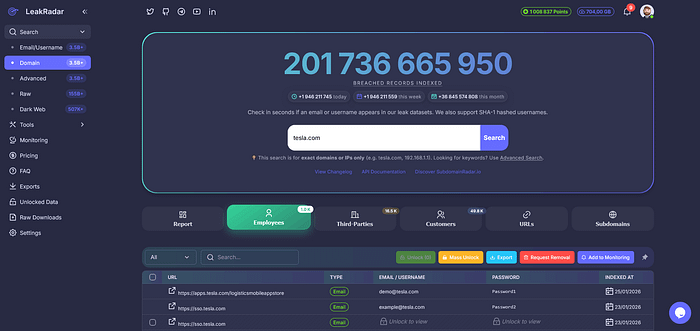
LeakRadar shows plain-text passwords, URLs, and timestamps on every result. What you search is what you get. No gated access to the actual credential data once you have a plan.
Search and segmentation
SpyCloud organizes data around employee identity. Strong if your goal is workforce protection and you already have an identity provider integration in place.
Hudson Rock organizes data around infection events. Useful if you need to understand the malware context or track threat actors.
LeakRadar organizes data around domains with automatic segmentation into employees, customers, and third-parties. One search shows you all three exposure categories without switching tools or queries.
Speed of indexing
SpyCloud processes data through enrichment pipelines before surfacing it. The tradeoff is context versus speed.
Hudson Rock indexes stealer logs with infection metadata, which adds processing time but provides attribution data.
LeakRadar indexes raw stealer logs within hours of collection. Less enrichment, faster availability. If a credential leaked this morning, you can find it this afternoon.
Pricing model
SpyCloud is enterprise-priced. Contracts typically start in the tens of thousands annually. Built for large security teams with budget.
Hudson Rock offers tiered pricing with different access levels. Mid-market to enterprise positioning.
LeakRadar offers monthly plans starting at accessible price points with full API access included. No annual commitment required. Scales from individual researchers to enterprise teams.
Best fit by use case
If you need automated password resets integrated with Okta or Azure AD and have enterprise budget, SpyCloud fits that workflow.
If you need threat actor attribution and malware family context for intelligence reports, Hudson Rock provides that depth.
If you need to see the actual passwords immediately, search any domain without friction, and segment results by employees versus customers versus vendors, LeakRadar does that out of the box.
The practical difference
When a credential appears in a stealer log, the question is what can you do right now.
LeakRadar answers that by showing you the password, the URL where it was captured, and when it happened. You can verify if the password still works, reset it, and revoke sessions within minutes of finding it.
That is the gap LeakRadar fills. Not replacing threat intelligence platforms. Giving you actionable data fast.