June 4, 2026
Versioning — The Blind Spot In Modern Software Engineering
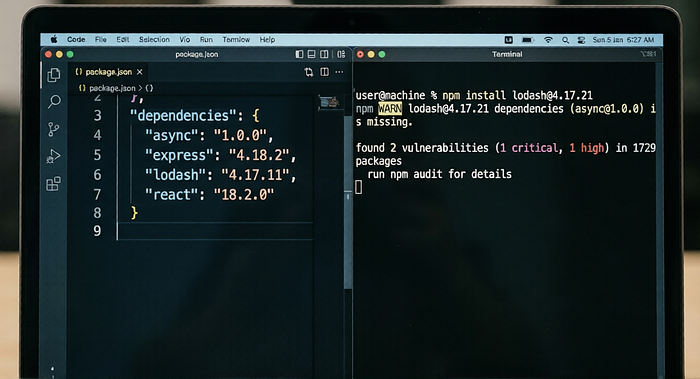
The modern engineering ecosystem heavily prioritizes velocity over validation. When commands like npm install or pip install execute in…

Okoli Chisom
1 min read
The modern engineering ecosystem heavily prioritizes velocity over validation. When commands like npm install or pip install execute in seconds, the friction required to trigger a security audit or architectural review is entirely bypassed.
Here is the structural failure in how development teams approach versioning and the ensuing supply-chain security implications.
The "Why": The Illusion of Frictionless Development
The root cause of this vulnerability is abstraction. Package managers have successfully abstracted away the complexity of integrating third-party code. Because implementation details are hidden, the associated risks are psychologically minimized. We treat third-party dependencies as static, sterile utilities rather than executable code written by fallible — and sometimes malicious — external actors.
The "What": The SemVer Blind Spot
Versioning is not a chronological label; it is a strict communication protocol between the author and consumer (Semantic Versioning). The failure point usually occurs with version operators in manifest files:
- The Caret (
^1.2.3): Allows minor and patch updates. This default prioritizes new features but exposes the project to regressions if the author breaks the SemVer contract. - The Tilde (
~1.2.3): Allows only patch updates. Safer, prioritizing bug fixes. - Strict/Pinned (
1.2.3): Locks the exact version.
The Security Fallout: Supply Chain Vectors
By blindly pulling packages via flexible version ranges, architectures are exposed to severe attack vectors:
- Typosquatting: Attackers publish malicious packages visually identical to popular ones (e.g.,
electornvselectron). Fast typing leads to exfiltrated environment variables. - Maintainer Hijacking: Open-source maintainers frequently burn out, occasionally handing over control to malicious actors. A previously safe package suddenly ships a cryptominer in a minor version update.
- Transitive Dependency Icebergs: You audit the single package you install, but it relies on 50 others, which rely on 200 more. A vulnerability deep in the tree compromises the top-level application
The Version Management Paradox
Engineering teams must navigate the tension between stability and security.
Strategy 1: Strict Version Pinning
- Pros: Guarantees deterministic, predictable builds. What is tested is exactly what ships.
- Cons: Introduces "dependency rot." You will miss critical zero-day security patches on underlying libraries unless manually intervening.
Strategy 2: Floating Versions (via Automated Tooling)
- Pros: Automatically ingests Patch-level security updates without developer friction.
- Cons: Highly susceptible to supply chain attacks if a compromised package pushes a malicious update within the allowed range.
To mitigate these risks, organizations must shift from implicit trust to explicit verification using Software Bill of Materials (SBOM) generators and automated vulnerability scanners.
Which ecosystem — Node, Python, Rust, or otherwise — are you seeing this "black box" trust model exploited in the most? Let's discuss below.
#SoftwareEngineering #CyberSecurity #DevSecOps #OpenSource #SupplyChainSecurity