June 4, 2026
Securing Software Supply Chains with SBOM and DevSecOps
Modern software development has transformed dramatically over the past decade. Today’s applications are rarely built entirely from scratch…
Saeed Fazal
4 min read
Modern software development has transformed dramatically over the past decade. Today's applications are rarely built entirely from scratch; instead, they are assembled from a vast ecosystem of open-source libraries, container images, cloud-native services, APIs, and third-party components. While this approach accelerates innovation and reduces development time, it also introduces significant software supply chain risks.
High-profile incidents such as SolarWinds, Log4Shell, and dependency hijacking attacks have demonstrated how a single compromised component can impact thousands of organizations worldwide. As a result, businesses are increasingly focusing on software supply chain security as a critical part of their cybersecurity strategy.
To improve visibility, accountability, and security throughout the software lifecycle, many organizations are adopting Software Bills of Materials (SBOMs) alongside DevSecOps practices. Together, these approaches help organizations understand what software they are running, identify vulnerabilities faster, and automate security controls throughout development and deployment processes.
Understanding the Software Supply Chain
The software supply chain encompasses every component, tool, service, and process involved in creating, testing, deploying, and maintaining software applications.
This includes:
- Open-source libraries and frameworks
- Container images and registries
- Package managers (npm, Maven, pip, etc.)
- CI/CD pipelines
- Source code repositories
- Artifact repositories
- Infrastructure-as-Code (IaC) templates
- Cloud platforms and services
- Third-party APIs and integrations
- Build and deployment tools
Each element within the supply chain represents a potential attack surface. Vulnerabilities, misconfigurations, malicious code injections, or compromised dependencies can introduce security risks that propagate throughout an organization's software ecosystem.
Without visibility into these components, organizations may struggle to identify affected applications when new vulnerabilities emerge.
What Is an SBOM?
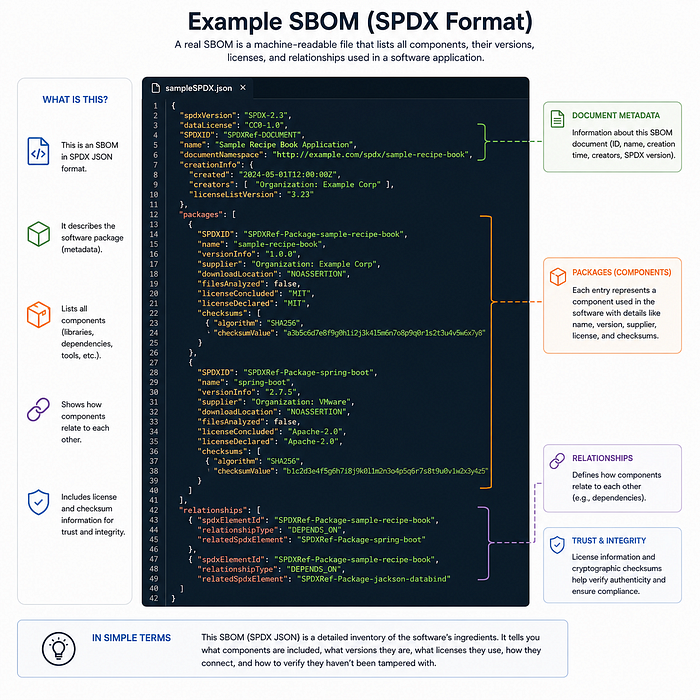
A Software Bill of Materials (SBOM) is a comprehensive inventory of all software components used within an application or system.
Much like an ingredient list on a food product, an SBOM provides detailed information about the software's composition, allowing organizations to understand exactly what is included in their applications.
An SBOM typically contains information such as:
- Libraries and packages
- Dependency versions
- Open-source components
- Container contents
- Licensing information
- Component relationships
- Supplier information
- Cryptographic hashes and identifiers
By maintaining an accurate SBOM, organizations gain visibility into their software assets and can quickly determine whether they are affected by newly disclosed vulnerabilities.
Common SBOM formats include:
- SPDX (Software Package Data Exchange)
- CycloneDX
- SWID (Software Identification Tags)
These standards enable interoperability across tools and platforms while supporting automated security workflows.
Why SBOMs Matter
When a critical vulnerability is announced, security teams often face urgent questions:
- Are we affected?
- Which applications contain the vulnerable component?
- How widespread is the exposure?
- What systems should be prioritized for remediation?
- Are there compliance implications?
Without an SBOM, answering these questions can require extensive manual investigation.
With an SBOM in place, organizations can rapidly identify impacted systems and take appropriate action.
Key Benefits of SBOMs
Improved Vulnerability Management
Security teams can quickly map vulnerabilities to affected applications and prioritize remediation efforts based on risk.
Faster Incident Response
During security incidents, SBOMs provide immediate visibility into software components, reducing investigation time and accelerating response efforts.
Enhanced Compliance
Many regulatory frameworks and government initiatives increasingly require software transparency and supply chain security controls.
Greater Supply Chain Transparency
Organizations gain a clearer understanding of third-party dependencies and associated risks.
Better Risk Management
SBOMs help security teams evaluate the security posture of software assets and make informed decisions regarding upgrades, replacements, or mitigations.
Integrating SBOMs into DevSecOps
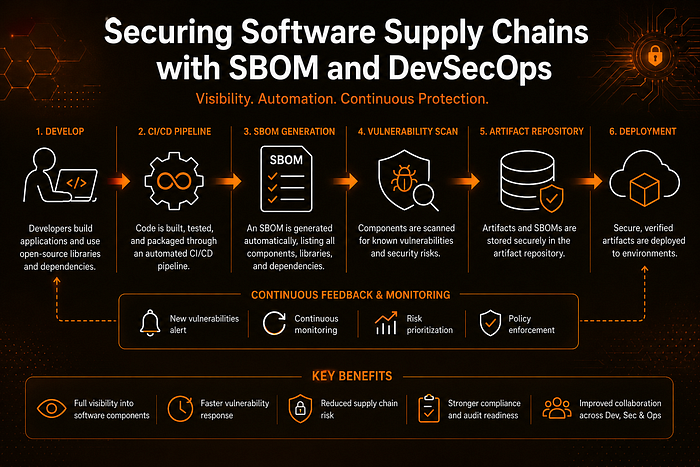
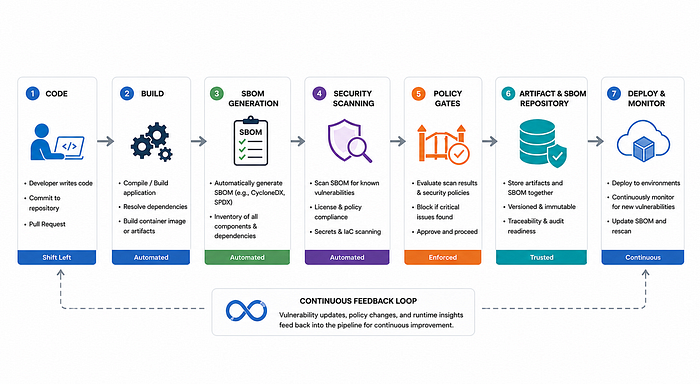
SBOMs deliver the greatest value when they are automatically generated and maintained throughout the software development lifecycle.
DevSecOps extends traditional DevOps practices by embedding security into every stage of development rather than treating it as a separate activity performed at the end of the process.
A modern DevSecOps workflow may include:
- Developers commit code.
- Automated builds are triggered.
- Dependencies are analyzed.
- An SBOM is generated automatically.
- Vulnerability scans are performed.
- Security policies are evaluated.
- Compliance checks are executed.
- Artifacts and SBOMs are stored securely.
- Applications are deployed.
- Continuous monitoring detects newly disclosed vulnerabilities.
This automated approach ensures that every release includes an accurate and up-to-date inventory of software components.
Benefits of SBOM Automation
- Reduced manual effort
- Consistent security controls
- Faster release cycles
- Improved audit readiness
- Continuous visibility into software assets
- Early detection of vulnerable dependencies
Common Challenges
While SBOM adoption provides significant benefits, organizations often encounter several implementation challenges.
Tool Sprawl
Modern environments frequently use multiple programming languages, frameworks, and deployment platforms. Different tools may generate SBOMs in varying formats, making standardization difficult.
Organizations should establish consistent standards and select tools that support widely adopted SBOM formats.
Vulnerability Prioritization
Not every vulnerability requires immediate remediation.
Security teams must evaluate at least:
- Severity scores
- Exploitability
- Business impact
- Asset criticality
- Exposure level
Risk-based prioritization helps organizations focus resources on the most significant threats.
Developer Experience
Security controls should support developers rather than slow them down.
Automated scanning, policy enforcement, and remediation guidance can reduce friction while maintaining strong security standards.
Organizations that integrate security seamlessly into development workflows often achieve higher adoption rates and better outcomes.
Continuous Monitoring
An SBOM represents a snapshot in time.
New vulnerabilities may be discovered weeks or months after software is deployed. Continuous monitoring is therefore essential to identify newly affected systems and trigger remediation workflows.
Organizations should combine SBOMs with vulnerability intelligence feeds and automated alerting systems to maintain ongoing visibility.
Building a More Resilient Software Supply Chain
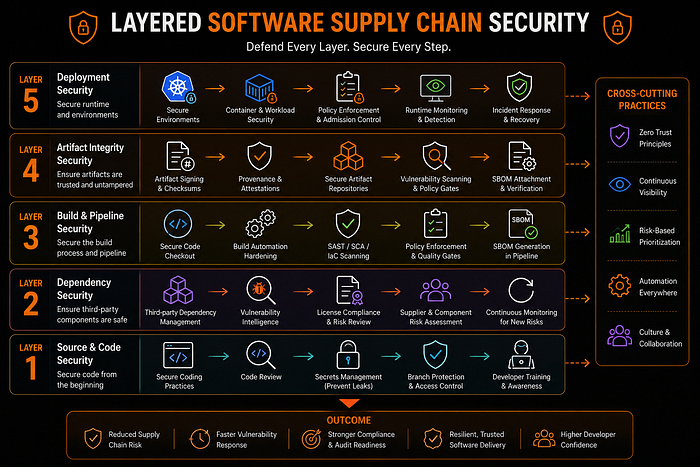
Effective software supply chain security requires collaboration across development, operations, security, compliance, and leadership teams.
A resilient strategy typically includes:
- Automated SBOM generation
- Secure CI/CD pipelines
- Dependency management controls
- Vulnerability scanning
- Code signing and artifact verification
- Continuous monitoring
- Security policy enforcement
- Incident response planning
Organizations that successfully implement these practices gain significant advantages, including improved visibility, faster vulnerability response, stronger compliance capabilities, and reduced exposure to supply chain attacks.
SBOMs provide transparency into software composition, while DevSecOps provides the automation necessary to operationalize security at scale.
Together, they create a foundation for proactive software supply chain risk management.
Conclusion
As software ecosystems continue to grow in complexity, understanding what software components exist within an organization becomes increasingly important.
Software supply chain attacks are no longer rare events, they are a persistent and evolving threat that affects organizations of all sizes. Visibility, automation, and continuous monitoring are essential for reducing risk and maintaining trust in software systems.
By integrating SBOM generation, vulnerability management, policy enforcement, and automated security controls into DevSecOps workflows, organizations can significantly strengthen their security posture.
The combination of SBOMs and DevSecOps enables organizations to move beyond reactive security practices and adopt a more proactive, resilient approach to software supply chain protection.