
Awareness, training, education, behavior change, role-based learning, and the program design choices that determine whether security culture is real.
Most organizations can prove that they delivered training. Far fewer can prove that behavior improved because of it. That gap is the real challenge of security awareness. Attendance is easy to measure. Cultural movement is harder. Yet that is exactly what Chapter 2 pushes us to think about: security learning as a living program rather than a compliance ritual.
Awareness, training, and education are not the same thing
The chapter closes by drawing a useful distinction among awareness, training, and education. Awareness establishes a broad foundation of understanding across the organization. Training teaches people how to perform their work tasks in compliance with security policy. Education goes deeper, helping people learn beyond immediate job need and often supporting career development, promotion, or certification pathways.
This distinction matters because organizations often blend the three together and then wonder why their program feels shallow. If everyone receives the same generalized content, awareness may increase slightly, but role-specific decision quality may not. If employees are trained only on task mechanics without broader context, they may comply mechanically but fail when the situation changes. If deep education is expected from a short mandatory session, both learners and leaders become frustrated.
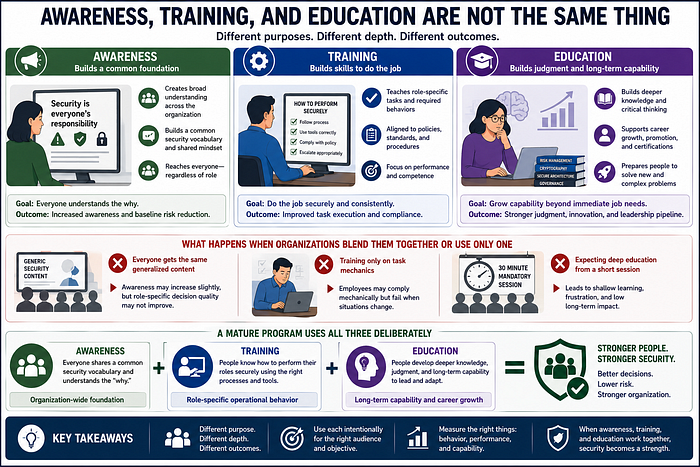
A mature program therefore uses all three deliberately. Awareness gives everyone a common security vocabulary. Training shapes operational behavior for specific roles. Education builds long-term capability, judgment, and career depth.
Why annual completion is a weak success metric
The quick scenario highlights a common trap: the company can show excellent completion data and still have weak security behavior. Completion is attractive because it is simple. It produces neat dashboards and satisfies audit conversations easily. But completion alone says little about whether the right people learned the right things at the right depth and can apply them under pressure.
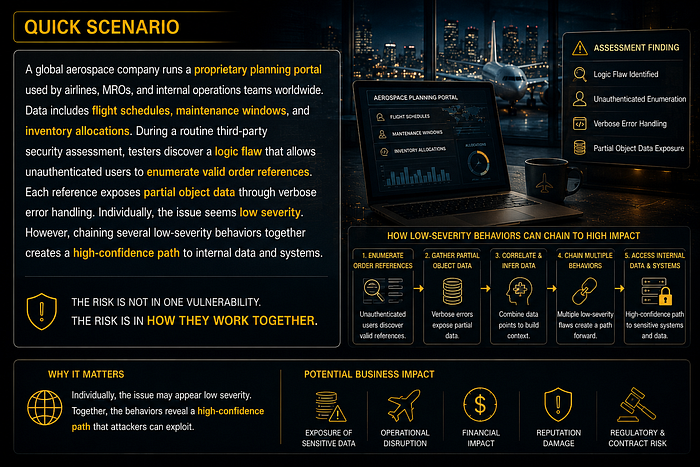
A healthier question is whether the program changes decisions. Do employees report suspicious messages more quickly? Do payment change workflows trigger more reliable verification? Do help desk staff challenge identity claims more consistently? Do managers reinforce policy instead of bypassing it? Do contractors receive learning tailored to the systems and data they touch?
CISSP thinking is helpful here because it resists superficial metrics. It asks whether the control achieves its intended effect. If awareness exists only as evidence of attendance, then the organization may be compliant in form while remaining fragile in practice.
A learning program should reflect how the organization actually works
The chapter notes several ways to improve awareness and training: change the target focus, vary topic order and emphasis, use diverse presentation methods, and incorporate role-playing. That is an important reminder that adults do not all learn the same way and do not all face the same decisions. Security culture becomes stronger when the program reflects the organization's real operating environment.
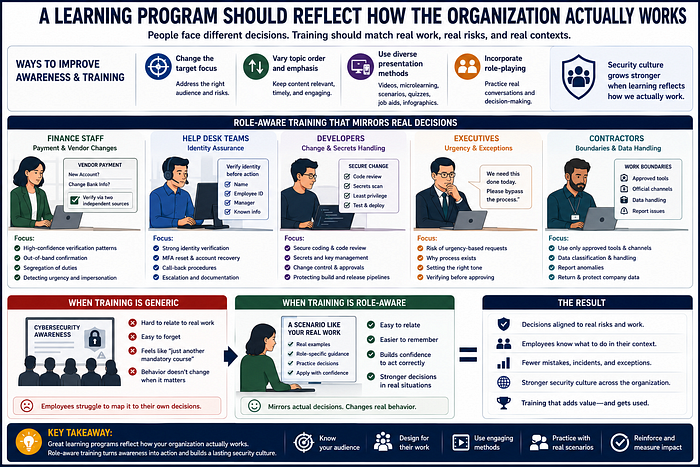
For the global services company, that means finance staff need high-confidence verification patterns for payment and vendor changes. Help desk teams need resilient identity assurance habits. Developers need secure change and secrets handling discipline. Executives need to understand the security consequences of requesting urgency-based exceptions. Contractors need explicit boundaries around tools, channels, and data handling.
When training is generic, employees often struggle to map it to their own work. When it is role-aware, the learning becomes easier to remember because it mirrors actual decisions rather than abstract warnings.
A visual model for security learning maturity
A simple visual model can help here: awareness answers "What should everyone remember?", training answers "What should this role know how to do?", and education answers "How do we build deeper capability over time?" When those three layers work together, the organization develops both broad culture and role-specific resilience. When they are blurred together, people often receive either too little detail for their real decisions or too much generic content to retain meaningfully.
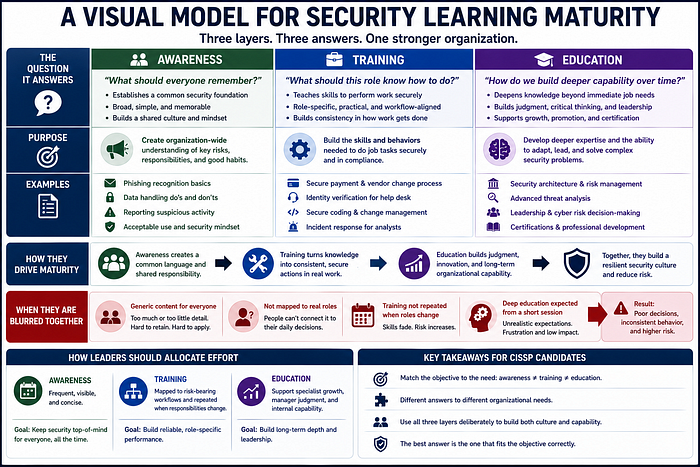
This model is useful because it helps leaders allocate effort. Awareness should be frequent, visible, and concise. Training should be mapped to risk-bearing workflows and repeated when responsibilities change. Education should support specialist growth, manager judgment, and the development of stronger internal capability. None of the three layers replaces the others. They are different answers to different organizational needs.
For CISSP candidates, that distinction is important because the best answer is often the one that matches the objective correctly. A broad reminder is not the same as job-specific instruction, and neither is the same as long-term professional development.
Role-playing and realism matter because memory is contextual
The chapter's suggestion to use role-playing is especially powerful. Many employees can answer correctly in a knowledge check and still hesitate in real situations because reality introduces speed, ambiguity, hierarchy, embarrassment, and competing priorities. Role-playing narrows that gap by letting people rehearse decisions in context.
A phishing simulation is one example, but role-playing can go further. Finance teams can practice vendor change verification. Help desk staff can rehearse identity-reset escalation. Physical security teams can test visitor and technician validation. Managers can practice how to respond when an executive asks for an exception to an established control.
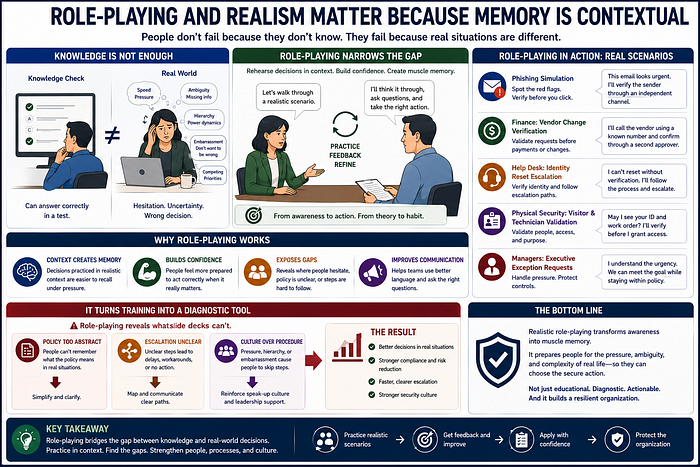
This kind of rehearsal turns awareness into muscle memory. It also reveals where policy language is too abstract, where escalation paths are unclear, and where cultural pressure overrides procedure. That makes the learning program not only educational but diagnostic.
Culture is created by repetition, reinforcement, and leadership behavior
The chapter describes awareness as something built not only through classes but also through reminders in the work environment: posters, newsletters, screen savers, and similar reinforcements. That idea still matters today, even if the formats evolve. The point is that awareness must remain visible between formal sessions.
However, visibility alone is not enough. Reinforcement becomes credible only when leaders behave consistently with the message. If employees are trained to verify, but managers reward speed over verification, the culture will follow management behavior. If executives expect exceptions through informal channels, staff will absorb that signal faster than any policy language.
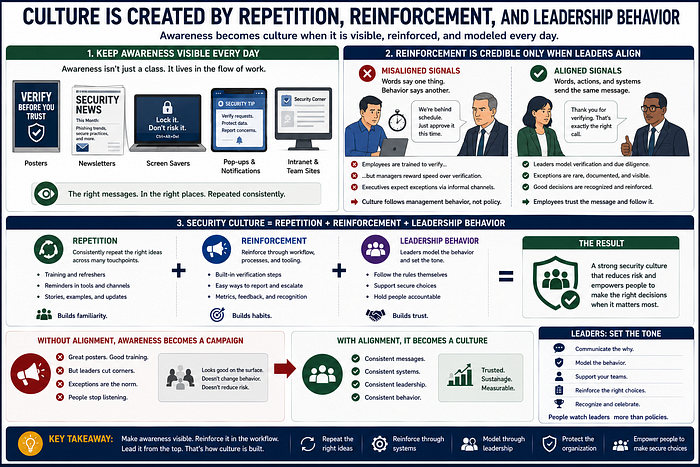
Security culture is therefore produced by repetition plus alignment. The organization repeats the right ideas, reinforces them through workflow and tooling, and models them through leadership conduct. Without that alignment, awareness becomes a campaign rather than a culture.
From awareness to capability: linking learning to career growth
Education, as the chapter describes it, goes further than immediate task training. It often relates to certifications, promotion, and deeper understanding than a person strictly needs for the current role. This is important because a strong security program should not only prevent mistakes. It should also create growth pathways.
When people understand that security learning improves judgment, credibility, and career mobility, the program becomes less transactional. Employees stop seeing security only as an annual obligation and start seeing it as part of professional excellence. That shift matters for managers too. It helps them view security capability building as a business investment rather than a productivity tax.
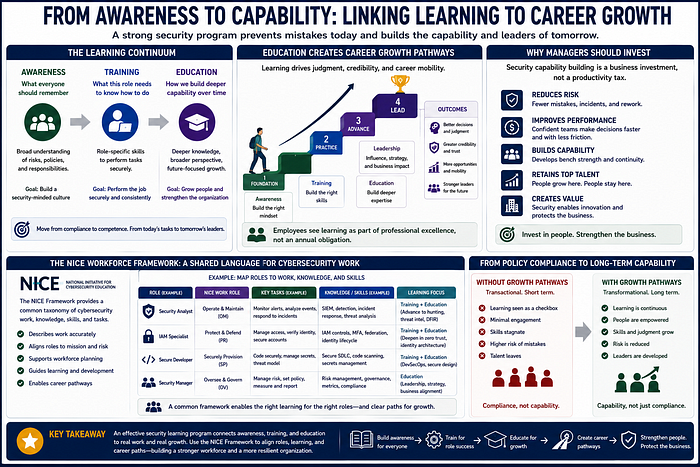
The NICE Workforce Framework is relevant here because it offers a shared language for describing cybersecurity work and workforce development. It helps organizations think more systematically about the knowledge and tasks different roles require. That is valuable when awareness, training, and education need to support not just policy compliance, but long-term capability development.
How to measure whether the culture is moving
If completion rates are not enough, what should organizations measure? They should look for indicators tied to behavior and decision quality. Examples include phishing reporting rates, time-to-report, reduction in repeat mistakes, stronger verification in financial workflows, quality of help desk identity checks, reduced policy exceptions, and increased use of approved channels for sensitive data handling.
Measurement should also be segmented. An enterprise average can hide problem areas. The question is not whether the organization is improving in the abstract; it is whether finance, support, engineering, HR, and management are improving in the behaviors that matter for their risk profile. This role-aware measurement mirrors the role-aware training approach described earlier.
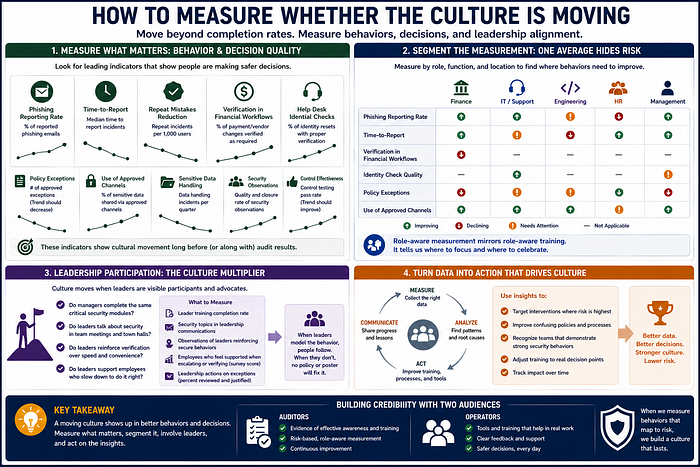
Another important metric is leadership participation. Do managers complete the same critical modules? Do they speak about security as part of operational excellence? Do they support employees who slow down to verify? Cultural movement becomes visible when managers stop treating security learning as someone else's program.
None of this makes awareness simple, but it does make it real. Once the organization measures behaviors that map to risk, the program gains credibility with both auditors and operators.
Why this chapter ends with culture for a reason
It is fitting that this part of Chapter 2 ends on awareness, education, and training because the rest of the chapter depends on them. Personnel security policies fail if people do not understand them. Risk management weakens if people cannot think clearly about assets, threats, and exposure. Social engineering defenses collapse if verification habits are not practiced. In that sense, the learning program is not the final topic because it is secondary. It is final because it supports everything else.
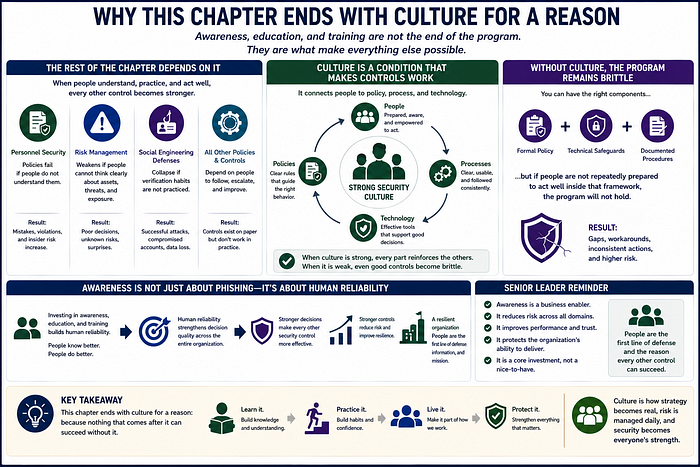
A strong security culture is therefore not an optional enhancement once the "real controls" are in place. It is one of the conditions that allows those controls to function as intended. The organization may have formal policy, technical safeguards, and documented procedures, but if people are not repeatedly prepared to act well inside that framework, the program will remain brittle.
This is a useful reminder for senior leaders too. Investment in awareness is not only about reducing phishing clicks. It is about strengthening the human reliability that every other security decision quietly depends on.
Question set — aligned with the scenario
Question 1: A global services company delivers mandatory phishing training once a year. Completion rates are high, LMS reports are clean, and compliance is satisfied. However, simulated phishing click rates remain inconsistent, help desk staff still approve weak identity-reset requests, and a contractor recently shared restricted files through an unapproved channel. What best explains why the program is underperforming?
A. Employees are not capable of retaining annual training content B. Awareness content has no security value and should be removed C. The organization is measuring completion more closely than behavior change and role-specific application D. The LMS reports are likely inaccurate
This scenario highlights one of the most important lessons in Part 4: delivered content is not the same as changed behavior. High completion rates may satisfy administrative and audit needs, but they do not prove that employees can apply the right security habits under pressure. The company's weak outcomes show that the learning program is being measured as a delivery exercise rather than as a behavior-shaping system. C is correct because the scenario shows a clear mismatch between completion metrics and operational outcomes. People finished the content, but risky behaviors continue in role-specific workflows.
Question 2: Which improvement would most directly strengthen the company's current security learning program?
A. Require every employee to watch the same annual awareness video twice B. Add role-based learning paths, realistic practice, and metrics tied to response behavior rather than completion alone C. Replace all learning with a short annual policy acknowledgment email D. Limit security learning primarily to technical teams because they are closest to the systems
Part 4 stresses that mature security culture depends on targeted learning, contextual rehearsal, and behavior-based measurement. Different roles face different decision pressures: finance, help desk, contractors, managers, developers, and executives do not need identical content at identical depth. A stronger program therefore combines role-aware learning paths, realistic simulations or role-play, and metrics that show whether decisions are improving in practice. B is correct because this answer matches the document's core recommendations: make learning relevant to real work, reinforce it through practice, and measure what people actually do.
Question 3: Leadership wants to improve the program and asks whether awareness, training, and education can all be handled through the same short annual session. Which answer best reflects a mature CISSP-aligned view?
A. Yes, because all three terms describe the same learning objective B. Yes, as long as attendance is documented and managers approve the content C. No, because awareness builds shared understanding, training builds task-specific ability, and education builds deeper long-term judgment D. No, because security education should be reserved only for technical specialists
A central theme of Part 4 is that awareness, training, and education are not interchangeable. Awareness helps everyone remember core ideas. Training teaches a specific role how to perform security-relevant tasks correctly. Education develops broader capability, depth, and long-term judgment, often tied to growth, certification, or leadership maturity. Treating all three as one short annual event creates shallow results because each serves a different objective. C is correct because this answer directly reflects the distinction drawn in the document and matches how mature programs allocate effort across the organization.
What this part should make you question
Are we proving that content was delivered, or that behavior improved? Do our learning paths reflect actual decision pressure in each function? Are our leaders modeling the habits the program teaches? Do contractors, managers, and nontechnical teams receive appropriately designed learning? Do we vary methods enough to keep the program alive? Are we building a culture of practiced judgment or just maintaining an annual checkbox?
These questions matter because security culture is not a slogan. It is the cumulative effect of what people are taught, what they rehearse, what they see rewarded, and what they experience when they follow the policy under pressure.
Scenario debrief: what mature review would change
A mature review of the training scenario would not end with course completion statistics or an annual compliance report. It would examine whether the learning program changed behavior in places that matter. Did reporting of suspicious messages increase? Did risky exceptions decrease? Did privileged users receive different training from general staff? Did managers reinforce the same expectations in operational meetings, or did the message exist only inside the learning platform?
That review would also test whether the program architecture matches workforce reality. If remote staff, contractors, executives, or high-risk teams receive the same generic content at the same cadence, the organization may be measuring participation while missing relevance. Mature awareness programs are designed around behavior change, role context, and continuous reinforcement.
CISSP mindset check
The CISSP mindset check here is to distinguish awareness, training, and education without treating any of them as interchangeable. Awareness builds shared understanding. Training builds task-specific ability. Education develops broader judgment and depth. The strongest answer in a scenario is usually the one that matches the intervention to the problem rather than assuming more content is always the fix.
If employees know the policy but still fail under realistic pressure, the issue may be practice, process friction, leadership messaging, or measurement quality rather than a lack of information alone.
Questions to carry forward
Carry these questions forward. Are we teaching security, or are we teaching secure behavior in context? Are our measures tied to risk reduction, or only to completion? Do our high-risk roles receive learning that reflects the decisions they actually make? And if employees fail repeatedly, are we adjusting the program, or simply replaying the same material and hoping for a different outcome?
Why reassessment matters
Reassessment matters because people, business processes, and threat patterns all change. A workforce that understood remote-work phishing in one year may need guidance on AI-enabled impersonation, collaboration-platform abuse, or insider data handling the next. New tools change the daily habits of employees, and new habits create new opportunities for error.
Awareness programs therefore need the same continuous-review discipline expected of technical controls. Topics should rotate. Metrics should evolve. Lessons from incidents, simulations, and audits should feed back into future content. Culture stays alive only when the program continues to learn.
A final operational reminder
Operationally, never confuse visibility of a program with effectiveness of a program. Posters, videos, and annual attestations can support the effort, but they are not the effort itself. Reinforce security in manager conversations, workflow design, technical prompts, and role-based practice. If secure behavior is not easier to remember and easier to perform, the culture message will remain decorative instead of operational.
Final perspective
If I had to summarize this final part in one sentence, it would be this: awareness becomes valuable only when it evolves into repeated, role-specific, and leadership-supported behavior change. That is why Chapter 2 ends so well. It reminds us that human security maturity is not created by content alone. It is created by a learning system that keeps security visible, practical, and professionally meaningful.
Closing thought
This closes the Chapter 2 series, but it also sets up an enduring CISSP habit: whenever a control seems weak, ask whether the problem is missing technology, or whether the organization has not yet shaped the human behavior that the control depends on.