June 6, 2026
Perimeter, DMZ, and Network Segmentation: The Security Layers That Stop Hackers Before They Reach…
Why Most Cyberattacks Succeed Long Before Hackers Reach the Target

Shalu
6 min read
Why Most Cyberattacks Succeed Long Before Hackers Reach the Target
Imagine a burglar trying to break into a bank.
Would you rely on a single lock to protect millions of dollars?
Of course not.
The bank would have fences, security guards, surveillance cameras, locked doors, vaults, and restricted areas. Even if an attacker gets through one layer, they still face multiple obstacles before reaching the valuable assets.
Modern cybersecurity works the same way.
Yet many organizations still operate networks where a single successful breach can give attackers access to critical systems. According to numerous cybersecurity reports, attackers often move laterally across networks after the initial compromise, allowing them to reach sensitive databases, servers, and business applications.
This is where three critical cybersecurity concepts come into play:
- Perimeter Security
- Demilitarized Zones (DMZs)
- Network Segmentation
These security architectures create multiple layers of defense that make attacks significantly more difficult.
In this article, you'll learn what they are, why they matter, and how organizations use them to reduce cyber risk.
What Is Network Perimeter Security?
If you are a member, please continue, otherwise, read the full story here.
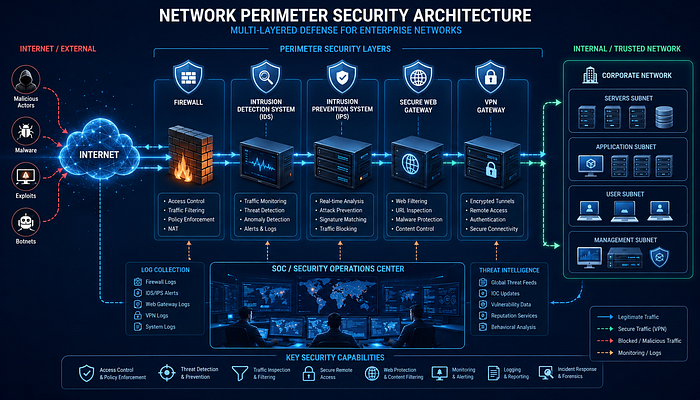
The network perimeter is the boundary between an organization's internal network and the outside world.
Think of it as the walls surrounding a castle.
Anything inside the walls is considered trusted, while everything outside is potentially dangerous.
Traditionally, cybersecurity focused heavily on protecting this perimeter because most threats originated from external attackers.
Simple Example
Imagine your home internet connection.
Your Wi-Fi router acts as a small perimeter device.
It:
- Blocks unwanted incoming traffic
- Allows legitimate communication
- Separates your devices from the internet
Organizations use more advanced technologies to perform the same function.
Common Perimeter Security Components
Firewalls
A firewall acts like a security guard at the entrance.
It examines traffic and decides whether to allow or block it based on predefined rules.
Examples:
- Allow web traffic (HTTP/HTTPS)
- Block unauthorized ports
- Restrict suspicious IP addresses
Intrusion Detection Systems (IDS)
An IDS monitors network activity and alerts administrators when suspicious behavior is detected.
Think of it as a surveillance camera that notifies security personnel when something unusual happens.
Intrusion Prevention Systems (IPS)
An IPS goes one step further.
Instead of only detecting attacks, it actively blocks them.
Secure Web Gateways
These solutions inspect internet traffic and prevent users from accessing malicious websites.
VPN Gateways
Virtual Private Networks (VPNs) allow remote employees to securely connect to corporate resources.
The Problem with Perimeter-Only Security
For years, organizations relied heavily on perimeter defenses.
The assumption was simple:
"If attackers can't get inside, we're safe."
Unfortunately, modern cyberattacks proved otherwise.
Attackers now gain access through:
- Phishing emails
- Stolen credentials
- Insider threats
- Vulnerable applications
- Third-party vendors
- Cloud misconfigurations
Once attackers enter the network, a weak internal architecture can allow unrestricted movement.
This is known as lateral movement.
A single compromised workstation can become a gateway to an entire organization.
That's why perimeter security alone is no longer enough.
What Is a DMZ (Demilitarized Zone)?
A DMZ, or Demilitarized Zone, is a separate network segment positioned between the internet and the internal network.
The concept comes from military terminology, where a DMZ refers to a buffer zone between opposing forces.
In cybersecurity, a DMZ acts as a security buffer between public-facing services and sensitive internal systems.
Why Organizations Use DMZs
Many services must be accessible from the internet:
- Websites
- Email servers
- DNS servers
- Application portals
- Customer-facing applications
These systems face constant attack attempts.
Instead of placing them directly inside the internal network, organizations place them in a DMZ.
This limits potential damage if one of these systems is compromised.
How a DMZ Works
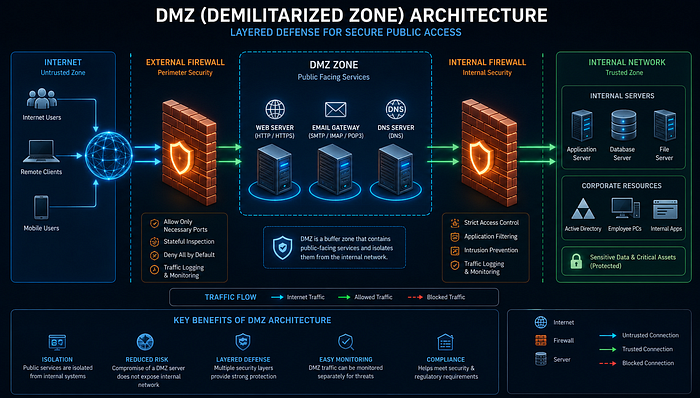
Consider an organization hosting a public website.
Without a DMZ:
Internet → Internal Network → Web Server
If attackers compromise the web server, they may gain direct access to internal resources.
With a DMZ:
Internet → Firewall → DMZ → Firewall → Internal Network
Now the web server sits inside the DMZ.
Even if attackers compromise it, they must still bypass another security layer before reaching internal systems.
This significantly reduces risk.
Typical Systems Found in a DMZ
Organizations commonly place the following services inside a DMZ:
Web Servers
Public websites accessed by customers.
Email Gateways
Mail servers receiving messages from external senders.
Reverse Proxies
Systems that handle incoming requests before forwarding them internally.
DNS Servers
Public-facing name resolution services.
API Gateways
Platforms that expose APIs to customers and partners.
Benefits of Using a DMZ
Reduced Attack Surface
Attackers cannot directly interact with critical internal systems.
Improved Isolation
Compromised public-facing services remain separated from sensitive resources.
Better Monitoring
DMZ traffic can be closely monitored for malicious activity.
Regulatory Compliance
Many compliance frameworks recommend or require network isolation for critical systems.
What Is Network Segmentation?
Network segmentation divides a network into smaller, isolated sections.
Instead of one large network, organizations create multiple controlled zones.
Think of a cruise ship.
If water enters one compartment, watertight doors prevent the entire ship from flooding.
Network segmentation follows the same principle.
A breach in one area should not compromise everything else.
Why Segmentation Matters
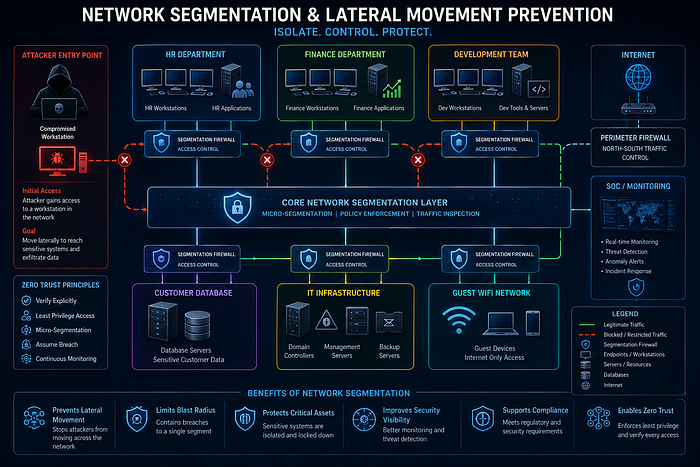
Many successful cyberattacks spread after the initial compromise.
Examples include:
- Ransomware outbreaks
- Worm-based malware
- Insider threats
- Credential theft
Without segmentation, attackers can move freely across systems.
With segmentation, their movement becomes restricted.
Real-World Example
Imagine a company with:
- HR department
- Finance department
- Development team
- Customer database
- Guest Wi-Fi
Without segmentation:
Everyone shares the same network.
A compromised guest device could potentially reach sensitive systems.
With segmentation:
Each department operates within its own network zone.
Access is controlled through security policies.
Compromising one segment does not automatically grant access to others.
Types of Network Segmentation
Physical Segmentation
Uses separate hardware and infrastructure.
Examples:
- Dedicated switches
- Separate routers
- Independent cabling
This provides strong isolation but can be expensive.
Logical Segmentation
Uses technologies such as:
- VLANs
- Firewalls
- Access control lists
Logical segmentation is more flexible and cost-effective.
Micro-Segmentation
A modern approach that creates extremely granular security controls.
Instead of protecting entire departments, organizations protect individual workloads, applications, or servers.
Micro-segmentation is widely used in cloud and Zero Trust environments.
Segmentation and Ransomware Defense
Ransomware is one of the biggest reasons organizations invest in segmentation.
Without segmentation:
One infected computer can encrypt hundreds or thousands of systems.
With segmentation:
The malware's ability to spread is significantly limited.
Security teams gain valuable time to detect and contain the attack.
This containment capability can mean the difference between a minor incident and a multi-million-dollar disaster.
Best Practices for Perimeter Security, DMZs, and Segmentation
Follow the Principle of Least Privilege
Users and systems should only have access to what they genuinely need.
Avoid excessive permissions.
Deploy Multiple Firewalls
Use layered security rather than relying on a single firewall.
Defense in depth remains one of the most effective security strategies.
Monitor Traffic Continuously
Visibility is critical.
Use:
- IDS
- IPS
- SIEM solutions
- Network monitoring tools
to identify threats quickly.
Segment Critical Assets
Protect:
- Databases
- Financial systems
- Domain controllers
- Cloud workloads
with dedicated network zones.
Secure the DMZ
Treat DMZ systems as high-risk assets.
Regularly:
- Patch servers
- Review configurations
- Monitor logs
- Conduct vulnerability assessments
Implement Zero Trust Principles
Modern security assumes no user or device should be trusted automatically.
Verify every request, regardless of location.
Common Mistakes Organizations Make
Treating the Firewall as the Entire Security Strategy
A firewall is important but insufficient on its own.
Creating a DMZ but Allowing Excessive Access
Poor firewall rules can undermine DMZ protection.
Ignoring Internal Threats
Many attacks originate from compromised internal accounts.
Overly Complex Segmentation
Complex designs become difficult to manage and maintain.
Lack of Visibility
You cannot protect what you cannot see.
Monitoring should accompany every security architecture.
The Future: From Perimeter Security to Zero Trust
Traditional cybersecurity assumed everything inside the network could be trusted.
That assumption no longer holds.
Cloud computing, remote work, mobile devices, and sophisticated attackers have fundamentally changed the threat landscape.
Today's security strategy combines:
- Strong perimeter defenses
- Well-designed DMZs
- Effective segmentation
- Continuous monitoring
- Zero Trust principles
Together, these controls create resilient security architectures capable of resisting modern cyber threats.
Key Takeaways
- Perimeter security forms the first line of defense against external threats.
- A DMZ creates a secure buffer zone between public-facing services and internal systems.
- Network segmentation divides networks into isolated zones to reduce attack spread.
- Segmentation significantly limits lateral movement during cyberattacks.
- Ransomware containment is one of the biggest benefits of network segmentation.
- Firewalls alone are not enough for modern cybersecurity.
- Combining perimeter security, DMZs, and segmentation creates a layered defense strategy.
- Zero Trust architectures build upon these concepts to provide stronger protection.
Conclusion
Cybersecurity is no longer about building a single wall and hoping attackers stay out.
Modern organizations must assume breaches can happen and design networks that limit the damage when they do.
Perimeter security blocks many threats. DMZs isolate internet-facing services. Network segmentation prevents attackers from moving freely across systems.
Together, these three concepts form the foundation of a resilient cybersecurity architecture.
As cyberattacks continue to grow in sophistication, organizations that embrace layered security will be far better positioned to protect their data, systems, customers, and reputation.
If you're beginning your cybersecurity journey, start by understanding these foundational concepts. Mastering perimeter security, DMZs, and segmentation will give you a strong understanding of how modern networks are designed to withstand real-world attacks.