
When Security Controls Look Good on Paper but Fail in Production
A SaaS company can have MFA enabled, security policies documented, and compliance frameworks mapped perfectly, yet still expose customer data through a simple API request.
That's the uncomfortable reality many CTOs discover during enterprise security reviews or ISO 27001 audits.
The problem is not always missing controls.
The problem is untested controls.
Modern SaaS platforms are heavily dependent on APIs, distributed services, role-based access systems, and rapid deployment cycles. Under that complexity, security gaps often hide inside business logic rather than infrastructure.
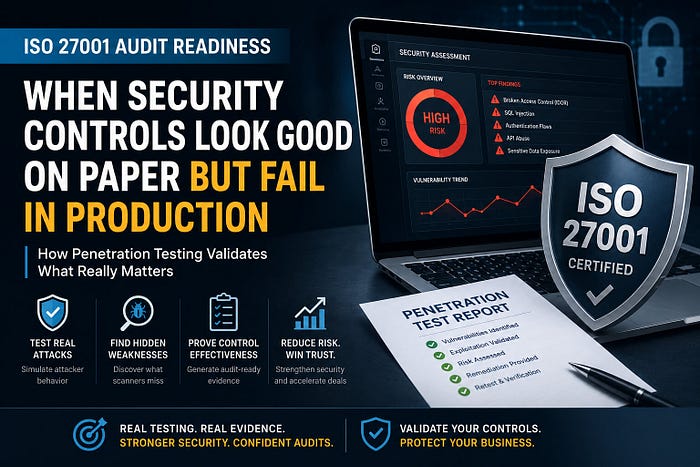
Before pursuing audit readiness, many teams should first check their application for security gaps and identify whether obvious exposure already exists in production.
Why This Becomes a Business Problem Fast
Security vulnerabilities today rarely stay "technical."
A single authorization flaw can create:
- Cross-tenant data exposure
- Compliance issues during ISO 27001 or SOC 2 reviews
- Delayed enterprise procurement approvals
- Customer trust damage
- Emergency remediation costs
OWASP continues to rank Broken Access Control among the most critical application security risks because it consistently appears in real-world environments.
For SaaS companies, this matters even more because customer trust is tied directly to data isolation and platform integrity.
A buyer may never ask about your infrastructure stack.
But they will ask whether another tenant can access their data.
A Realistic Attack Scenario Most Teams Miss
During a penetration test, an API endpoint was discovered that returned invoice information based on a customer ID supplied in the request.
The application required authentication. The user was logged in legitimately. Everything appeared secure.
But when the object ID changed from:
/api/invoices/1201
to:
/api/invoices/1202
…the API returned another customer's financial records.
This is a classic IDOR vulnerability and a form of broken object-level authorization. OWASP specifically highlights this as one of the most dangerous API security issues because APIs commonly expose object identifiers directly in requests.
The attacker mindset is straightforward:
- Create a normal account
- Observe API requests
- Modify identifiers
- Test authorization boundaries
- Escalate access quietly
No malware. No sophisticated tooling. No advanced persistence.
Just weak authorization logic.
This is exactly why SaaS companies should regularly test their application against real attack scenarios before enterprise customers or auditors discover the weakness first.
Why Automated Security Tools Miss These Vulnerabilities
Automated scanners are useful for identifying known patterns:
- Missing security headers
- Known CVEs
- Outdated components
- Simple injection flaws
But scanners struggle with:
- Business logic abuse
- Tenant isolation testing
- Multi-step workflows
- Privilege escalation chains
- API authorization complexity
A scanner cannot fully understand whether a user should access a specific object under a specific workflow condition.
Humans can.
That distinction matters.
OWASP's API Security guidance repeatedly emphasizes authorization weaknesses because APIs expose direct access paths into sensitive business functions.
The same issue appears in authentication testing.
We still regularly see:
- Weak session handling
- Missing rate limiting
- GraphQL batching abuse
- Broken reset workflows
- Inconsistent role validation
OWASP specifically notes that attackers abuse weak authentication controls to accelerate credential attacks and bypass protections.
Why Manual Penetration Testing Still Matters
This is where a manual penetration testing approach becomes valuable.
Real penetration testing is not just scanning.
It involves:
- Manual exploit validation
- Authentication testing
- Authorization analysis
- API workflow abuse
- Chained attack simulation
- Business logic review
The goal is not simply to "find vulnerabilities."
The goal is to validate whether the controls actually work under realistic attacker behavior.
That difference is critical for:
- ISO 27001 audit readiness
- SOC 2 evidence collection
- Enterprise customer security reviews
- SaaS risk reduction
Strong testing also produces better evidence.
Instead of generic scan output, engineering and compliance teams receive:
- Exploit proof
- Risk context
- Remediation guidance
- Retest validation
- Executive-level reporting
If your SaaS platform relies heavily on APIs, API security testing should be treated as core infrastructure validation, not optional coverage.
What Security Leaders Should Actually Look For
One of the biggest mistakes companies make is selecting penetration testing vendors based only on price or automated scan volume.
Effective testing for SaaS platforms should include:
- Manual authorization testing
- API-specific assessment
- Multi-role validation
- Real exploit simulation
- Compliance-aligned reporting
Security leaders should also evaluate whether the provider understands SaaS business models and enterprise buyer expectations.
A weak pentest report may satisfy a checkbox internally.
But it often fails during customer due diligence reviews.
That's why mature organizations invest in a proper security assessment for SaaS platforms that aligns technical findings with business risk.
Final Takeaway
Most serious SaaS vulnerabilities are not hidden behind advanced exploitation.
They hide inside assumptions:
- "The API validates ownership."
- "The scanner would have caught it."
- "Authentication means authorization is secure."
- "The audit evidence is sufficient."
Those assumptions create risk.
Real security validation requires testing controls the same way attackers test them.
If your organization is preparing for ISO 27001, SOC 2, or enterprise procurement reviews, now is the right time to schedule a penetration testing consultation and validate whether your controls truly hold up under real-world attack conditions.