
Table of Content
TL;DR: The End of Static Pinning Abstract Problem Statement What SPKI is Why certificate-bound pinning breaks Why SPKI survives the new model CSR, issuance, and key continuity Pin lifetime is owned by the application Conclusion Next chapter References
TL;DR: The End of Static Pinning
Public TLS is accelerating. As certificate lifecycles shrink from years to just 47 days by 2029 , traditional certificate-bound pinning is becoming an operational liability. To survive this high-churn environment, developers must shift their trust anchors from the volatile certificate wrapper to the stable SubjectPublicKeyInfo (SPKI). By pinning the key identity rather than the certificate instance, you decouple your app's security from the CA's issuance cadence — ensuring your connections remain secure without breaking every six weeks.
Abstract
The operational model of public TLS has changed. Certificate validity is being reduced on a fixed schedule: 398 days today, 200 days from March 15, 2026, 100 days from March 15, 2027, and 47 days from March 15, 2029. Validation reuse windows are being reduced as well. Under that model, legacy certificate pinning stops being operationally viable, because the pinned object changes too frequently for client updates to remain a sane synchronization mechanism. [1][2]
The architectural consequence is direct. If pinning is retained, the pinned object can no longer be the short-lived certificate instance. It must move to a more stable trust object. That object is the certificate's SubjectPublicKeyInfo (SPKI). SPKI pinning does not eliminate key-management requirements, but it decouples certificate churn from client pin churn and is therefore the only operationally coherent continuation of pinning under the current public-TLS trajectory. [1][3][4]
1. Problem statement
Legacy SSL pinning assumed that a certificate was stable enough to serve as an application-level trust anchor. That assumption no longer holds. In the new public-TLS schedule, certificate replacement becomes a routine operational event rather than an occasional maintenance action. Once certificate validity drops to 200, then 100, then 47 days, certificate-bound pins inherit the same churn. At that point, the client is coupled to a server artifact whose lifecycle is too short for direct pinning to remain practical.
This is not primarily a cryptographic problem. It is an architectural one. The trust object selected by the pinning design has become too volatile. The issue is therefore not whether pinning is desirable in the abstract. The issue is that the original pinned object is no longer compatible with the operating cadence of public TLS. [1][2]
2. What SPKI is
In X.509, SubjectPublicKeyInfo is the certificate field that carries the subject public key together with the identifier of the algorithm used with that key. In ASN.1 terms, it is the structure:
SubjectPublicKeyInfo ::= SEQUENCE { algorithm AlgorithmIdentifier, subjectPublicKey BIT STRING }
This distinction matters. The certificate is a signed wrapper that includes issuer data, validity bounds, extensions, and other metadata. SPKI is the public-key identity component embedded inside that wrapper. Operational pinning typically binds to the hash of the DER-encoded SPKI rather than to the full certificate. That is what allows the trust object to remain stable across multiple certificate issuances. [3][4]
3. Why certificate-bound pinning breaks
Under the new TLS issuance schedule, certificate renewal frequency increases sharply. A leaf certificate that previously changed on a roughly annual cadence becomes an object that may change several times a year and, by 2029, on a cadence measured in weeks. Domain and IP validation reuse windows also tighten. This turns certificate replacement into a high-frequency operational process.
If the application pins the certificate instance, then each certificate replacement becomes an application-compatibility event. The client pin must be updated, released, distributed, and adopted by the installed population before the backend transition begins to fail. That model is no longer credible once certificate churn becomes routine. The break is structural: the pin is attached to the wrong PKI object.
Under the modern public-TLS schedule, certificate-bound pinning is not merely inconvenient. Its operational model is broken. [1][2]
4. Why SPKI survives the new model
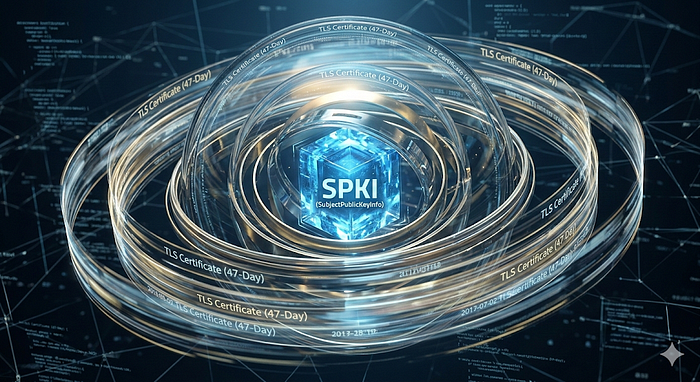
SPKI pinning moves the pin from the short-lived certificate wrapper to the public-key identity carried inside it. That is the architectural correction. A certificate may be renewed repeatedly while preserving the same SPKI, provided issuance continues over the same keypair. The certificate changes; the key identity does not. [3][4]
This is why SPKI pinning is the only defensible form of pinning under the 47-day model. It allows certificate replacement to occur on the cadence required by public PKI without forcing the client pin to move at the same speed. The pin is no longer bound to certificate lifetime. It is bound to key identity. [1][3][4]
SPKI continuity, however, is not created by renewal alone. It is produced by an explicit key-lifecycle decision: renewal may preserve the existing keypair, or it may introduce a new one. Those are different operational outcomes. Once key continuity is treated as a design parameter rather than an accidental byproduct of certificate renewal, SPKI becomes stable enough to serve as the client trust anchor under short certificate lifetimes. [5]
5. CSR, issuance, and key continuity
A Certificate Signing Request carries the subject identity attributes, the public key to be certified, and a signature created with the corresponding private key. The CA uses that request as the input for certificate issuance. The key point is simple: the CSR reflects whichever keypair is chosen for issuance. [4]
This is why SPKI continuity is a design choice rather than a side effect. If renewal CSRs are generated over the same keypair, the resulting certificates retain the same SPKI and the in-app SPKI pin remains valid across successive certificate issuances. If issuance moves to a new keypair, the SPKI changes, and the client trust set must already account for that future key identity. [4][5]
Under the short-lifetime TLS model, certificate renewal and key rotation therefore have to be decoupled. Certificate renewal follows the cadence imposed by the public-TLS ecosystem. Key rotation remains a separate architectural event governed by custody model, cryptoperiod, and operational readiness. Those two lifecycles can no longer be treated as identical. [1][5][6]
6. Pin lifetime is owned by the application
Once pinning is moved to SPKI, certificate lifetime and pin lifetime are no longer the same variable. Certificate validity may fall to 47 days, yet the in-app pin may remain stable far longer because the pinned object is the key identity rather than the current certificate instance. In practice, pin lifetime is determined by the application's shipped pinset, its key-rotation schedule, and whether future key identities are already present as backup pins.
That is the operational shift that matters. Under certificate-bound pinning, the public CA issuance cadence dictated the practical lifetime of the client pin. Under SPKI pinning, the application owner regains control of that timeline. Certificates may rotate frequently; the pin only needs to rotate when the key identity rotates. [1][5]
7. Conclusion
The modern public-TLS model invalidates the assumptions on which legacy certificate pinning depended. Certificate lifetime is now short enough that pinning the certificate instance directly no longer scales as a client-side trust strategy. The issue is not cosmetic. The operational model itself has failed. [1][2]
SPKI pinning is the architectural correction because it moves the pin from a volatile issuance artifact to a stable key-identity object. It does not remove the need for key policy, backup pins, or planned key rotation. It does restore the one property that now matters most: the pinned object remains stable across routine certificate churn. Under the current trajectory toward 47-day public TLS certificates, SPKI is not simply a better variant of pinning. It is the only form of pinning that remains operationally coherent. [1][3][5]
Next chapter
From architecture to code: implementing SPKI pinning correctly in Android and iOS.
References
[1] DigiCert, TLS Certificate Lifetimes Will Officially Reduce to 47 Days https://www.digicert.com/blog/tls-certificate-lifetimes-will-officially-reduce-to-47-days
[2] CA/Browser Forum, Baseline Requirements for the Issuance and Management of Publicly-Trusted TLS Server Certificates https://cabforum.org/working-groups/server/baseline-requirements/requirements/
[3] RFC 5280, §4.1.2 and §4.1.2.7, Internet X.509 Public Key Infrastructure Certificate and Certificate Revocation List (CRL) Profile https://datatracker.ietf.org/doc/html/rfc5280
[4] RFC 2986, §4.1, PKCS #10: Certification Request Syntax Specification https://datatracker.ietf.org/doc/html/rfc2986
[5] DigiCert Documentation, Renewal settings https://docs.digicert.com/en/iot-trust-manager/certificate-templates/create-json-formatted-certificate-templates/renewal-settings.html
[6] NIST SP 800–57 Part 1 Rev. 5, Recommendation for Key Management https://csrc.nist.gov/pubs/sp/800/57/pt1/r5/final