
When people talk about AI in security, it's usually about detection, automation, or scanning. For me, the biggest impact has been somewhere much simpler: writing vulnerability reports and handling triage communication.
I'm a software developer by profession and a security researcher by passion. I hunt bugs in my free time. That means I don't always have hours to carefully write long, structured vulnerability reports that explain impact, risk, reproduction steps, and edge cases in a way that makes triagers happy.
And if you've ever used Bugcrowd or any bug bounty platform, you know one thing:
A good bug can still be rejected if the report isn't clear.
My first experiment with AI
Early in my security research journey, I decided to try AI for writing my first Bugcrowd report. I gave it:
- What I found
- How I found it
- Why it mattered
It produced a clean, well-structured report: steps to reproduce, impact, and technical explanation — in a format that felt exactly like something a triager would want to read.
That report got accepted.
So I used it again. And again. And eventually it became my default way of reporting.
From writer to "bridge"
Later I realized something even more interesting.
Once a report is submitted, the real work often begins:
- Triagers ask for clarification
- Customers ask questions
- Proof of impact is requested
- Scope or severity is challenged
Normally, this back-and-forth eats a lot of time.
So I started feeding those comments back into AI — along with the original report it had written — and asked it to draft replies. Because it already had the full context of the vulnerability, the responses were usually:
- Technically accurate
- Clear
- Calm and professional
At that point, I stopped thinking of AI as a "writer" and more as a co-pilot.
I became the human in the loop — checking, adjusting, and sending — but the heavy lifting was done.
The result
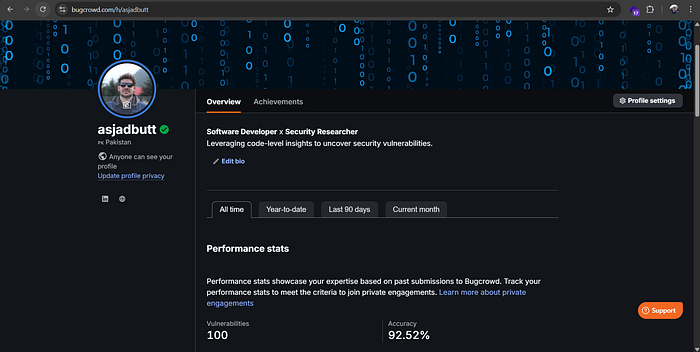
Today I've crossed 100 valid vulnerabilities on Bugcrowd, and AI wrote every single one of those reports.
That doesn't mean AI found the security vulnerabilities. I did.
But it removed the friction between finding a vulnerability and getting it accepted.
Instead of spending my limited free time formatting reports and arguing over wording, I spend it doing what I enjoy most: finding security issues.
Final thoughts
AI didn't make me a better hacker. It made me a more efficient one.
And in security research, efficiency is everything.
— Asjad Butt