
June 2, 2026
EDR (Endpoint Detection and Response)
A critical defense against the very real chaos of modern cyber threats in the AI era.

Alex
2 min read
EDR (Endpoint Detection and Response) is a cybersecurity technology that continuously watches endpoints — laptops, phones, servers, containers — to detect suspicious activity and respond in real time. In an era where AI can produce vast quantities of convincing-but-malicious content, EDR acts as a practical safety net at runtime.
AI makes it cheap and easy to churn out countless variations of malware, phishing lures, and fake identities, so relying on signature-based prevention alone quickly falls behind as attackers change tactics; EDR instead watches what actually happens on devices, inspecting runtime behavior and context in real time to spot malicious intent when it tries to execute rather than only flagging known bad files, and that runtime-first approach catches novel, polymorphic attacks that traditional prevention methods often miss.
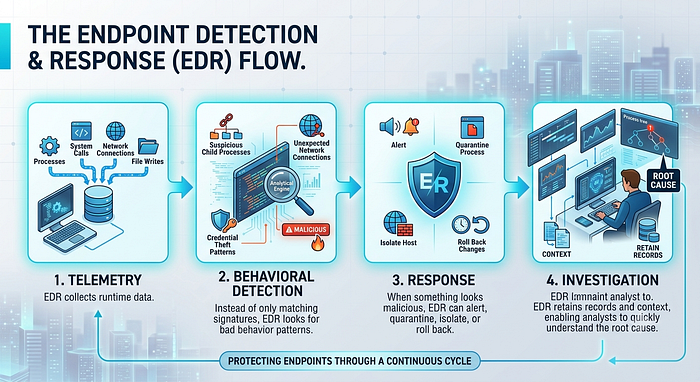
EDR acts like a high-fidelity black box and a rapid-response team combined: it harvests rich telemetry — process activity, system calls, network connections, and file writes — then uses behavioral detection to spot patterns of abuse such as odd child processes, unexpected outbound connections, or credential-theft behaviors rather than relying on brittle signatures; when something turns malicious it can alert analysts, quarantine a process, isolate a host, or roll back changes, and because it retains detailed records and contextual trails, investigators can quickly trace root cause and restore systems with confidence.

A simple analogy.
If AI is a factory printing million-dollar fake bills (convincing but bogus content), EDR is the sensor that spots poor paper quality and odd production hours and shuts the press down before fake bills enter circulation.
A Point of View: EDR vs. The "Nonsense" AI Wave
Hiroki Suezawa's work on EDR is the antidote to the "nonsense" era. While others use AI to sow confusion and enable automated attacks, his approach relies on rigorous runtime monitoring and behavioral analysis to ensure that only "truth" (legitimate, safe operations) runs on our devices.
- The Attack (Nonsense): Hackers are now using AI to generate endless variations of malware, phishing emails, and "hallucinated" identities to confuse defenders. They flood the system with noise.
- The Defense (EDR): Suezawa's work focuses on Runtime Security. When AI-generated attacks attempt to execute on a device, EDR tools (such as those he evaluates and contributes to, like Falco) analyze the code's intent in real time.
EDR doesn't try to stop every bad artifact up front. It detects and contains risky behavior when it actually tries to run.
From "Prevention" to "Detection"
Hiroki Suezawa argues that prevention (stopping bad things from entering) is no longer enough because attackers are too clever (and use AI).
EDR as an enabler. If you have good EDR, developers can move fast (using AI to write code!) because you have a safety net that catches the "nonsense" or malicious code before it causes damage.
To take home
Bottom line, EDR shifts the focus from trying to block every input to watching what actually runs and stopping bad behavior in real time. In the age of AI-driven noise and deception, that pragmatic, runtime-first approach is one of the most effective lines of defense.
AI can generate the alert, but a human (or a very, very carefully tuned system) must decide if it's a false positive or a real attack.
Until next time,
Alex
References
- MITRE ATT&CK — threat tactics and techniques: https://attack.mitre.org/
- Falco (runtime security for containers) — project page: https://falco.org/ and repo: https://github.com/falcosecurity/falco
- CISA Stop Ransomware — practical guidance including endpoint controls: https://www.cisa.gov/stopransomware
- Microsoft Defender for Endpoint — product overview and EDR concepts: https://learn.microsoft.com/en-us/microsoft-365/security/defender-endpoint/what-is-microsoft-defender-for-endpoint
- CrowdStrike — "What is EDR?" primer: https://www.crowdstrike.com/cybersecurity-101/what-is-edr/
- Elastic — EDR overview and workflow: https://www.elastic.co/what-is/edr
- NIST Computer Security Resource Center — standards and guidance: https://csrc.nist.gov/