

Why PCI DSS 4.0 Is Exposing Security Gaps Most SaaS Companies Never Knew They Had
Many SaaS companies believe they're prepared for PCI DSS 4.0 because they already run vulnerability scans.
Then the QSA review starts.
Suddenly, hidden API flaws, broken access control issues, weak authentication logic, and segmentation gaps become major compliance blockers.
What's happening now is bigger than compliance.
PCI DSS 4.0 is forcing organizations to confront a reality many security teams already know:
Automated scanning alone does not represent real security.
For modern payment platforms, APIs, cloud infrastructure, and SaaS environments, attackers move far beyond simple vulnerability detection. They chain weaknesses together and exploit business logic the way real users interact with applications.
That's exactly why many organizations are now rushing to check their application for security gaps before formal PCI assessments begin.
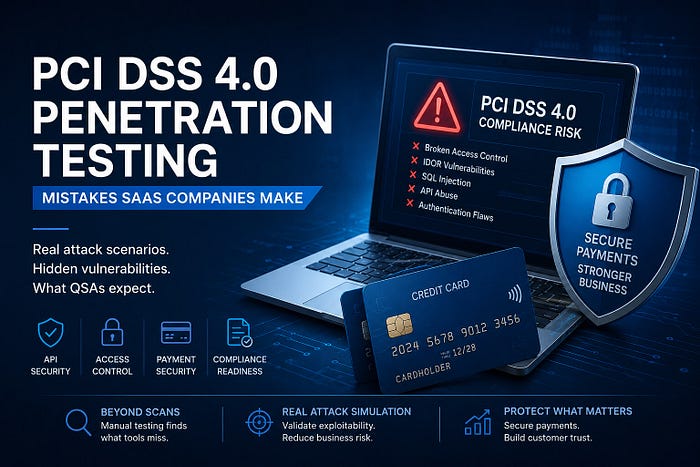
The Problem Most Teams Don't Realize Exists
Modern SaaS applications evolve quickly.
New APIs are deployed weekly. Microservices grow over time. Authentication systems become fragmented across products. Legacy workflows remain exposed long after development priorities shift.
Eventually, security visibility breaks down.
On paper, everything looks compliant:
- Vulnerability scans pass
- SSL configurations look clean
- Infrastructure patches are current
But attackers don't care about compliance dashboards.
They look for:
- Broken object-level authorization
- Exposed administrative APIs
- Weak session handling
- Authentication bypass opportunities
- Business logic flaws
- Misconfigured cloud access paths
According to the OWASP API Security Project, broken authorization and authentication remain among the most dangerous API security risks facing organizations today.
A Real-World Attack Path Most Scanners Miss
Imagine a SaaS billing platform that processes recurring payment data for thousands of customers.
The company already completed:
- Vulnerability scanning
- Infrastructure reviews
- Basic compliance checks
Everything appeared secure.
But during manual testing, a penetration tester discovered an exposed API endpoint using predictable customer identifiers.
At first glance, the issue looked minor.
Then the tester chained additional weaknesses:
- Weak object-level authorization
- Missing rate limiting
- Reusable session tokens
- Inconsistent admin validation
Within hours, it became possible to:
- Access customer invoices
- Enumerate merchant records
- Modify billing workflows
- Extract internal API data
At the same time, a secondary SQL Injection vulnerability in a reporting feature exposed backend database structures.
This is how real attackers operate.
Not through isolated findings. Through exploit chains.
And this is exactly why organizations should test your application against real attack scenarios instead of relying entirely on automated tooling.
Why Automated Security Tools Keep Missing These Risks
Automated scanners are valuable.
But they have serious limitations.
They typically fail to understand:
- Business workflows
- Multi-step authorization logic
- Role-based access abuse
- API trust assumptions
- Tenant isolation flaws
For example, a scanner may confirm authentication exists.
But it cannot reliably determine whether one authenticated customer can access another customer's billing records through an IDOR vulnerability.
That's where manual testing becomes essential.
The OWASP Top 10 continues highlighting broken access control as one of the most critical application security risks.
In payment environments, these flaws often become audit failures and breach vectors simultaneously.
APIs Are Becoming the Largest PCI DSS 4.0 Risk Area
Most modern payment workflows rely heavily on APIs.
Unfortunately, APIs often introduce:
- Excessive data exposure
- Weak authorization controls
- Token abuse opportunities
- Insecure object references
- Hidden administrative functions
Attackers know APIs frequently receive less security scrutiny than traditional web applications.
That's why dedicated API security testing is becoming essential for PCI DSS 4.0 readiness.
In many environments, APIs effectively become direct pathways into payment systems.
Why PCI DSS 4.0 Is Raising Expectations
PCI DSS 4.0 significantly increases emphasis on:
- Manual testing
- Exploit validation
- Segmentation testing
- Authentication security
- Retesting after remediation
- Real-world attack simulation
QSAs are increasingly asking for evidence that organizations validated whether vulnerabilities are actually exploitable.
That changes everything.
A clean scan report is no longer enough.
Organizations must now demonstrate that security controls withstand realistic attack behavior.
This is also why many security leaders are trying to understand how manual penetration testing works before entering formal compliance reviews.
What Strong PCI-Focused Penetration Testing Looks Like
Effective testing goes beyond surface-level automation.
A proper engagement should include:
- Manual authentication testing
- API authorization validation
- Business logic abuse testing
- SQL Injection validation
- Privilege escalation testing
- Session security analysis
- Cloud exposure testing
- Segmentation verification
The goal isn't simply to produce findings.
The goal is to determine whether attackers can realistically compromise sensitive payment workflows.
That distinction matters enormously during PCI audits.
The Business Impact Is Bigger Than Compliance
For SaaS companies, PCI DSS failures often create downstream business problems:
- Enterprise deal delays
- Customer trust erosion
- Security questionnaire failures
- Cyber insurance complications
- Incident response costs
- Reputation damage
Security gaps directly impact growth.
And in highly competitive SaaS markets, trust is often a deciding factor during procurement reviews.
Final Thoughts
PCI DSS 4.0 is exposing a hard truth for many organizations:
Compliance does not automatically equal security.
Attackers continue exploiting APIs, broken access control, authentication weaknesses, and business logic flaws that automated tools fail to identify.
The companies that succeed under PCI DSS 4.0 will be the ones treating penetration testing as realistic security validation, not just an audit requirement.
If your organization handles payment workflows, APIs, or customer billing systems, now is the right time to schedule a penetration testing consultation and review whether your environment can withstand real-world attacks before your QSA review begins.
1 Bold / Contrarian Statement
Automated scanning alone is giving many SaaS companies a false sense of PCI compliance. (SecureLayer7)