June 3, 2026
Family · Health · Community
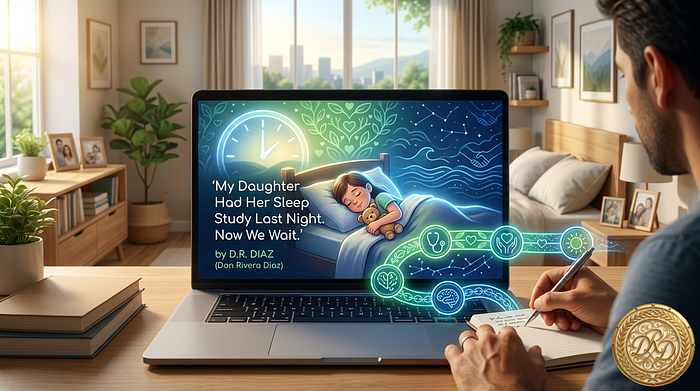
My Daughter Had Her Sleep Study Last Night. Now We Wait.
Don Rivera Diaz
3 min read
by D.R. DIAZ (Don Rivera Diaz)
She was brave. The sensors were everywhere. The results come today. While I sit with this quiet knot of parental worry, I want to hear from you — what has sleep, and the science of it, looked like in your life?
Parenting Sleep apnea Sleep study Family health Community
There is something uniquely humbling about watching your child get wired up for a sleep study. Not scary, exactly — the technicians are kind, the room is designed to feel as un-clinical as possible, and your kid is right there in front of you, alive and fine. It is just the particular vulnerability of seeing your daughter lying still with sensors taped to her scalp, her chest, her little fingers, understanding for the first time that something about the way she sleeps has been worth a whole night of medical attention.
That was yesterday. Her mom — my wife — was with her the whole time. I dropped them off, and then I drove home through the dark with that particular kind of helplessness that parents learn to carry: the knowledge that you have done everything you can for now, and now the doing is someone else's job.
She did well. That is the first thing I want to say. She went in there and she handled it. Kids are more resilient than we give them credit for, and mine proved it last night.
"She went in there and she handled it. Kids are more resilient than we give them credit for, and mine proved it last night."
What a sleep study actually is
A sleep study — formally called a polysomnography — is an overnight test where sensors monitor your body while you sleep. They track brain wave activity, oxygen levels in the blood, heart rate, breathing patterns, eye movement, and leg movement. Nothing is painful. Nothing is invasive in the traditional sense. You are simply observed, in extraordinary detail, doing the thing you do every night without thinking.
The whole point is to catch what happens that you cannot catch yourself, in the dark, when no one is watching. Apnea — from the Greek for "without breath" — is exactly that: moments where breathing stops or becomes so shallow it fails to do its job. Some people have dozens of these episodes per hour. Some have hundreds. Most have no idea it is happening.
The American Academy of Sleep Medicine estimates that sleep apnea affects somewhere between 10 and 30 percent of adults, with children accounting for a meaningful and often underdiagnosed portion of cases. In children, the signs can look different than in adults — not just loud snoring, but behavioral changes, difficulty focusing, restless sleep, even mood shifts that get written off as something else entirely.
The waiting part
We get the results today. I am writing this in the in-between hours, the ones that feel slightly too long. Not panicked — we are past panic, which passed somewhere around the third week of wondering. Just present with it. Waiting is its own kind of work.
What I know is this: whatever the results say, we will have information. Information is the thing you need to move forward. A diagnosis is not a verdict — it is a door that opens into options. A clear result either way gives us somewhere to go. That is the gift of the sleep study, whatever it finds.
"A diagnosis is not a verdict. It is a door that opens into options."
Now I want to hear from you
This is the part of Medium I love most — the fact that the comment section can become its own kind of community wisdom. I am asking genuinely, not rhetorically.
Questions for the community
Have you ever had a sleep study done? What was the experience like — for you, for a partner, for a child? Did you walk in expecting one result and leave with another?
Has sleep apnea touched your life in some way — a diagnosis, a loved one, a suspicion that was never followed up on?
What do you wish someone had told you before you went in? What did the results change for you, practically, day to day?
What has your relationship with sleep been like — easy, fractured, medicated, mystifying? Do you feel like you actually rest when you rest?
Sleep is one of those things we assume we understand because we do it every night. Then you learn that the body keeps an entirely different log of what happens during those hours — one you never get to read without help. There is something almost strange about that. Eight hours of your life, every night, that you are present for and simultaneously absent from.
My daughter spent last night in a monitored room while her brain and lungs and heart had a conversation with medical equipment. Today we find out what they said. Whatever it is, we are ready to listen.
· · ·
If you have been through this — as a parent, as a patient, as someone who sat in the waiting and drove home through the dark — I would genuinely love to read your story in the comments. There is no wrong answer here. There is only the truth of what it was like for you. That is exactly what I am looking for today.
Results pending. Updates to follow. Thank you for being the kind of community that makes the waiting feel less alone.