
The digital asset landscape in India has undergone a major shift over the last few years. Following the introduction of a strict fiscal framework — including a flat 30% tax on profits from Virtual Digital Assets (VDAs) and a 1% Tax Deducted at Source (TDS) on transactions — many Indian crypto users have adjusted their trading habits. Instead of keeping all their capital on centralized domestic exchanges, a growing number of investors are moving toward self-custody solutions like Trust Wallet.
However, moving to a non-custodial wallet introduces its own set of technical, regulatory, and security realities. Below is an informative breakdown of what you need to know when using Trust Wallet in India.
1. Understanding Self-Custody: How Trust Wallet Works
A common misconception is that crypto wallets store digital coins directly inside an app on your phone. In reality, your digital assets exist permanently on public, decentralized block ledgers (such as Ethereum, Bitcoin, or BNB Chain).
Trust Wallet functions purely as a localized dashboard and a secure manager for your private keys. When you set up the app, it generates a unique 12- or 24-word master seed phrase. This phrase is used to cryptographically sign and authorize transactions on the blockchain.
Core Features of Trust Wallet
- Counterparty Risk Isolation: Because you hold your own private keys, your funds are completely insulated from third-party exchange issues, bankruptcies, or platform freezes.
- Permissionless Access: Users can interact directly with decentralized applications (dApps), swap tokens, and explore decentralized finance (DeFi) without relying on a centralized intermediary.
- No Initial Identity Verification (KYC): Setting up a wallet relies on pure cryptography rather than submitting documents like an Aadhaar or PAN card. However, as explained below, this privacy does not mean transactions are completely anonymous.
2. Regulatory Reality: FIU-IND and the PMLA
The Financial Intelligence Unit of India (FIU-IND) brought Virtual Digital Asset Service Providers (VASPs) under the strict purview of the Prevention of Money Laundering Act (PMLA). Centralized exchanges operating in India are required to register with the FIU, enforce strict KYC policies, and report suspicious financial activities.
Non-custodial software applications like Trust Wallet is legal in India niche. Because Trust Wallet is a decentralized software application — meaning it does not take custody of user funds or manage centralized user accounts — it does not operate as a traditional VASP business entity.
As a result, it remains entirely legal for individuals in India to download and use self-custody apps to manage their private cryptographic keys. There is no federal ban on owning or utilizing a private wallet.
3. The Myth of Total Anonymity
While Trust Wallet doesn't require you to complete a KYC process to generate a seed phrase, every single transaction you make is recorded permanently on a public blockchain ledger. The wallet address, timestamps, and token volumes are fully viewable on public block explorers.
The Indian Income Tax Department and law enforcement use advanced data analytics to trace public wallet trails back to real-world identities. The pseudo-anonymous wall of a self-custody wallet is typically broken when:
- On-Ramping or Off-Ramping: Transferring assets from your private wallet to an FIU-registered exchange to cash out into Indian Rupees (INR).
- P2P Trading: Sourcing assets from or sending them to peer-to-peer trading counterparties whose bank accounts or exchange accounts are tied to verified PAN cards.
- Initial Funding Tracks: Sourcing gas fees or startup crypto directly from a KYC-verified account to a private wallet address.
4. Navigating the 30% VDA Tax Framework
From a tax perspective, the Indian government treats all virtual digital assets strictly. Under Section 115BBH of the Income Tax Act, net profits generated from the transfer of VDAs are taxed at a flat 30% rate.
Crucially, the legal code does not allow individuals to offset losses from one token against gains made in another. Furthermore, you cannot deduct business expenses, mining costs, or wallet gas fees from your taxable income calculation.
Compliance for Self-Custody Users
Because Trust Wallet is decentralized code, it does not generate annual tax forms, calculate your cost basis, or report data automatically to the Indian government. Tracking transactions is the absolute responsibility of the individual.
To stay compliant and avoid steep penalties under updated Finance Act provisions (such as flat fines for inaccurate declarations), users should:
- Maintain Meticulous Records: Track the exact acquisition cost, sale price, and timestamp for every on-chain swap or transfer.
- Use Specialized Tools: Leverage dedicated crypto tax software to import public wallet addresses and auto-generate compliance reports.
- Reconcile with the AIS: Ensure self-reported figures line up smoothly with data captured in your official Annual Information Statement (AIS) and Form 26AS.
5. Essential Security Practices for Indian Web3 Users
While self-custody protects you from exchange failures, it removes the security nets of traditional finance. If you make a mistake or fall victim to a scam, there is no customer support team that can reverse the transaction.
Guarding Against Common Threat Vectors
- Phishing Scams: Scammers frequently set up fake support accounts on platforms like X (Twitter), Telegram, and WhatsApp. They look for users asking technical questions and try to trick them into entering their 12-word seed phrase on fake validation sites. Never share your seed phrase with anyone.
- Malicious Smart Contract Approvals: Be incredibly cautious when connecting your wallet to unvetted dApps or clicking promotional "airdrop" links. Some malicious sites prompt you to sign an unlimited approval transaction (setApprovalForAll). Once signed, the attacker gains full authority to drain your tokens directly from the blockchain.
- Address Poisoning: Attackers use bots to send tiny, zero-value transfers to your wallet from addresses that look nearly identical to your regular transaction contacts (matching only the first and last few characters). They do this hoping you will accidentally copy the wrong address from your history when making future transfers. Always double-check every character of a destination address.
Summary Checklist for Trust Wallet Users
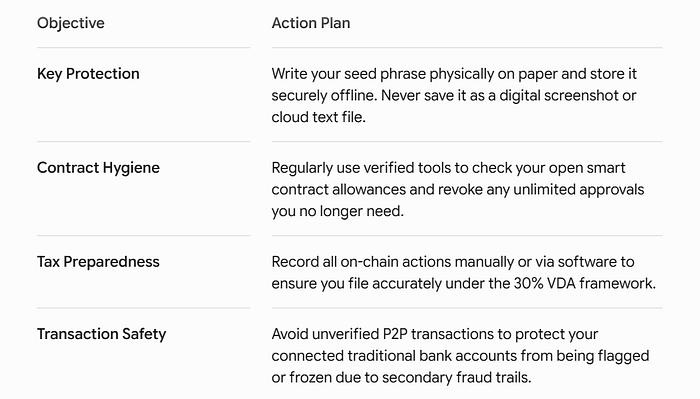
By treating your private keys as highly sensitive physical property and taking a proactive approach to tax compliance, you can safely leverage the benefits of decentralized technology within India's regulatory framework.