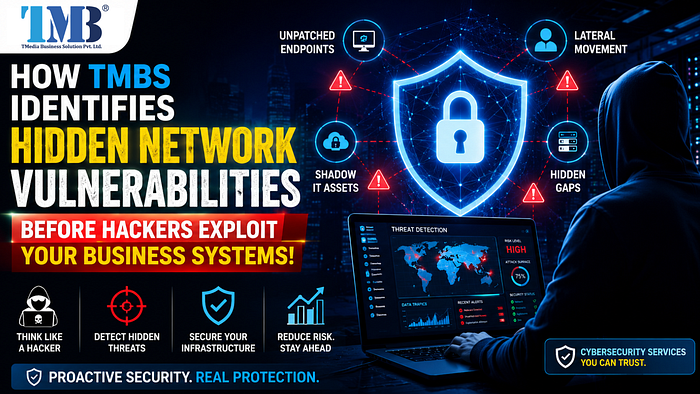

Most attackers move quietly.
They exploit hidden vulnerabilities, unpatched systems, weak internal permissions, and unmanaged devices long before businesses realise their infrastructure has already been compromised.
The biggest cybersecurity risk today is no longer just preventing attackers from entering the network.
It's understanding what happens after they get inside.
That's why proactive cybersecurity is becoming essential for modern organisations operating across cloud infrastructure, hybrid environments, and connected enterprise systems.
Why Traditional Security Is No Longer Enough
For years, businesses relied heavily on perimeter security:
- Firewalls
- Antivirus tools
- Intrusion prevention systems
- Basic endpoint protection
While these technologies still matter, modern attack methods have evolved significantly.
Today's attackers focus on:
- Credential abuse
- Privilege escalation
- Cloud misconfigurations
- Lateral movement
- Shadow IT
- Weak internal segmentation
Once a single vulnerable endpoint is compromised, attackers often move silently through internal systems without triggering traditional security alerts.
This is especially dangerous for organizations operating in:
- Hybrid work environments
- Multi-cloud ecosystems
- Remote workforce infrastructures
- Legacy IT networks
Many businesses unknowingly expose critical infrastructure through unmanaged assets and outdated systems.
The Shift Toward Proactive Cybersecurity
Modern cybersecurity requires a completely different mindset.
Instead of reacting after a breach occurs, organisations now need to identify vulnerabilities before attackers exploit them.
This is where advanced penetration testing and adversarial simulations become important.
By thinking like attackers, cybersecurity teams can uncover:
- Hidden vulnerabilities
- Weak access controls
- Misconfigured systems
- Unsecured APIs
- Internal trust weaknesses
- Legacy infrastructure gaps
The objective is not simply identifying technical flaws.
It's understanding how attackers could navigate the environment in a real-world attack scenario.
Why Lateral Movement Is So Dangerous
One of the most dangerous techniques used in modern cyberattacks is lateral movement.
After gaining access to a single system, attackers attempt to spread internally across the network while avoiding detection.
This allows them to:
- Escalate privileges
- Access sensitive data
- Compromise additional systems
- Deploy ransomware
- Disrupt operations
Many traditional security environments focus heavily on external defense while leaving internal infrastructure pathways exposed.
Organizations that fail to monitor internal traffic often discover breaches only after major damage has already occurred.
The Hidden Risk of Shadow IT
One of the fastest-growing cybersecurity problems is shadow IT.
Shadow IT refers to systems, devices, applications, or cloud services operating outside official security governance.
Examples include:
- Personal employee devices
- Unmanaged SaaS tools
- Temporary third-party integrations
- Forgotten legacy systems
- Unapproved cloud resources
These assets frequently remain invisible to traditional monitoring tools.
As hybrid work environments expand, shadow IT dramatically increases the organizational attack surface.
Businesses cannot secure infrastructure they cannot see.
Why Infrastructure Visibility Matters
Modern cybersecurity is heavily dependent on visibility.
Organizations need continuous awareness across:
- Endpoints
- Cloud workloads
- Authentication systems
- APIs
- Network traffic
- User behavior
- Infrastructure logs
Without infrastructure visibility:
- Threat detection becomes delayed
- Incident response slows down
- Attack paths remain hidden
- Compliance becomes difficult
- Operational risk increases
This is why Security Operations Centers (SOC), continuous monitoring, and infrastructure observability are becoming critical for enterprise cybersecurity.
Unpatched Endpoints Remain One of the Biggest Risks
Many cyberattacks still succeed because of something surprisingly simple:
Unpatched systems.
Attackers continuously scan networks searching for:
- Outdated operating systems
- Unsupported software
- Vulnerable remote access services
- Weak endpoint configurations
Even one vulnerable device can expose an entire organization.
Proactive vulnerability assessment helps organizations:
- Identify missing patches
- Prioritize high-risk systems
- Reduce exploit exposure
- Strengthen endpoint security posture
The goal is not temporary fixes.
The goal is long-term infrastructure resilience.
Cybersecurity Must Be Continuous
Cybersecurity is not a one-time project.
Threats evolve constantly.
Organizations now require:
- Continuous monitoring
- Threat intelligence
- Vulnerability assessments
- Infrastructure hardening
- Identity and access governance
- Incident response readiness
Security teams must continuously adapt as infrastructure environments grow more complex.
Reactive security strategies are no longer sustainable in modern digital ecosystems.
Building Resilient Infrastructure
Strong cybersecurity today depends on a layered security architecture.
Modern organisations are increasingly implementing:
- Zero Trust frameworks.
- Multi-factor authentication (MFA).
- Network segmentation.
- Endpoint detection and response (EDR).
- Security monitoring systems.
- Infrastructure logging and observability.
- Access governance controls.
The objective is not only to prevent attacks.
It's reducing the blast radius when incidents occur.
Organizations capable of detecting threats early and responding quickly dramatically improve operational resilience.
Final Thoughts
Modern cyber threats are becoming more sophisticated, quieter, and harder to detect.
Businesses can no longer rely solely on traditional perimeter defences.
The future of cybersecurity depends on:
- Visibility
- Proactive testing
- Infrastructure resilience
- Continuous monitoring
- Threat simulation
- Operational readiness
Organisations that identify vulnerabilities before attackers do will be significantly better positioned to protect infrastructure, maintain trust, and reduce long-term cybersecurity risk.
Optional Source Link
Link: [Insert YouTube or TMBS video link]