

Web applications power everything from online banking to learning platforms — but they're also prime targets for attackers. Some of the most dangerous and widely exploited web application vulnerabilities are SQL Injection (SQLi), Cross-Site Scripting (XSS), and Cross-Site Request Forgery (CSRF).
This guide breaks each one down in plain language, shows real-world examples, explains why they're dangerous, and shares practical tools used by developers and security professionals to detect and prevent them.
1. SQL Injection (SQLi)
What Is SQL Injection?
SQL Injection occurs when an attacker manipulates user input to execute malicious SQL queries against a database. If input is not properly validated, the database may run commands the developer never intended.
In simple terms: 👉 The attacker tricks your app into talking to the database in a dangerous way.
SQL Injection Example
Imagine a login form:
SELECT * FROM users WHERE username = 'admin' AND password = 'password'
If the application does not sanitize input, an attacker could enter:
' OR Ƈ'=Ƈ
The query becomes:
SELECT * FROM users WHERE username = '' OR Ƈ'=Ƈ'
✅ Result: The attacker logs in without knowing a password.
Why SQL Injection Is Dangerous
- Unauthorized access to sensitive data
- Ability to modify or delete databases
- Complete system compromise
- Regulatory and legal consequences
How to Prevent SQL Injection
- Use parameterized queries / prepared statements
- Validate and sanitize all user input
- Apply the principle of least privilege to database accounts
- Avoid dynamic SQL when possible
Helpful SQLi Tools
- OWASP ZAP — Scan apps for injection flaws
- SQLMap — Automated SQL injection testing
- Burp Suite — Intercept and analyze requests
2. Cross-Site Scripting (XSS)
What Is Cross-Site Scripting?
XSS happens when an attacker injects malicious JavaScript into a website that then runs in another user's browser.
Instead of attacking the server, XSS attacks the user.
XSS Example
A comment box that doesn't filter input:
<script>alert('Hacked!')</script>
When another user views the comment:
- The browser executes the script
- Cookies, session tokens, or keystrokes can be stolen
Types of XSS
- Stored XSS — Malicious code saved in a database
- Reflected XSS — Script reflected via URL or input
- DOM-Based XSS — Exploits client-side JavaScript logic
Why XSS Is Dangerous
- Session hijacking
- Credential theft
- Defacement
- Malware delivery
How to Prevent XSS
- Escape output (HTML encoding)
- Use Content Security Policy (CSP)
- Sanitize all user-generated content
- Avoid directly injecting user input into the DOM
Helpful XSS Tools
- OWASP ZAP — Detect XSS vectors
- Burp Suite — Payload testing
- Browser DevTools (Chrome / Firefox)
3. Cross-Site Request Forgery (CSRF)
What Is CSRF?
CSRF tricks an authenticated user into unknowingly sending a malicious request to a web application.
The app trusts the request because it comes from a logged-in user's browser.
CSRF Example
You're logged into your bank. You click a malicious link:
<img src="https://bank.com/transfer?amount=5000&to=attacker">
💥 The bank processes the transfer — without your consent.
Why CSRF Is Dangerous
- Unauthorized transactions
- Account changes
- Data manipulation
- Abuse of user trust
How to Prevent CSRF
- Use CSRF tokens
- Enforce SameSite cookies
- Require re-authentication for sensitive actions
- Avoid state-changing requests via GET
Helpful CSRF Tools
- OWASP CSRF Cheat Sheet
- Burp Suite — CSRF PoC generation
- Framework protections (ASP.NET Core, Django, Spring)
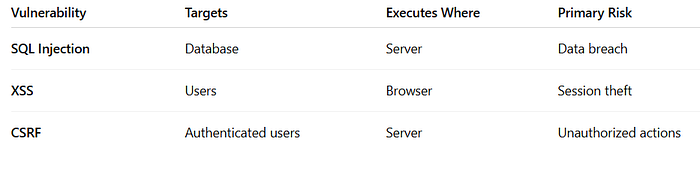
SQLi vs XSS vs CSRF (Quick Comparison)
Why These Vulnerabilities Still Exist
- Poor input validation
- Over-trusting user data
- Legacy codebases
- Lack of security testing
Attackers don't need advanced exploits — just one weak input field.
Best Practices for Secure Web Applications
- Validate every input
- Encode every output
- Use modern frameworks with built-in protections
- Perform regular security testing
- Follow secure coding standards
Final Thoughts
SQL Injection, Cross-Site Scripting, and Cross-Site Request Forgery remain some of the most critical web application vulnerabilities because they exploit trust — between users, browsers, and servers.
Understanding how they work isn't just for security professionals. Developers, students, and IT teams who grasp these concepts build safer, more resilient applications from day one.

Thank you for reading this blog article.

More books available on Amazon. Click my Authors page link to check them all out — Dennis Duke Authors Page
If you like this blog and want to read more feel free to follow me on Medium. More to come and thanks for the support.
You can find more of my blog articles here