Next-Gen Recon Automation for Modern Pentesters
Reconnaissance is one of the most important phases in cybersecurity. The more intelligence you collect, the better your attack surface understanding becomes.
Traditional recon tools are powerful — but often:
- Command-heavy
- Complex for beginners
- Difficult to visualize
- Hard to automate intelligently
That's where Recon-ng UI comes in.
Built around the well-known Recon-ng framework, this project introduces a more modern experience by combining:
🔍 Recon-ng + 🧠 AI Models + 🖥️ User-Friendly Interface
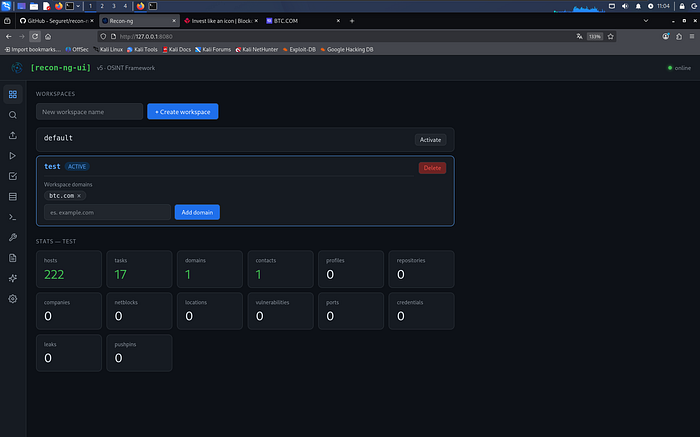
🚀 What is Recon-ng UI?
Recon-ng UI is a graphical interface built for the Recon-ng reconnaissance framework.
The project aims to simplify OSINT and reconnaissance workflows by providing:
- Better visualization
- Easier module management
- AI-assisted workflows
- Improved usability
Instead of relying only on terminal commands, users can interact with recon modules through a cleaner interface.
The original Recon-ng framework itself is widely known as a modular OSINT reconnaissance platform used by red teams and pentesters.
🧠 Why Combine AI with Reconnaissance?
Modern reconnaissance generates massive amounts of data:
- Domains
- Subdomains
- Emails
- IP addresses
- Metadata
- Open ports
- Leaked assets
The challenge is no longer collecting data…
👉 It's understanding the data quickly.
AI models help solve this by:
- Summarizing findings
- Identifying patterns
- Prioritizing targets
- Automating analysis
- Reducing manual effort
⚙️ Key Features of Recon-ng UI
🖥️ Visual Interface for Recon-ng
Traditional Recon-ng works through CLI commands.
Recon-ng UI provides:
- Easier navigation
- Better workflow management
- Improved accessibility for learners
🤖 AI Model Integration
One of the most exciting aspects is AI integration.
This enables:
- Automated analysis
- Smarter recon workflows
- AI-assisted decision support
Instead of manually reviewing large datasets, AI can help highlight important findings.
🔍 OSINT Automation
Recon-ng itself is known for modular OSINT collection and automation.
The UI enhances this workflow by making modules easier to manage and visualize.
⚡ Faster Reconnaissance
By combining:
- Automation
- Modular recon
- AI processing
Users can speed up the reconnaissance phase dramatically.
🔄 How the Workflow Looks
1️⃣ Define Target
Enter domain or organization
2️⃣ Launch Recon Modules
Collect OSINT data automatically
3️⃣ AI Processes Findings
Models analyze gathered intelligence
4️⃣ Review Results
Visualized findings improve understanding
5️⃣ Expand Attack Surface Mapping
Continue deeper enumeration
💥 Why This Matters for Pentesters
Recon is often:
- Time-consuming
- Repetitive
- Data-heavy
Recon-ng UI helps reduce these problems by improving workflow efficiency.
This is especially useful for:
- 🐞 Bug bounty hunters
- 🔴 Red teamers
- 🧠 OSINT researchers
- 🎓 Cybersecurity students
🧪 Potential Use Cases
🌐 Attack Surface Mapping
Discover exposed assets and services
🐞 Bug Bounty Recon
Automate early-stage target analysis
🧠 OSINT Investigations
Collect and organize public intelligence
🔴 Red Team Operations
Support reconnaissance during engagements
⚠️ Important Considerations
AI-assisted recon is powerful — but not perfect.
Users still need to:
- Validate findings
- Understand false positives
- Apply human judgment
AI should assist analysts — not completely replace them.
🔐 Ethical Usage
Always use reconnaissance tools responsibly:
- Test only authorized targets
- Follow legal boundaries
- Respect privacy and disclosure rules
🔮 The Future of Reconnaissance
Cybersecurity tooling is evolving fast:
- Manual recon → automated recon
- Static analysis → AI-assisted intelligence
- CLI-only workflows → intelligent interfaces
Recon-ng UI represents a glimpse into:
🤖 The future of AI-powered reconnaissance platforms