June 6, 2026
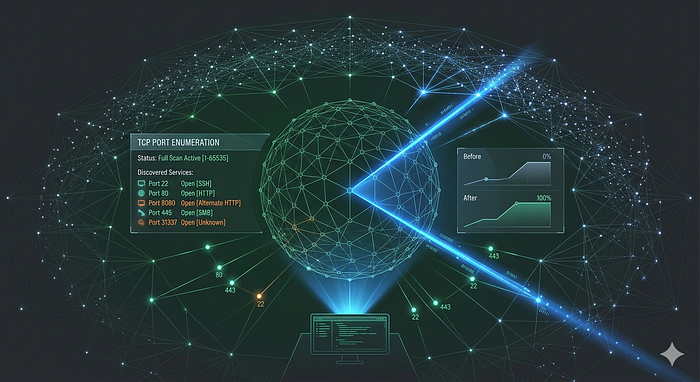
Full TCP Port Enumeration: Discovering the Complete Attack Surface
Introduction

Satishkakani
3 min read
Introduction
Reconnaissance is the foundation of every penetration test. Before attempting to identify vulnerabilities, it is essential to understand which services are exposed on a target system.
One common mistake during enumeration is relying solely on default or fast scans. While they provide quick results, they may overlook services running on non-standard ports. A comprehensive assessment requires examining the entire TCP port range to ensure that no exposed service is missed.
In this article, we will explore how full TCP port enumeration and service version detection can provide complete visibility into a target's attack surface using Nmap.
Objective
The objective of this exercise was to identify all TCP services exposed by the target system through complete port enumeration and service fingerprinting.
Why Full Port Scanning Matters
Default scans focus primarily on commonly used ports and may fail to identify services operating on uncommon or non-standard ports.
A full-range scan helps security professionals:
• Discover hidden services
• Identify misconfigured applications
• Reveal non-standard service deployments
• Understand the complete attack surface
• Improve assessment accuracy
As the saying goes:
Fast scans miss truths.
Step 1: Full TCP Port Enumeration
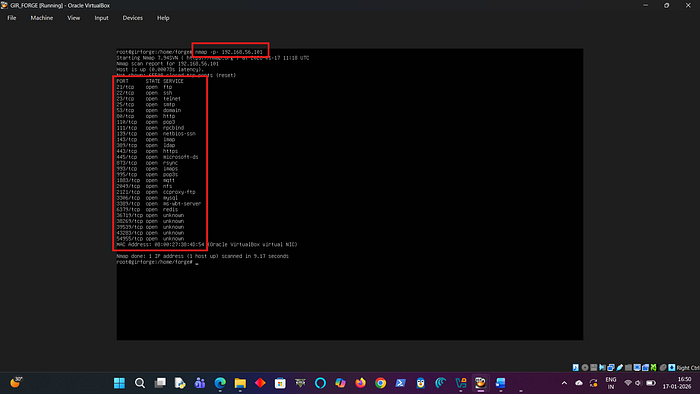
The first step is to scan all 65,535 TCP ports on the target system.
Command
nmap -p- TARGET_IPnmap -p- TARGET_IPCommand Explanation
nmap — Network scanning tool used for host discovery and service enumeration.
-p- — Instructs Nmap to scan all TCP ports from 1 to 65535.
TARGET_IP — The IP address of the target system.
This scan ensures that no exposed TCP service is overlooked during the reconnaissance phase.
Full TCP Port Scan Results
Step 2: Service and Version Enumeration
After identifying open ports, the next step is to determine which services are running and identify their software versions.
Command
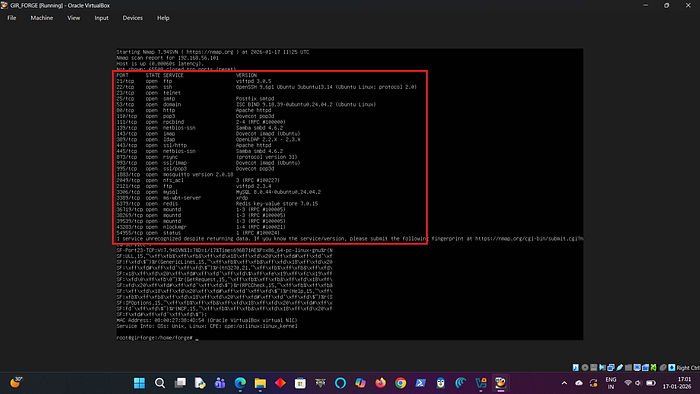
nmap -p- -sV TARGET_IPnmap -p- -sV TARGET_IPCommand Explanation
-sV — Enables service and version detection.
Version Detection — Attempts to identify the software version running on each open port.
Security Benefit — Helps discover outdated or potentially vulnerable services.
Understanding service versions is critical for vulnerability assessment and attack surface analysis.
Service and Version Enumeration Results
Findings
The assessment identified multiple exposed services spanning several categories.
Remote Access Services
SSH, Telnet, and RDP services were discovered. These services provide remote administrative access and are frequently targeted during security assessments.
File Sharing and Transfer Services
FTP, SMB, NFS, and Rsync services were identified. Misconfigured file-sharing services can expose sensitive information and increase the risk of unauthorized access.
Web Services
HTTP and HTTPS services were exposed. Web applications often represent one of the largest attack surfaces within enterprise environments.
Mail Services
SMTP, POP3, IMAP, and secure mail variants were detected. Mail services may be targeted through brute-force attacks, phishing campaigns, or credential theft attempts.
Database and Messaging Services
MySQL, Redis, and MQTT services were identified. Improperly secured database and messaging services can expose sensitive business data and operational information.
Directory and Network Services
LDAP, DNS, and RPC services were present. These services can provide valuable information for attackers conducting reconnaissance and lateral movement activities.
Security Risks
The presence of numerous exposed services significantly increases the overall attack surface and introduces multiple security concerns.
Legacy protocols such as FTP and Telnet may expose credentials in clear text.
Remote administration services may enable unauthorized access if weak authentication mechanisms are used.
File-sharing services may expose sensitive business information.
Database and messaging services may allow unauthorized access to stored data.
Mail services may become targets for credential-based attacks.
Web services may contain exploitable vulnerabilities.
RPC services can aid further network enumeration and lateral movement.
Non-standard ports may evade basic monitoring and security controls.
Security Recommendations
Reduce Unnecessary Services
Disable services that are not required for business operations and remove unnecessary applications from the system.
Implement Network Restrictions
Use firewall rules to restrict access to exposed services and limit access to trusted networks wherever possible.
Replace Insecure Protocols
Replace Telnet with SSH and replace FTP with secure alternatives such as SFTP or FTPS.
Strengthen Access Controls
Enforce strong password policies, implement multi-factor authentication, and limit administrative access.
Maintain Patch Management
Regularly update exposed services and promptly remediate known vulnerabilities.
Perform Continuous Monitoring
Conduct periodic full-range port scans, review exposed services regularly, and monitor unusual network activity.
Conclusion
Full TCP port enumeration is a critical reconnaissance activity that provides visibility into the complete attack surface of a target system.
While fast scans offer convenience, they often miss services running on non-standard ports. By combining comprehensive port scanning with service version detection, security professionals can gain a deeper understanding of exposed infrastructure and identify potential security risks before attackers do.
Understanding what is exposed is the first step toward securing it.
About GIR Technologies
GIR Technologies specializes in Cybersecurity Training, Penetration Testing, DevSecOps, SOC Operations, Security Research, and Enterprise Security Solutions.
For more cybersecurity insights, technical walkthroughs, and professional security resources, visit:
Follow GIR Technologies for more cybersecurity research, practical security learning content, and industry-focused technical articles.