The High Stakes of Staying Online
The old guard of cybersecurity was obsessed with the perimeter; the new vanguard is obsessed with the pulse. In an era where digital disruptions — from ransomware to regional outages — are a mathematical certainty rather than a statistical "if," the focus has shifted from preventing the breach to ensuring the survival of the organism. This is the essence of Continuity of Operations (COOP).
COOP is the backbone of modern business strategy. It isn't just about technical recovery; it is the formal discipline of ensuring critical functions maintain their heartbeat during a crisis. To achieve this, organizations must move beyond the narrow view of "defense" and embrace a comprehensive architecture of resiliency that bridges the gap between technical redundancy and human ingenuity.
1. Asset Management: Tracking Everything "With Value"
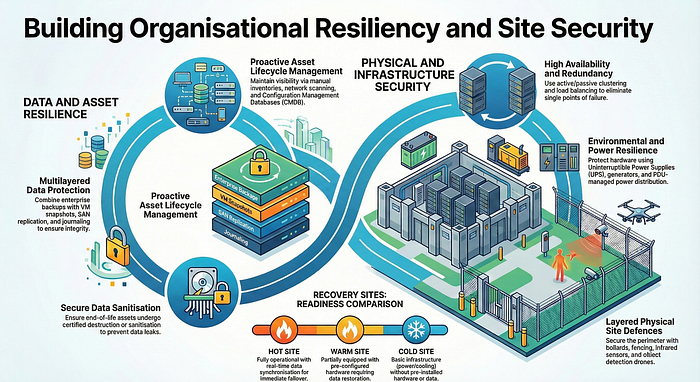
You cannot protect — let alone recover — what you don't know exists. In the heat of a system failure, the difference between a controlled recovery and a chaotic guessing game is your Configuration Management Database (CMDB). While traditional inventory might look like a simple list of hardware, modern cyber asset tracking is IT-centric and highly dynamic.
Strategic resiliency relies on specialized tools to map the digital estate:
- CMDB and Asset Management Software: These provide the "ground truth" for how systems are configured and interconnected.
- Mobile Device Management (MDM): Essential for maintaining visibility into an increasingly decentralized fleet of edge hardware.
- Cloud Asset Discovery: Vital for identifying "shadow IT" and elastic resources that exist only in virtualized environments.
However, the secret weapon in asset management is the standard naming convention. By enforcing rigorous naming and configuration management, organizations strip away the "fog of war" during an outage. When every server and database follows a predictable taxonomy, identification and prioritization happen in seconds, not hours.
"Assets: Anything with value!"
2. The Leap from Simple Backups to Enterprise Data Protection
A "simple backup" is a liability if it hasn't been designed for the enterprise. Today's organizations must adopt an Enterprise Data Protection Strategy that views data not as a static file to be stored, but as a living asset that must be guarded.
"Ensure the availability and integrity of an organization's critical data and systems."
Modern strategies go beyond physical tapes. They require support for virtual, physical, and cloud environments, utilizing Data Deduplication and compression to manage the sheer volume of information. But the real shift is in the "how" of protection. Advanced environments leverage Snapshots — at the VM, Filesystem, and SAN levels — to provide point-in-time recovery that is almost instantaneous.
Integrity is the non-negotiable variable here. A backup without integrity is simply a high-fidelity copy of a disaster. By integrating ransomware protection and encryption directly into the backup layer, the recovery environment becomes a "vault" that ensures the data you restore hasn't been tampered with or corrupted by the very attack you are trying to survive.
3. Capacity Planning: The Surprising Risks of "People Power"
Even the most expensive redundant hardware will sit idle if the "human infrastructure" isn't resilient. Capacity planning is often misidentified as a hardware-only problem, but the source of the greatest resiliency risk is often the workforce.
- Remote Work Plans: In a crisis, the physical office is often the first thing to go. Resiliency requires a pre-validated plan for the team to operate from anywhere without losing access to critical tools.
- Cross-Training: Technical knowledge siloes are single points of failure. Resiliency demands that multiple people can perform critical failovers.
- Workforce Volatility: Rapid hiring or sudden layoffs create massive gaps in operational knowledge. Resiliency planning must account for these changes in workforce capacity to ensure that the "how-to" of recovery isn't lost during headcount shifts.
Resiliency isn't just about server uptime; it's about establishing Alternative Reporting Structures so that if leadership is offline, the rank-and-file know exactly who holds the keys to the kingdom.
4. Site-Level Resiliency: The Cloud as the Modern Disruptor
When a primary site goes dark, the speed of your return to operations is dictated by your site model. Traditionally, this was a choice between the high cost of a Hot Site (live and ready), the delay of a Warm Site (hardware ready, data needs loading), or the glacial pace of a Cold Site (basic shell).
The Cloud has disrupted this cost-benefit analysis. Cloud-based resiliency allows smaller organizations to achieve "Hot Site" performance by rapidly provisioning scalable, elastic resources without the overhead of physical real estate.
The mechanisms that make this possible are Replication and Journaling:
- Replication: Using Database Mirroring, SAN replication, and VM replication to keep a live, standing copy of data at a secondary location.
- Journaling: Maintaining a historical record of changes so that if data is corrupted at 10:00 AM, the organization can "roll back" the clock to 9:59 AM with minimal loss.
To truly bolster this layer, forward-thinking organizations are now looking toward Vendor Diversity and Multi-Cloud strategies, ensuring that a single provider's outage doesn't become their own.
5. The Art of Deception: Fighting Back with Fake Telemetry
Resiliency is traditionally viewed as reactive, but the most sophisticated strategies are proactive. Deception Technologies represent a tactical shift in the resiliency narrative.
By deploying Honeypots, Honeytokens, and — crucially — Fake Telemetry, an organization creates a digital hall of mirrors. When an attacker is fed a stream of fake data, they exhaust their time and resources attacking decoys. This preserves the capacity of the real systems and buys the security team the most valuable commodity in a crisis: time. It moves the organization from a posture of mere endurance to one of active tactical advantage, protecting the "pulse" of the business by distracting the threat.
Conclusion: Testing the Foundation
A resiliency plan is nothing more than a document until it is tested under fire. While tabletop exercises and simulations are vital for the "people" side of the equation, technical validation requires high-impact testing like Load Testing and Failover Testing.
The ultimate gold standard is the Parallel Processing Test, where the recovery site is brought online to process real-world data alongside the primary site. This proves, beyond a shadow of a doubt, that the synchronization of technology, strategy, and power redundancy (UPSs and generators) is flawless.
Resiliency is a triad of technology, people, and strategic diversity. If your primary site went dark in the next ten minutes, does your team know who to report to, or are they only trained to fix the servers?