June 6, 2026
The Biggest AI Security Risk Has Nothing to Do With the Model — It’s Identity
Organizations are rushing to deploy AI assistants, AI agents, autonomous workflows, and enterprise copilots.

Qamar Nomani
3 min read
Security teams are responding by focusing on model security, prompt injection, guardrails, and data protection.
Those concerns are valid.
But they are not the biggest risk.
The biggest AI security risk has nothing to do with the model.
It has everything to do with identity.
Every AI agent, copilot, automation workflow, and autonomous system ultimately operates through permissions. The real question is not what the model knows.
The real question is:
- What is the AI allowed to do?
The Industry Is Focused on the Wrong Problem.
Most discussions around AI security revolve around Large Language Models.
- Can the model be jailbroken?
- Can prompts be manipulated?
- Can sensitive data leak through responses?
These are important questions.
But in enterprise environments, AI systems are rarely operating in isolation.
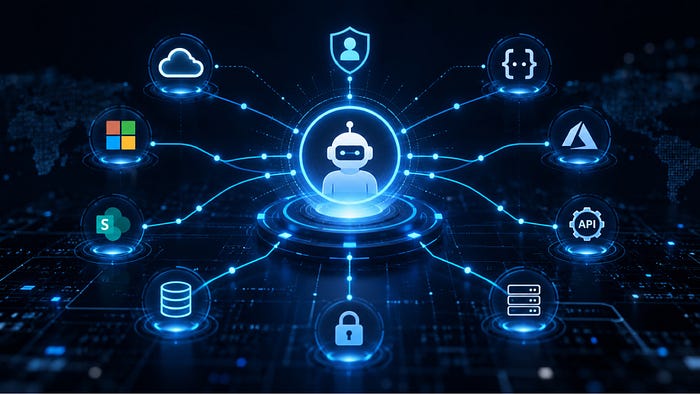
They are connected to:
- Microsoft 365
- *SharePoint
-
- Teams
-
- Internal APIs
-
- Knowledge repositories
-
- Cloud platforms
-
- Business applications
The moment an AI system gains access to enterprise resources, identity becomes the primary security concern.
At that point, the risk is no longer what the model can generate.
The risk is what the model can access and what actions it can perform.
AI Agents Are Becoming Digital Employees
Many organizations are treating AI agents as software.
That is a mistake.
From a security perspective, AI agents increasingly resemble digital employees.
They can:
- Access information
-
- Execute workflows
-
- Interact with applications
-
- Trigger business processes
-
- Make decisions based on context
-
- Perform actions without direct human involvement
This changes the security conversation entirely.
For decades, security teams focused on two primary actors:
- Humans
-
- Applications
AI introduces a third category:
Autonomous Actors
And autonomous actors require a new security model.
The Four Questions Every Security Team Should Ask me
Before deploying any AI agent, security teams should answer four fundamental questions.
1. Who Is the Agent?
Every AI agent requires an identity.
Whether that identity is implemented through a service principal, managed identity, agent identity, or another mechanism, it must be uniquely identifiable.
If an organization cannot clearly answer who the agent is, it cannot effectively govern or secure it.
2. What Can It Access?
Many AI deployments fail because permissions are granted too broadly.
An AI agent should only have access to the specific data required to perform its intended function.
The principle of least privilege remains just as important in AI systems as it is for human users.
Possibly more important.
3. What Can It Execute?
Access is only part of the equation.
Modern AI systems can invoke APIs, trigger workflows, create tickets, modify records, execute scripts, and interact with business applications.
Security teams must understand not only what an agent can see, but also what it can do.
An AI agent with excessive execution privileges can become a significant attack surface.
4. How Is It Monitored?
Every action performed by an AI agent should be observable, auditable, and attributable.
Organizations need visibility into:
- Authentication events
-
- Authorization decisions
-
- Data access
-
- Tool usage
-
- Administrative actions
-
- Privileged operations
Without monitoring, AI agents become black boxes operating inside critical business systems.
Why Traditional Security Frameworks Need to Evolve
Most security frameworks were designed around human users and traditional applications.
AI systems blur those boundaries.
An AI agent can consume information like a user while executing actions like an application.
As a result, security teams must expand their threat models.
Questions that were once uncommon are becoming increasingly important:
- Can an AI agent access sensitive business data?
-
- Can it invoke privileged APIs?
-
- Can it modify permissions?
-
- Can it create new identities?
-
- Can prompt manipulation influence privileged actions?
-
- Can compromised data alter agent behavior?
These scenarios are rapidly moving from theoretical discussions to real-world security concerns.
The Rise of Non-Human Identities
Identity teams spent the last decade managing the growth of human identities, service accounts, and machine identities.
The next challenge is significantly larger.
Organizations may soon operate thousands — or even millions — of AI-driven identities.
Each one will require:
- Authentication
-
- Authorization
-
- Governance
-
- Lifecycle management
-
- Monitoring
-
- Risk assessment
The scale of identity management is about to increase dramatically.
This is why AI security is increasingly becoming an identity problem.
What Security Leaders Should Focus on Now
Security leaders do not need to become machine learning experts overnight.
But they do need to understand how AI systems interact with enterprise identities, permissions, and data.
Priority areas should include:
- Agent identity governance
-
- Least-privilege access models
-
- Non-human identity management
-
- AI threat modeling
-
- Security architecture for AI platforms
-
- Monitoring and auditability of autonomous systems
Organizations that establish these foundations early will be better positioned to scale AI securely.
Final Thoughts
The security industry spent the last decade learning that identity is the new perimeter.
AI is reinforcing that lesson.
As organizations deploy thousands — and eventually millions — of non-human identities, the challenge will no longer be securing people.
It will be securing autonomous actors.
The organizations that solve this problem first will gain a significant advantage.
The organizations that ignore it may discover that their most privileged users were never human to begin with.